Article · 26 May 2026 · By Mike
Flood Barriers Australia: Buyer's Guide
Compare demountable, portable, and automatic flood barriers for Australian homes and businesses. Prices, specs, and expert advice — updated 2026.

Flood barriers for Australian homes and businesses fall into five categories: water-activated sandbags, Oxford cloth barriers, aluminium demountable barriers, ABS portable barriers, and automatic flood gates. Each protects a different kind of opening at a different price point, with a different deployment method. This guide covers all five — specs, costs, and the decision framework for matching the right barrier to your property — so you can buy once, store it, and have it ready when the next warning arrives.
Why do Australian properties need flood barriers now?
Australia has one of the most variable climates on Earth, and flooding is a recurring feature across most of the populated coastline. The Bureau of Meteorology's national flood warning service monitors river heights and catchment conditions across the continent, issuing Flood Watch, Flood Warning, and Emergency Warning alerts for at-risk areas. In May 2026, BoM issued Flood Watches for NSW's Northern Rivers and Mid North Coast — a region that has experienced significant flooding repeatedly over the past decade. East-coast lows, La Niña amplification events, and tropical cyclone remnants pushing south all drive flood events across NSW, Queensland, and Victoria on a seasonal basis.
The problem for property owners is the gap between the warning and the water arriving. Properties in catchments that flood every few years rarely have barriers stored and ready. When a Flood Watch is issued, sandbags sell out at hardware stores within hours. Barriers purchased and stored before the season starts are the only reliable solution — and they cost a fraction of a single flood claim.
For anyone unsure where to start with flood preparation, the what to do if flooding guide covers the full emergency response sequence alongside the right barriers for each stage.
What types of flood barriers are available in Australia?
The Australian market offers five distinct product types, each suited to a different combination of opening size, flood depth, budget, and whether the site is attended or unattended.
| Barrier type | Best for | Deploy time | Price from |
|---|---|---|---|
| Water-activated sandbags | Doorways, gaps, irregular surfaces | 2–3 min | $39 / 4-pack |
| Oxford barriers | Doors, garages, smaller openings | No tools needed | $449 / 2-pack |
| Aluminium demountable barriers | Shopfronts, doorways, up to 3 m wide | < 10 min | $890 / set |
| ABS portable barriers | Loading bays, wider entries, warehouses | Manual | $1,659 / 8-pack |
| Automatic flood gates | Unattended sites, carparks, basements | Water-level sensing | Site assessment required |
For a full spec-by-spec comparison — dimensions, rated depths, materials, and deployment differences — see the types of flood barriers guide.
Water-activated sandbags
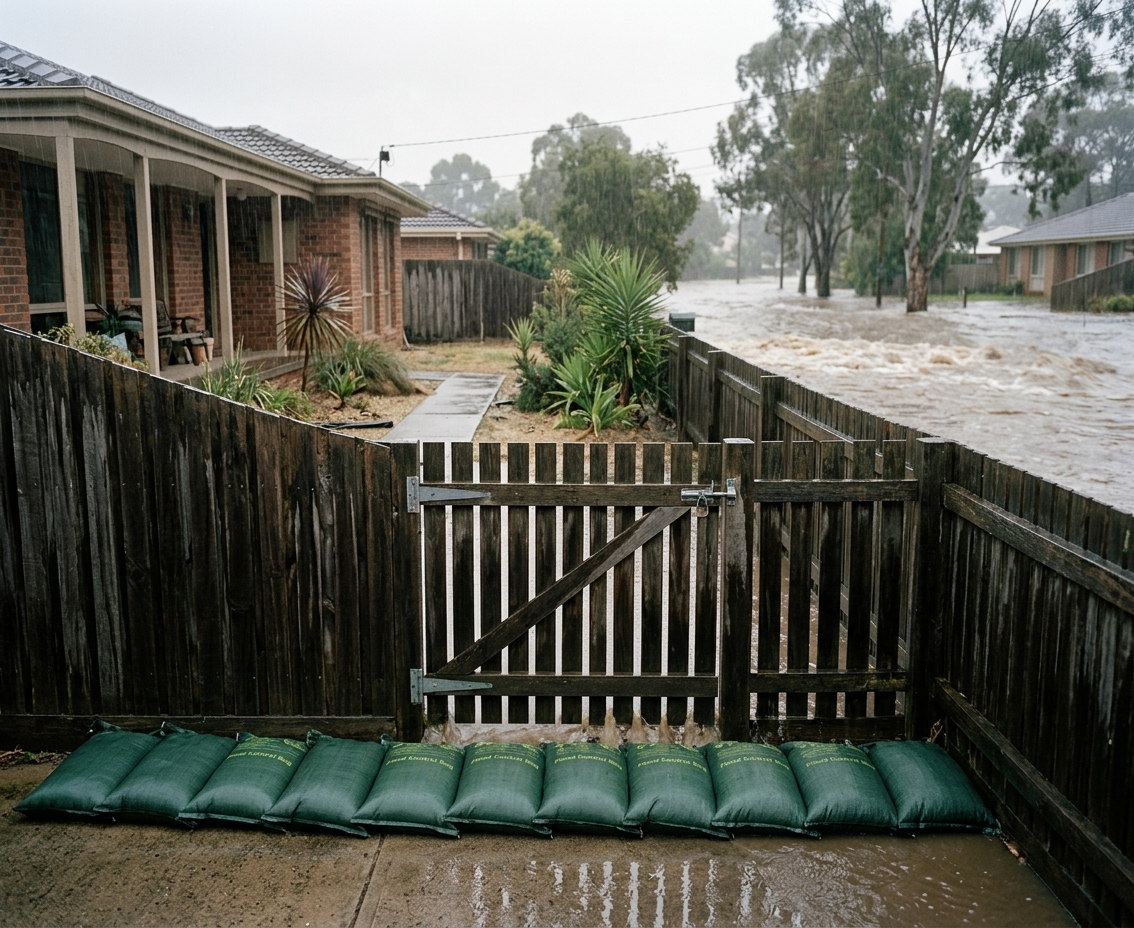
Water-activated sandbags are the fastest-deploying option in the range. Each bag in a 4-pack stores flat at 270 g and swells to 18–22 kg within 2–3 minutes of contact with fresh water, forming a barrier 600 × 400 × 120 mm per bag. No sand, shovels, or filling required — drop the bags in front of the opening and they expand on contact with surface runoff. Stack layers to achieve greater height. A single 4-pack covers most standard doorways; two layers of two packs protects against depths up to 240 mm.
The limitation is that they are single-use. Once activated they cannot be deactivated, so annual replacement is part of the ongoing cost. For properties that flood every few years rather than every season, the per-event cost remains low. For sites that flood annually, reusable barriers deliver better value over time.
Oxford barriers
Oxford barriers are a reusable rigid-flexible hybrid: PVC-coated Oxford cloth stretched across a reinforced steel pipe frame that telescopes from 150 mm to 1,300 mm wide. Water pressure on the upstream face presses the base down against concrete or pavers, forming a watertight seal without anchors. Each 2-pack protects openings up to 1,300 mm wide and 900 mm deep; link multiple units end-to-end for wider spans. At 5.3 kg per pack, they fold flat for cupboard or boot-of-car storage and set up without tools. They suit residential garage doors, side entries, sliding glass doors, and low-threshold entries across most standard openings.
Aluminium demountable barriers
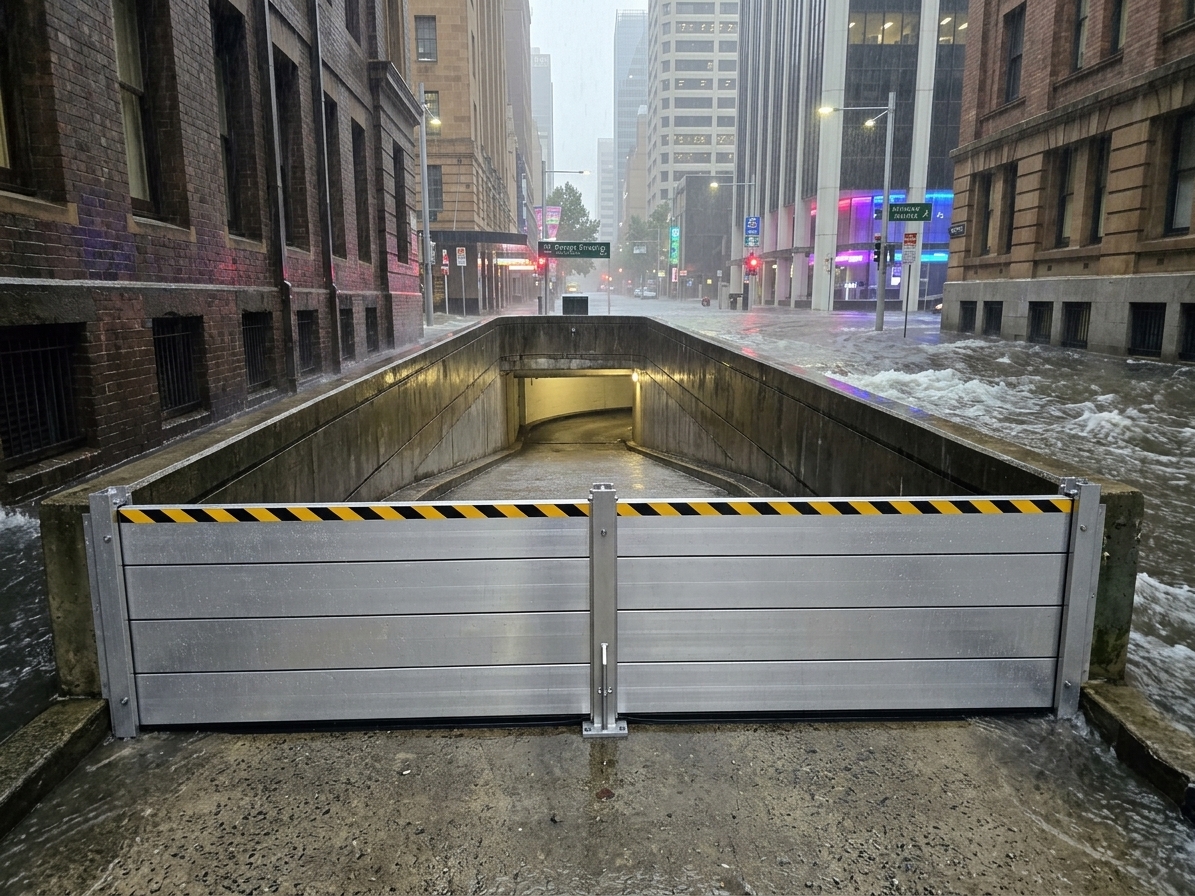
Aluminium flood barriers are the step up to season-ready permanent protection. Marine-grade aluminium panels seal openings up to 3,000 mm wide and 1,000 mm high via a rubber seal that presses against the door frame. One person deploys the full set in under 10 minutes using a quick-release anchor system. At approximately 12 kg per set, they are light enough to handle solo but rigid enough to hold against significant hydrostatic pressure. Rated lifespan is 25 years or more, making the $890 entry price the lowest-cost-per-deployment option for properties that flood annually. Custom widths and heights are available for non-standard openings.
ABS portable barriers
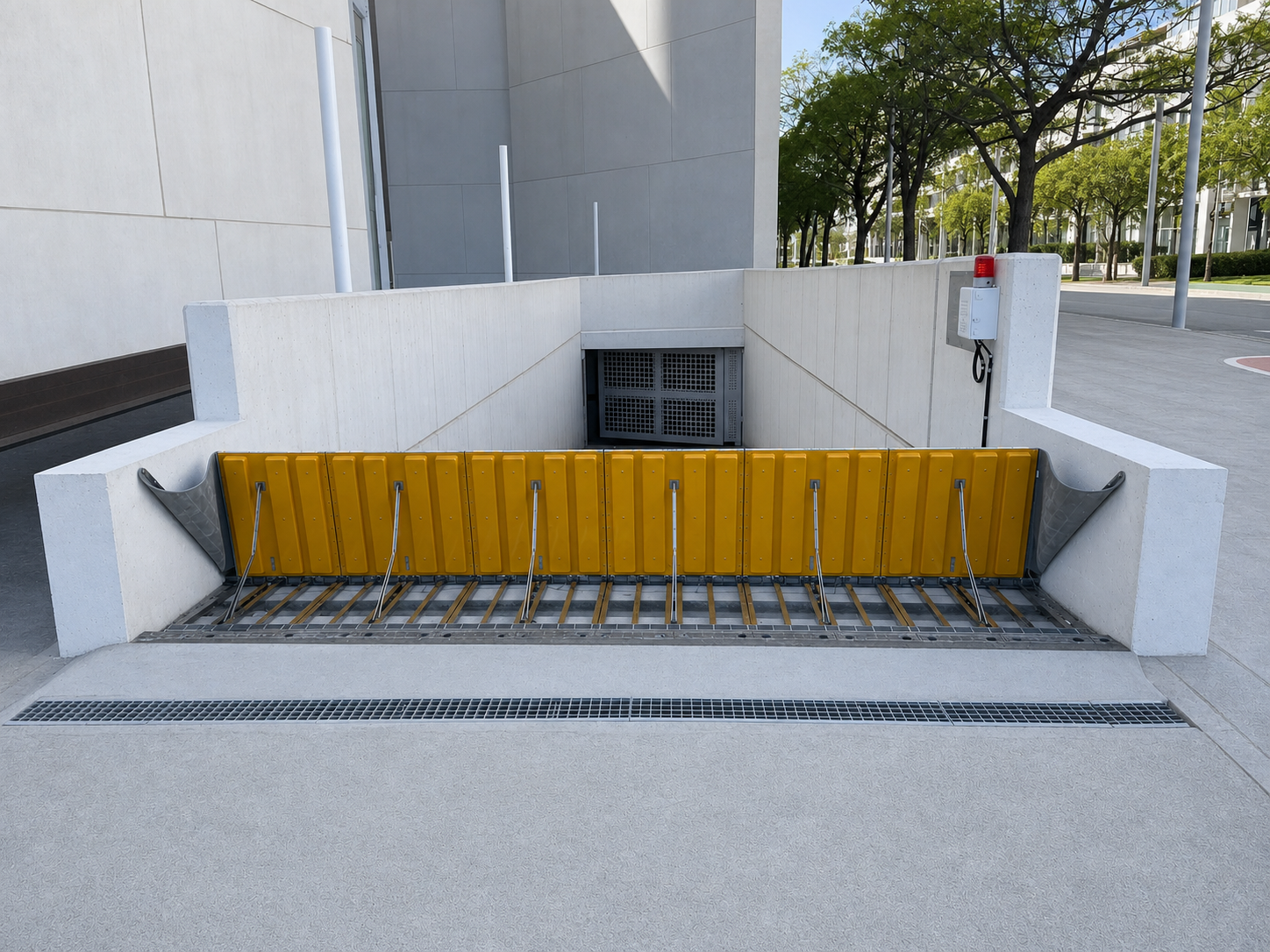
ABS portable flood barriers suit wide openings that exceed the standard aluminium set's span. An 8-panel pack deploys across garage roller doors, loading bay entries, wide retail shopfronts, and carpark ramps without tools. Panels are modular and reconfigure to different opening widths as needed. At $1,659 per 8-pack, ABS barriers sit between aluminium demountable and automatic gate territory in the cost spectrum, making them practical for commercial sites that need flexible, wide-span coverage.
Automatic flood gates
Automatic flood gates use water-level sensing and an electrically powered hydraulic lift. They are custom-engineered for each installation, including the opening, flood conditions, electrical supply and control requirements. A site assessment is required before a quotation is provided.
How do you choose the right flood barrier for your property?
Five questions narrow the selection to the right product type:
What is the opening width? Standard residential doors under 900 mm wide suit Oxford barriers or water-activated sandbags. Openings up to 3 m suit aluminium demountable barriers. Wider entries, loading bays, or carpark ramps suit ABS barriers or automatic gates.
How deep does the water get? Water-activated sandbags in two layers protect to approximately 240 mm. Oxford barriers protect to 900 mm. Aluminium barriers protect to 1,000 mm. Automatic gates can be engineered to 2 m.
Is the site attended or unattended? If no one is reliably present to deploy barriers on short notice — a rental property, a small commercial building, a basement carpark — automatic flood gates are the only solution that works without someone on site. Manual barriers of any kind require a person to deploy them before water arrives.
How often does your property flood? Annual or biennial flooding justifies reusable rigid barriers regardless of upfront cost. Once-a-decade flooding may suit sandbags or Oxford barriers as the lowest total cost option for the exposure level.
What is your budget? Compare published prices for portable products with a site-specific proposal for an automatic hydraulic flood barrier. Reusable barriers cost more upfront but significantly less per deployment over their rated lifespan.
What does flood barrier protection cost in Australia?
Flood barrier costs span a wide range, and total cost of ownership often looks different from the upfront price:
Water-activated sandbags at $39 per 4-pack are single-use. For a standard doorway requiring one 4-pack per season, that is $39 annually for the life of ownership — low per event but accumulating over decades of ownership.
Oxford barriers at $449 per 2-pack are reusable across multiple seasons. For a garage door requiring four units linked end-to-end, the upfront cost is $898. Used two to three times per year over five years, the per-deployment cost drops below $30.
Aluminium demountable barriers from $890 per set carry a 25-year rated lifespan. A set deployed once annually costs under $36 per deployment at that horizon — less than sandbag replacement in most flood-prone areas.
ABS portable barriers from $1,659 per 8-pack are reusable across multiple seasons and suit commercial applications where flexibility across different opening widths is required.
Automatic flood gates require professional electrical and hydraulic installation, with pricing provided after a site assessment. For high-value unattended assets — basement carparks in commercial buildings and strata complexes — compare the site-specific proposal with the potential cost of flood damage and manual deployment arrangements.
One cost often overlooked is the cost of doing nothing. A single moderate flood event at 200 mm depth in a ground-floor retail tenancy typically results in stock loss, electrical damage, and several weeks of remediation. Insurance excess and business interruption combined frequently exceed the cost of a permanent barrier system by a significant margin.
For a full breakdown of prices by product type and a five-year total cost of ownership comparison across each barrier category, see the flood barrier cost guide.
Which Australian states have the highest flood risk?
New South Wales and ACT carry the heaviest flood burden in absolute terms. East-coast lows, La Niña rainfall amplification, and river systems draining the Blue Mountains, Hunter Valley, and Northern Rivers converge on a densely populated coastal corridor. The Hawkesbury-Nepean, Hunter, and Richmond rivers flood on cycles ranging from annual minor events to decade-scale major inundations. The Sydney flood barriers guide covers site-specific considerations for properties in the greater Sydney area. Properties in the Lower Hunter — from Maitland and Morpeth to Hamilton and Islington — face both river flooding and stormwater inundation on different timelines; the flood barriers Newcastle guide covers suburb-by-suburb risk and barrier selection for Hunter region properties.
Queensland faces tropical cyclone remnants in the north, the Brisbane River catchment in the south-east, and a wet season that drives significant runoff across interior regions. Brisbane and surrounding river suburbs experienced severe flooding in 2022, and south-east Queensland regularly receives Flood Watches during the November-to-April season. The flood barriers Brisbane guide covers at-risk suburbs — from Rocklea and Fairfield to Graceville and Chelmer along the Oxley Creek corridor — and the right barrier type for Queenslander homes, apartments, and strata buildings.
Victoria has the Yarra, Maribyrnong, and Barwon systems in and around Melbourne, plus extensive flood plains in the state's north and west. Spring melt and east-coast low events are the primary risk periods. The flood barriers Melbourne guide covers at-risk suburbs — from Maribyrnong and Kensington to Docklands and Port Melbourne — and the right barrier type for each area. For rural and regional properties along the Goulburn, Ovens, and Mitta Mitta catchments in north-east Victoria, the flood barriers for rural properties guide covers wide shed entries, homestead preparation, and the pre-season checklist for country property owners.
Western Australia sees flash flooding in the Perth metro during intense winter rainfall events, and severe flooding across the Pilbara during cyclone season. The flood barriers Perth guide covers at-risk suburbs — from the Swan River corridor in Guildford and Bassendean to inner-ring stormwater zones in Subiaco and Leederville — and the right barrier type for double-brick homes facing winter rainfall flooding.
South Australia faces winter flooding driven by cold fronts sweeping rainfall from the Great Australian Bight across the Mount Lofty Ranges east of Adelaide. Heavy range rainfall drains rapidly into the Torrens River corridor and overwhelms inner suburban stormwater networks on the Adelaide Plains. The flood barriers Adelaide guide covers at-risk suburbs — from the Torrens River corridor in Walkerville and St Peters to stormwater-prone inner western suburbs in Hindmarsh and Bowden — and the right barrier type for the stone and brick homes common in Norwood, Unley, and Campbelltown.
Across all states, properties on low-lying ground within 2 km of a river, creek, or drainage channel face materially elevated flood risk. The BoM's online flood mapping tools show historical flood extent for most catchments — a practical first check before deciding on barrier type and height.
What is the most effective way to get flood-ready before the next warning arrives?
The single most effective step is buying and storing barriers before the season begins — not after a Flood Watch is issued. By the time a Flood Watch is public, local hardware stores are sold out and online delivery lead times extend past the window for deployment.
For most residential properties, a practical starting kit is one 4-pack of water-activated sandbags for low-threshold entries and gap-filling, and one or two 2-packs of Oxford barriers for the primary door or garage. For commercial properties, aluminium flood barriers at the primary entry and ABS portable barriers across wider loading bay openings cover most scenarios. Unattended access points — basement carparks, loading docks with no staff after hours — are the strongest candidates for automatic flood gates.
Once your barriers are in storage, the flood barriers vs sandbags comparison explains how the products interact in a layered protection setup, and when sandbags add value alongside rigid barriers rather than replacing them.
Landlords and property investors have additional considerations — tenancy legislation, responsibility between landlord and tenant, and the case for automatic gates at unattended investment properties. The flood barriers for rental properties guide covers these in detail.
If you are unsure which barrier suits your specific openings, send through your door dimensions and we will recommend the right product before the next warning arrives.
Recommended next step
Match the guide to a flood barrier option.
These are the product pages and guides most relevant to this topic. Use them to compare flood barriers Australia-wide, then request a site-specific recommendation.