
Article · 20 November 2024
What to Do When Flooding: A Property Guide
A practical flood guide for homes and businesses in Australia: the order of actions when flooding starts, what not to do, and how to protect property.

When water approaches your property, the order of actions matters. Keep people safe first, stop avoidable property damage second, and only then begin clean-up. Waiting at any stage narrows the options still available to you.
What should you do the moment flooding begins?
Speed is the critical variable in a flood response. The actions that reduce damage are only available before water enters the building. Once floodwater is inside, the focus shifts from prevention to documentation and clean-up — a substantially more expensive outcome.
Work through the following sequence:
1. Move people and animals to high ground. This stays the absolute priority regardless of property type or flood depth. Vital documents, medications, and portable devices come next. Leave all other belongings if there is any doubt about time.
2. Isolate utilities safely. Switch off power at the main switchboard, turn off gas at the meter, and isolate non-essential equipment — but only when it can be done without entering water. Never compromise personal safety to manage utilities.
3. Move vehicles and inventory. Relocate vehicles, stock, and portable equipment away from low-lying areas. A flooded vehicle is a significant loss and may block access for emergency services.
4. Deploy barriers at entry points. Place temporary barriers at primary entries — doors, roller shutters, loading docks, garage openings. Even a modest barrier height meaningfully reduces water infiltration.
5. Stay clear of floodwater. Maintain distance from floodwater, storm drains, and any submerged or partially submerged electrical equipment. Floodwater carries contamination and concealed hazards well beyond its visible depth.
6. Contact emergency services early. Call the NSW SES on 132 500 or your state equivalent. Do not wait until the situation is unmanageable. Early notification allows better coordination of rescue and recovery resources.
How do barriers work during a live flood event?
Deploying a barrier after floodwater has already reached the door is too late — the barrier needs to be in position before water arrives. Understanding what each product type can and cannot do helps set realistic expectations under time pressure.
Oxford Barriers are freestanding and telescopic from 15–130 cm, suiting residential doorways and commercial entries without permanent installation. One person can install them without tools in a few minutes. From $449 per two-pack, they store flat between uses.
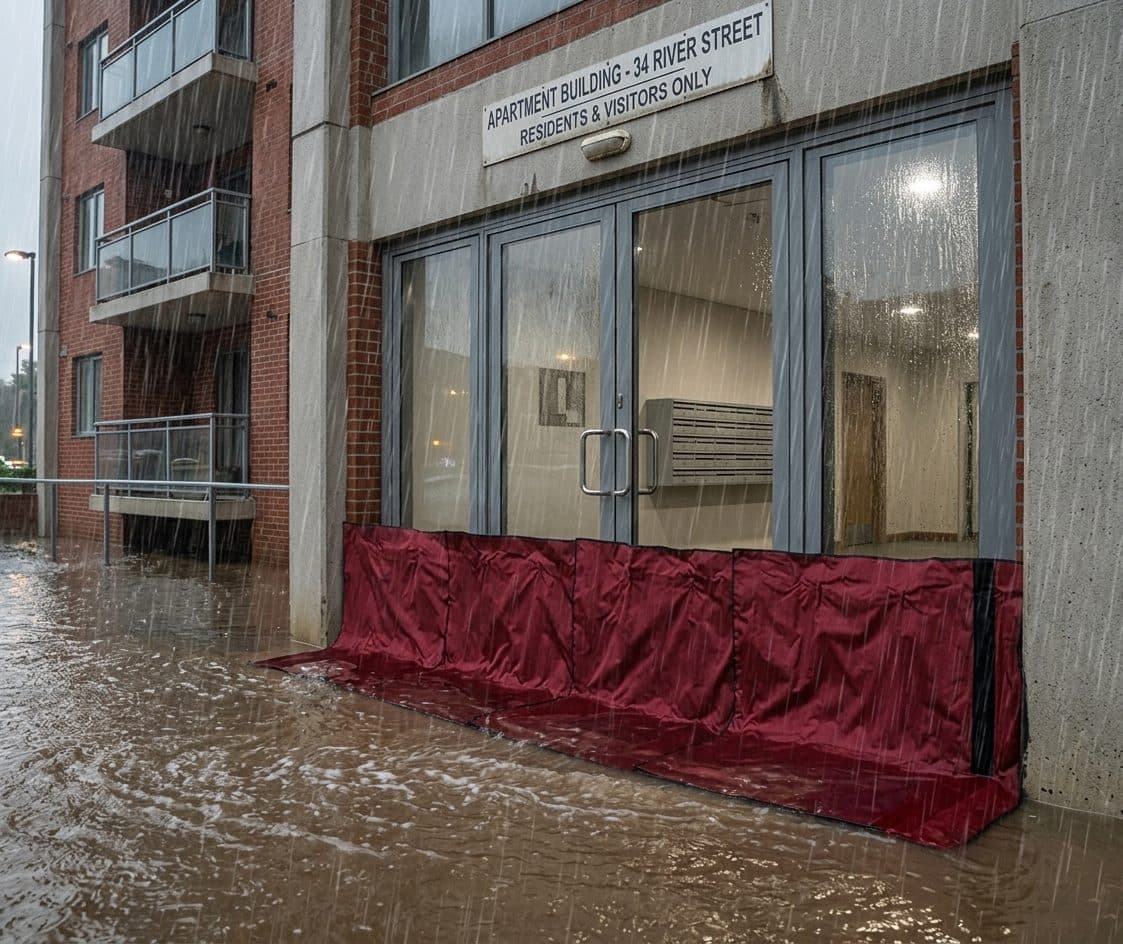
Water-activated sandbags serve a different role — rapid deployment at secondary access points, cable entries, seal gaps, and irregular spaces where a rigid barrier cannot sit flush. Each bag in the $59 pack of 6 contains sodium polyacrylate that swells from 270 g to 18–22 kg in 2–3 minutes on water contact. No sand, no equipment, no advance preparation.
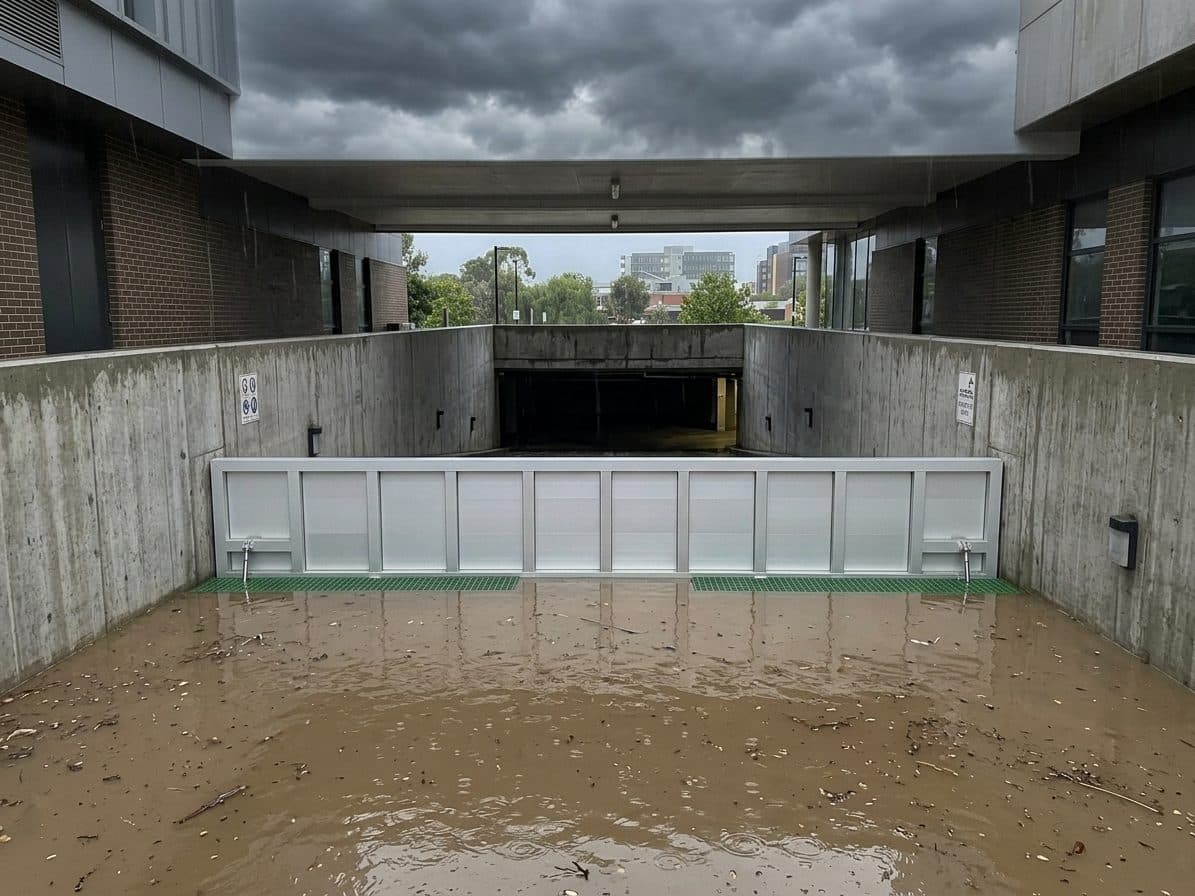
Automatic flood barrier systems use water-level sensing to activate an electrically powered hydraulic lift at the configured level. They can be specified for basement entries and car park ramps where no one may be present when the event develops; a site assessment is required before quoting.
What flood protection does a commercial or industrial site require?
Commercial facilities face distinct vulnerabilities that a residential checklist does not fully address. The loading dock, service entries, cable penetrations, and drainage infrastructure all represent paths through which water enters buildings — often independently of the main entry doors.
Inventory and equipment protection. Raise chemicals, stock, and electronics above anticipated flood levels before water approaches. This is the single most effective action to reduce loss value in a commercial flood. Remove forklifts, tools, and pallets from floor-level exposure.
Perimeter defence. Seal low door gaps and cover entry points before floodwater reaches the building. A combination of demountable aluminium barriers at primary entries and water-activated sandbags at seal gaps and secondary doors covers most scenarios up to 600 mm depth. Marine-grade aluminium panels deploy in under 10 minutes per opening.
Drainage protection. Protect drains and backflow points so water cannot rise through the floor from below. Many industrial floods involve water entering through drainage infrastructure rather than through doors. Backflow prevention on floor drains is often the most cost-effective protective measure for facilities with multiple drainage outlets.
Permanent engineered systems. For facilities facing repeat flooding risk — particularly those at or below street level in flood-prone catchments — automatic flood gates or demountable barriers with permanently fixed side posts provide better reliability than temporary arrangements. They also remove the dependency on staff availability during an event.
What not to do when flooding occurs
Following the correct actions matters, but avoiding the wrong ones is equally important:
- Do not drive or walk through floodwater. Fifteen centimetres of fast-moving water can knock a person over. Sixty centimetres can carry a vehicle. Road surfaces beneath water may be eroded or absent entirely.
- Do not touch wet electrical equipment. Electricity poses fatal risk even in shallow water. Assume any equipment in or near floodwater is live until confirmed otherwise.
- Do not assume the flood will be minor. Flash floods can rise faster than official forecasts. Depth estimates from early-stage BOM warnings may significantly understate local peaks in narrow catchments.
- Do not wait for neighbours to act first. The time spent watching and waiting is time the barriers could be deployed.
- Do not re-enter a flooded building until it has been inspected for structural damage, contamination, and electrical hazards.
- Do not rely on traditional sandbags alone for commercial sites where significant water depth is possible. Sand-filled sandbags leak, shift, and require substantial labour to position. For depths above 200 mm, rigid barriers or engineered systems provide more reliable protection.
How should you protect a site before the flood arrives?
The most effective flood response is one prepared before the event. Properties that have barriers staged near entry points, roles assigned, and warning thresholds set in advance consistently experience less damage than those improvising a response during the event. Part of setting those thresholds is understanding BOM's alert system — for a breakdown of what a Flood Watch versus a Flood Warning means in practice and which alert is the right trigger for barrier deployment, see Flood Watch vs Warning: When to Act in Australia.
Three pre-event investments produce reliable outcomes:
- Permanently fixed side posts for demountable barriers — allow a doorway to be sealed in under 5 minutes without searching for anchor points
- Water-activated sandbags stored dry — minimal storage footprint, deploy in 2–3 minutes with water on-site
- Automatic flood gates at basement entries or car park ramps — use water-level sensing and an electrically powered hydraulic system
Identify which entry points are at risk during a dry walk-around. Note the opening widths for barrier sizing. Store equipment near the entry it protects, not in a storage room that requires multiple trips to access.
What flood protection suits different property types in Australia?
The right combination of barriers and preparation steps varies by property type. These are the most common scenarios across residential and commercial sites in coastal Australian cities.
Residential house, suburban street. The primary risks are overland flow through the front door and water entry through the garage roller door. Oxford Barriers at the main entry suit standard door widths; water-activated sandbags address the gap below the roller door where the bottom seal has compressed. A $59 pack of 6 is sufficient for a single garage entry. Total pre-season setup time: under 30 minutes.
Ground-floor apartment. Shared building entries and individual apartment front doors are both exposure points. Residents in ground-floor apartments should coordinate with building management on shared entry protection while maintaining their own sandbag supply for the apartment door. Check whether building stormwater drains are maintained — shared drainage in older apartment buildings is a frequent flood-entry path.
Retail shopfront. A commercial shopfront at or near kerb level needs a rigid barrier solution. Aluminium demountable barriers provide a professional seal that deploys in under 10 minutes and stores compactly. For shopfronts in flood-prone postcodes, keep barriers staged near the entry point rather than in a storage room — retrieval time adds to deployment time.
Warehouse or light industrial. The warehouse combines wide roller door entries, loading dock infrastructure, and floor-level drainage. A layered approach is most reliable: demountable aluminium barriers at personnel doors, water-activated sandbags at roller door bases, drain plug covers at floor drainage points, and an inventory protocol that keeps chemicals and electronics off the floor. For facilities with regular flood exposure, automatic flood gates at the main vehicle entry can use water-level sensing and hydraulic control without relying on staff to deploy a temporary barrier.
Below-street-level entry (basement, sunken car park). These entries are at highest risk because surface water and stormwater naturally concentrate in below-grade spaces. An automatic hydraulic flood barrier is a site-specific option when manual deployment cannot be relied on. Water-level sensing and electrical/hydraulic requirements need to be assessed before a system is quoted.
What are the right steps after the flood recedes?
Post-event actions determine both recovery speed and insurance outcomes:
Document damage immediately. Photograph all damage before moving or cleaning anything. Photo-timestamp records support insurance claims and are required by most commercial policies before debris removal.
Contact your insurer before clean-up. Most policies require notification before cleaning begins. Premature removal of flood debris can void claims for affected materials.
Use protective equipment in contaminated areas. Floodwater carries sewage, chemical runoff, and biological material. Waterproof boots, gloves, and eye protection are minimum requirements for any clean-up work. Use a N95 or P2 respirator if mould is visible or suspected.
Ventilate before re-entry. Open all windows and doors before entering a building that has been closed after flooding. Floodwater generates gases — including methane and hydrogen sulphide — as organic material decomposes in enclosed spaces.
Inspect structural elements before relying on them. Timber floors, subfloor spaces, and wall cavities may be damaged in ways not visible on the surface. Have a building inspector assess the structure before moving heavy equipment back into position.
For guidance from NSW SES on safe re-entry procedures, visit the NSW SES website.
Useful references
- Flood preparation checklist for Australian homes and businesses — step-by-step pre-season planning, barrier selection, and dry-run guide
- Flood damage cost Australia — what an unmitigated event costs in repairs, contents, and temporary accommodation, and the barrier ROI case
- Bureau of Meteorology warnings
- NSW SES
- Queensland Disaster Management
- VIC SES
If your current protection failed or was not in place during a recent event, contact us to review your options before the next one.
Recommended next step
Match the guide to a flood barrier option.
These are the product pages and guides most relevant to this topic. Use them to compare flood barriers Australia-wide, then request a site-specific recommendation.