Article · 23 June 2026 · Updated 6 October 2026
Flood Barriers Melbourne: Suburb Guide
Melbourne's flood-prone suburbs need barriers that work. Shop demountable, portable and automatic flood barriers — free shipping to all VIC addresses.
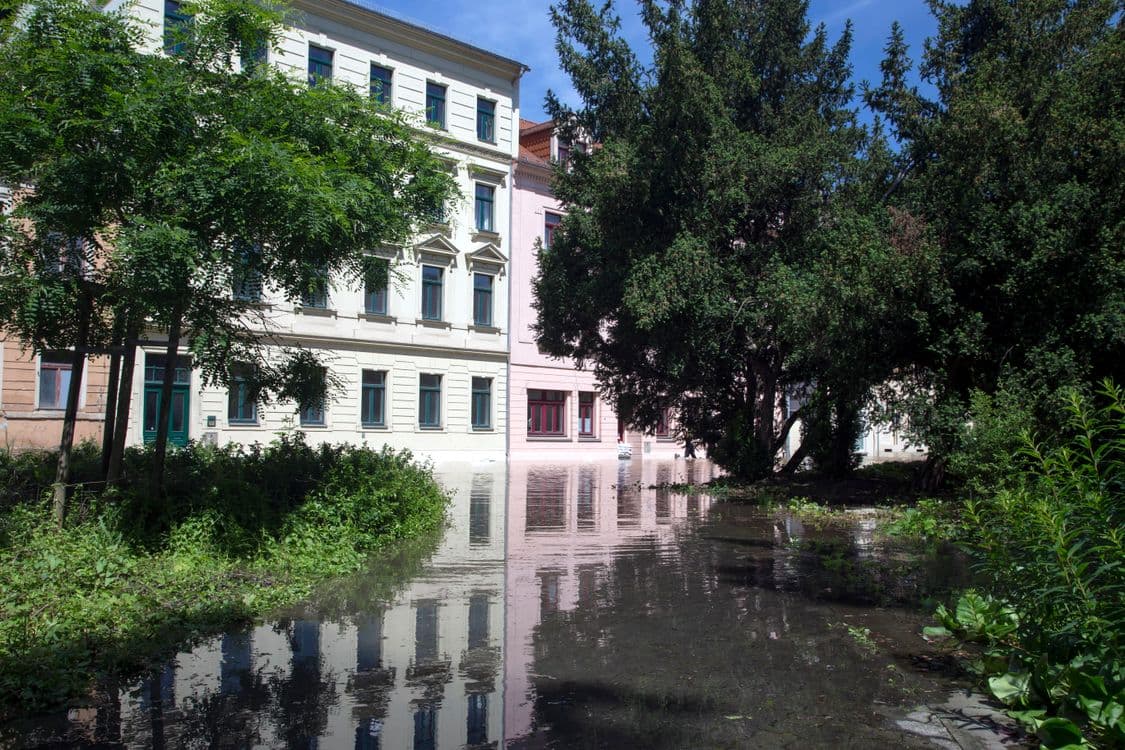
For Melbourne's flood-prone inner suburbs, the right barrier depends on your property type and which risk zone you sit in. A Victorian terrace house in Footscray needs aluminium panels at the front entry; an underground car park in Docklands needs an automatic gate that rises without staff present. Melbourne sits across two major river systems, and the stakes are higher than most residents expect before the first event hits their street.
Which Melbourne suburbs face the highest flood risk?
Two river corridors account for the majority of residential flood events in Melbourne. The Maribyrnong River corridor runs through Maribyrnong, Footscray, Maidstone, Moonee Ponds, Ascot Vale, and Flemington. These suburbs flooded severely in the 2010–2011 La Niña period and again in October 2022 when the Flemington racecourse precinct was inundated and VIC SES received over 3,000 calls in 24 hours. Homes close to the Maribyrnong gauge face riverine flooding that builds over hours as upstream catchments fill after sustained rainfall.
The Yarra River corridor affects Kew, Ivanhoe, Fairfield, Alphington, and Fitzroy North. The Yarra rises slowly after significant rainfall upstream — bank overflow typically arrives 12–24 hours after the main rain event, giving affected residents more warning time than the Maribyrnong. Fitzroy North sits near the Merri Creek confluence with the Yarra, introducing a second flood vector during simultaneous rain events across the northern catchment.
A third risk zone covers Port Melbourne, Docklands, and Southbank. These areas face stormwater overflow from Melbourne's combined sewer system under heavy rainfall and, in severe storm events, coastal storm surge that pushes water back through the Yarra outfall. Underground car parks across the Docklands precinct are particularly exposed during short-duration high-intensity storms.
Residents can confirm their specific risk by checking Melbourne Water's flood information map — enter your address for flood overlay data covering 1-in-20, 1-in-100, and 1-in-500 year extents. Council planning portals also show Special Building Overlay (SBO) and Land Subject to Inundation Overlay (LSIO) designations, which carry planning conditions for affected properties.
What caused Melbourne's most significant flood events?
Melbourne's documented flood events help size the actual risk rather than treating flooding as a theoretical concern.
The 2010–2011 La Niña sequence produced the most widespread residential damage in recent decades. The Maribyrnong River peaked at 5.7 metres at the Maribyrnong gauge in September 2010, according to Bureau of Meteorology records, inundating hundreds of properties across Footscray and Maribyrnong. The event ran across multiple flood pulses through summer and into autumn.
October 2022 brought flash flooding across inner Melbourne that affected properties well outside the traditional river corridors. Flemington racecourse was inundated. VIC SES fielded more than 3,000 calls in 24 hours across metropolitan Melbourne. The Bureau of Meteorology recorded point rainfall totals of 40–60 mm in under two hours across western and northern suburbs — the intensity that overwhelms standard stormwater drainage and sends water overland through streets faster than residents can respond.
January 2025 storms produced flash flooding across inner-north and eastern suburbs including Alphington, Fairfield, and Kew, following intense short-duration rainfall in the Yarra upper catchment. Properties that had not experienced flooding in decades recorded water inside ground-floor entries.
Each of these events followed a pattern: more rain than the drainage system could move, in less time than manual barrier deployment typically allows. Properties without barriers already staged for deployment were the ones that flooded.
How does flooding enter Melbourne homes and commercial properties?
Understanding the entry path is the starting point for choosing the right barrier. Melbourne properties experience flood entry through five main routes.
Garage doors and driveways are the most common path in suburban Melbourne. Streets act as overland flow channels during intense rainfall — water runs off impervious surfaces and funnels toward the lowest point, which is often a driveway. This pattern is consistent across Footscray, Moonee Ponds, and Flemington.
Front entry doors at or near street level are the key vulnerability for Victorian-era terraces in the inner west and inner north. Many properties in Maribyrnong, Footscray, and Ascot Vale were built with door thresholds at or below street grade, making them directly exposed to overland flow.
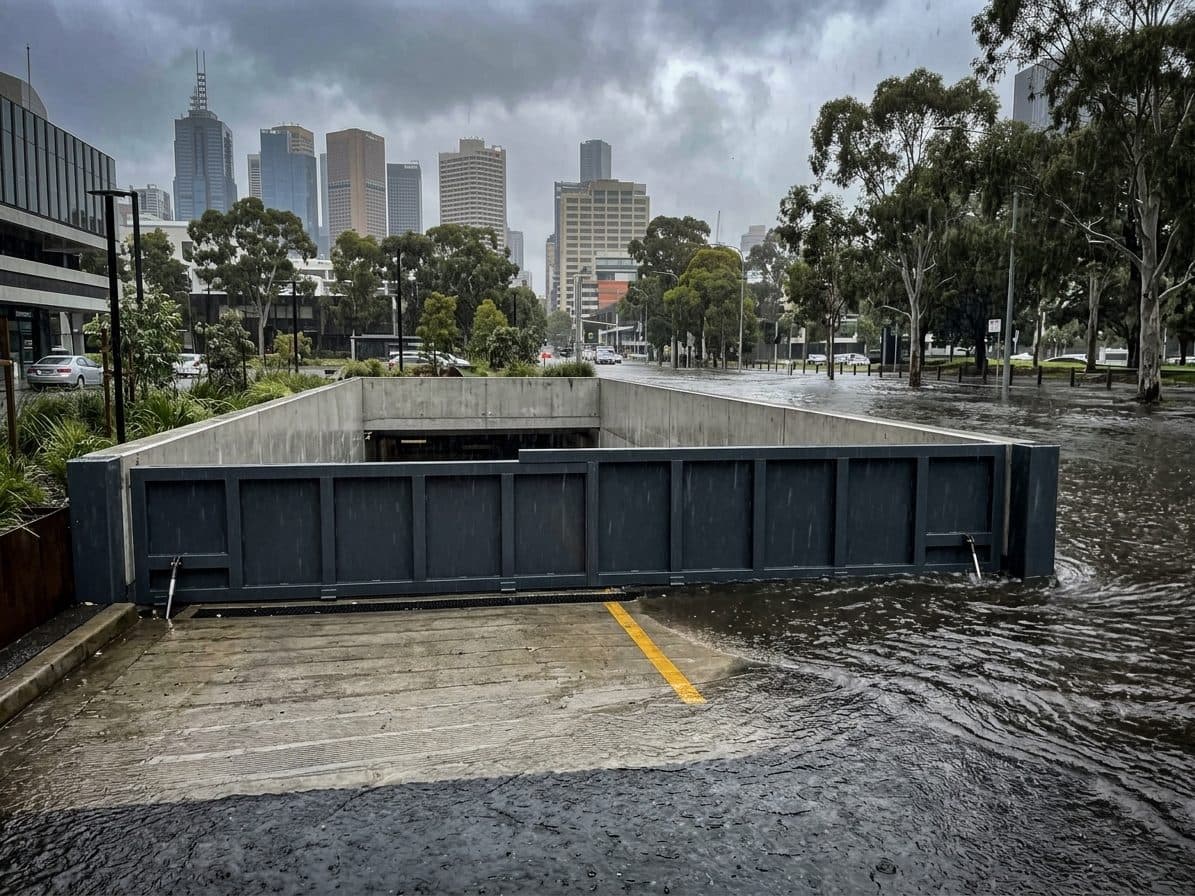
Underground car park ramps concentrate water by geometry. Ramps in Docklands, Port Melbourne, Southbank, and the CBD fringe act as funnels during intense storms — water accelerates down the ramp and enters the car park before building management can respond, particularly during after-hours events.
Side passages and rear gates between Victorian-era terraces channel water from adjacent streets toward dwelling entries. Narrow passages create a venturi effect that increases flow velocity.
Stormwater drain backflow occurs when Melbourne's combined sewer system surcharges under sustained heavy rainfall. Water backs up through ground-level drain grates and into basements and low-lying entries.
Which flood barrier suits a Melbourne property?
Terrace houses and ground-floor apartments — inner west and inner north
The standard entry door on a Victorian-era terrace is 900–1,200 mm wide and typically sits at or close to street level. Aluminium demountable flood barriers are made to measure for the opening and deploy in under 10 minutes without specialist tools. The rubber base seal compresses under water pressure to prevent seepage at the threshold. Because the same set comes out again every season, the long-term cost per deployment is substantially lower than any disposable alternative.
For rear patios, back doors, or secondary entries, Oxford barriers add a compact secondary layer. The telescopic PVC-coated frame adjusts from 150 mm to 1,300 mm wide and provides protection up to 900 mm high. At $449 per 2-pack, they are the most cost-effective option for a property with multiple lower-risk exposure points.
Underground car parks and strata buildings — Docklands, Port Melbourne, Southbank, CBD fringe
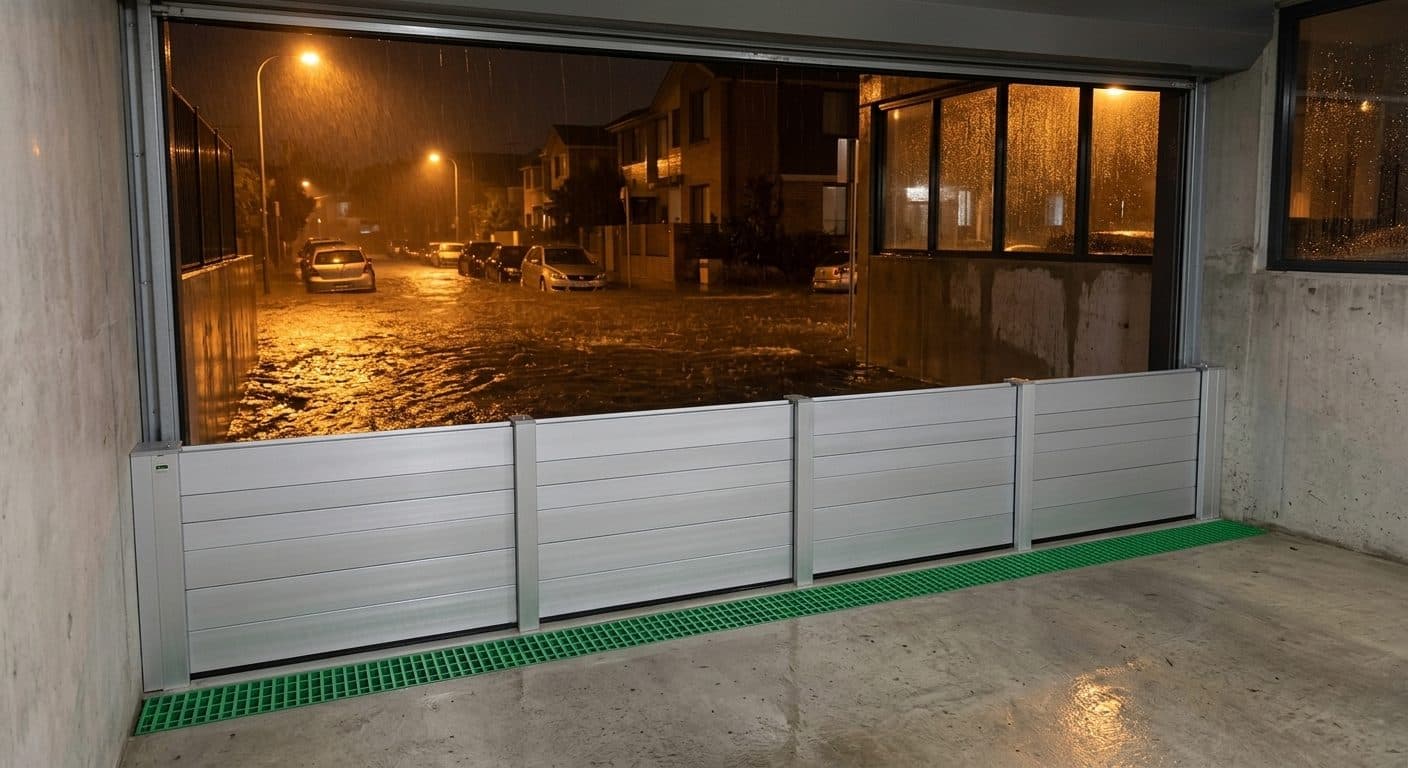
Ramp entries are often unattended during after-hours storm events. Automatic flood gates use water-level sensing and an electrically powered hydraulic lift to raise the barrier at its configured activation level. Each system is custom-engineered to the ramp geometry; a site assessment is required before quoting. Where the ramp has no dependable power, a self-operating passive flood barrier is raised by the floodwater itself, with no power supply and no operator.
Under the Owners Corporation Act 2006 (Vic), removable barriers that do not require structural modification to common property typically fall within a building manager's maintenance authority — a full OC general meeting vote is not required for most installations.
Garage doors and driveway entries — suburban Melbourne
Garage door openings are typically 2.4–4 metres wide and present a larger surface area than a standard door. ABS portable flood barriers cover this range with an 8-panel modular format that configures to any opening width. At $1,659 per 8-panel pack with free shipping to all VIC addresses, they suit homeowners in Moonee Ponds, Ascot Vale, and other suburban addresses who need to cover a double garage entry quickly.
Water-activated sandbags at $59 per pack of 6 work effectively as a secondary seal along the base of a garage door after the primary barrier is in position. Each bag swells from 270 g dry to 18–22 kg within 2–3 minutes of contact with fresh water, filling any gap where a rigid panel cannot form a clean seal against an uneven floor surface.
Commercial shopfronts and loading bays — Docklands, Collingwood, Richmond, Fitzroy
Wide shopfront openings and loading bay entries need barriers that deploy fast across large spans. Aluminium demountable barriers are built to the measured opening, while ABS portable barriers suit loading bay entries where nothing can be fixed to the building and panels are linked end-to-end. For shops in Richmond and Collingwood — which sit close to the Yarra River and experienced repeated inundation in 2022 and 2025 — having barriers on-site and pre-staged before a forecast event is the only workable strategy.
How do you check your Melbourne property's flood risk before buying a barrier?
Four steps give a complete picture of a Melbourne property's flood exposure.
1. Melbourne Water flood information map — enter your address at melbournewater.com.au to view flood overlays for the Yarra and Maribyrnong catchments. The map shows three return period scenarios: 1-in-20, 1-in-100, and 1-in-500 year flood extents.
2. Council planning portal — search for Special Building Overlay (SBO) or Land Subject to Inundation Overlay (LSIO) on the property. Properties within these overlays have planning conditions on new development and may carry additional building requirements.
3. VIC SES household emergency plan — download from ses.vic.gov.au and register your address for automatic flood warnings. VIC SES monitors river gauges on the Maribyrnong and Yarra in real time and issues warnings by SMS and app alert.
4. Bureau of Meteorology flood alerts — subscribe to Maribyrnong and Yarra catchment alerts at bom.gov.au/water/floods. BOM issues Flood Watches and Flood Warnings at defined gauge thresholds. For riverine events, this typically gives properties 12–48 hours of advance notice — enough time to deploy staged barriers before water reaches the threshold.
Flash flooding from intense short-duration rainfall gives far less lead time. Properties in Port Melbourne, Docklands, and inner-north suburbs should treat a Severe Thunderstorm Warning from BOM as the deployment trigger rather than waiting for a formal Flood Warning.
What should Melbourne homeowners do before the next wet season?
Start with a walk around your property after any moderate rain event — note where water pools, which paths it takes, and which entry points it approaches first. Most inner-west terrace houses will see water moving toward the front door threshold and the side passage. A double garage on a slight downward grade in Moonee Ponds will funnel water toward the roller door.
Order barriers sized to your specific opening before the season starts. For a standard terrace entry, one aluminium set covers the main door, built to the height you need held back. Add Oxford barriers for a secondary rear door or patio entry. For a driveway or garage, measure the clear width and order ABS panels to match.
Our flood preparation checklist for Australian homes and businesses covers the full pre-season deployment sequence — from opening measurement through dry-run practice. For a breakdown of Melbourne's flood warning system — what each alert level means and how much lead time each type of event gives you — see our Melbourne flood warning guide. For a broader comparison of product types available across Australia, the flood barriers guide covers every category with selection criteria by property type.
All products ship free to Melbourne and all Victorian addresses, with delivery in 3–5 business days. Order before the season, not during it. Contact us for urgent orders ahead of a named weather event — we can advise on product selection for your specific address and opening dimensions.
Flood barrier guides for other Australian cities
- Flood barriers for Sydney homes and apartments: sloped driveways, entry doors and apartment underground car parks.
- Flood barriers in Brisbane: Brisbane River and creek flooding, Queenslander lower levels, and apartment car parks.
- Flood barriers in Adelaide: winter stormwater off the Mount Lofty Ranges and the Torrens River, and barriers for stone homes and shopfronts.
- Flood barriers in Perth: Swan and Canning River flooding, winter stormwater, and barriers for Perth homes and strata buildings.
- Flood barriers in Newcastle: Hunter and Paterson River flooding, East Coast Lows, and a barrier selector by suburb type.
Recommended next step
Match the guide to a flood barrier option.
These are the product pages and guides most relevant to this topic. Use them to compare flood barriers Australia-wide, then request a site-specific recommendation.