Article · 2 June 2026 · Updated 6 October 2026
Types of Flood Barriers Australia
The five types of flood barriers available in Australia, with deployment times, depth ratings, and cost ranges to help you choose the right product.
Five types of flood barriers are available for Australian homes and businesses, and choosing the wrong one for your opening type leaves you exposed when water arrives. This guide explains what each type does, where it works, what it costs, and where it falls short.
What are the five flood barrier types used in Australia?
The product categories available from Australian flood protection suppliers are:
- Aluminium demountable flood barriers — rigid panels made to measure for doorways and openings of any width
- Automatic flood barrier systems — hydraulic barriers raised on water-level sensing, or passive barriers raised by the floodwater itself, custom-engineered for qualifying sites
- ABS portable flood barriers — modular polymer panels for wide openings and commercial entries
- Oxford cloth telescopic barriers — adjustable-width fabric and steel-frame barriers for residential doors and garage entries
- Water-activated sandbags (sandless) — reusable bags that swell on contact with fresh water in minutes
Each type has a defined depth rating, a deployment requirement, and a best-fit use case. None covers every scenario. The comparison table in the section below sets them side by side; the sections that follow explain each one in detail.
For a cost-focused side-by-side, the flood barriers Australia buyer's guide covers long-term ownership costs and purchase considerations across all five types.
How do demountable aluminium flood barriers work?
Aluminium flood barriers are precision-engineered panels made from marine-grade aluminium that slot into permanent anchor channels installed beside a doorway or opening. One person deploys the full set in under 10 minutes. A rubber gasket at the base and sides is clamped against the frame and floor.
Specifications from the product:
- Width: made to measure for the opening
- Height: set by panel count in 200 mm steps
- Approximate weight: 12 kg per set
- Deploy time: under 10 minutes, one person
- Reuse: redeployed season after season
- Price: made to measure, quoted per opening
Aluminium panels are the preferred choice for commercial shopfronts, garage entries, and residential front doors that face recurring or high-depth flood risk. One-person deployment in under 10 minutes is meaningful when a Flood Warning gives you 6–12 hours notice and you have multiple openings to cover.
The anchor channels are installed once — typically into a door frame or concrete threshold — and remain in place permanently. On most standard entries the property owner can complete this themselves. Wider commercial openings may require a builder to handle the channel placement. For a full breakdown of specifications, material comparisons and lifecycle cost, see the aluminium flood barriers guide.
How do automatic flood barrier systems work?
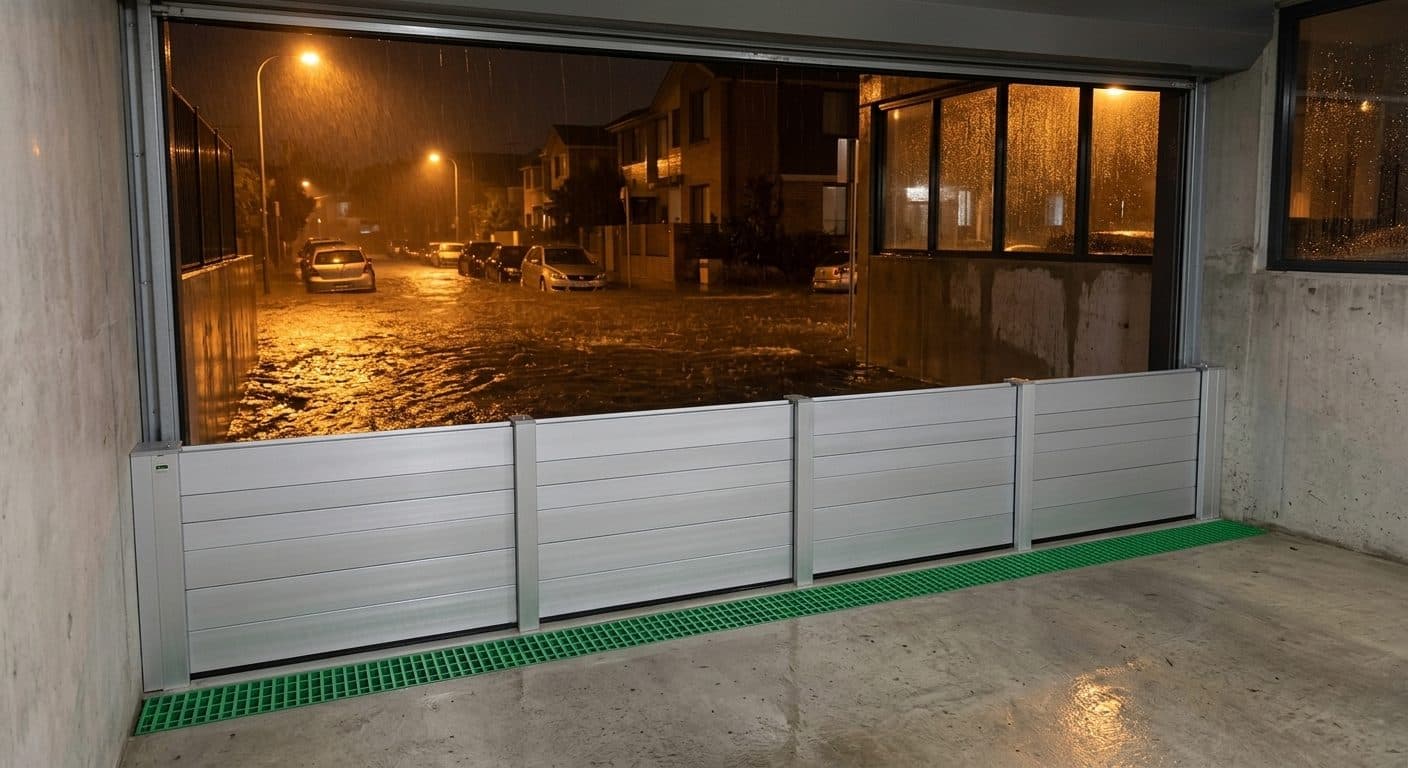
Automatic flood gate systems use water-level sensing and an electrically powered hydraulic lifting system. When water reaches the configured activation level, the control system operates the hydraulic pump to raise the barrier. Remote or central controls lower and reset it. Each system is assessed and engineered for the opening, electrical supply and operating requirements.
This makes automatic gates the only viable solution for:
- Underground and basement car parks
- Storerooms and plant rooms that flood at night or on weekends
- Building entries where management cannot guarantee someone will be present
- Infrastructure access points in remote or semi-remote locations
Specifications are custom-engineered to each opening and site condition. Water-level sensing, electrical supply, hydraulic controls and installation requirements are confirmed through a site assessment before a supply quote is provided.
A second kind of automatic barrier needs no power at all. The Hydrodynamic Passive Flood Barrier is a self-activating barrier raised by the floodwater itself: buoyancy lifts the panel as water flows in beneath it, and it lowers under its own weight as the water recedes. It is recessed flush with the slab on a new build, or surface-mounted with a ramp each side on an existing site, and is trafficable to 20 tonnes GVM when fully lowered. Protection heights are 0.6 m, 0.8 m, 1.0 m and 1.2 m. It is also called a mechanical, self-closing or self-operating flood barrier; mechanical flood barriers for basement car parks covers how it is used at a car park entry.
For a detailed look at car park, hospital, and campus applications, see automatic flood gates for unattended sites.
What are ABS portable flood barriers and where do they work?
ABS portable flood barriers are modular panels made from ABS polymer that interlock to form a temporary wall across wide openings — garage roller doors, loading bay entrances, and commercial shopfronts. The 8-panel pack configuration lets you cover variable opening widths, and panels can be deployed by one person without tools.
Specifications:
- Pack size: 8 panels
- Material: ABS polymer
- Best for: garage doors, shopfronts, loading bays, commercial access points
- Deployment: manual, no tools required
- Reuse: multiple flood seasons
- Price: $1,659 per 8-panel pack, free Australia-wide shipping
ABS barriers fill the gap between Oxford barriers — which top out at 1,300 mm wide — and permanent aluminium installations. If you need to protect a wide roller door without the cost or lead time of aluminium anchors, a portable ABS pack gives you a reusable, tool-free option that can be stored and redeployed across seasons.
How do Oxford cloth telescopic barriers work?
Oxford barriers are a 2-pack of telescopic flood barriers built from PVC-coated Oxford cloth with a reinforced steel pipe frame. The telescopic width adjusts from 150 mm to 1,300 mm to fit standard entry doors, sliding glass doors, garage pedestrian entries, and internal thresholds.
The sealing mechanism is water-pressure assisted. As floodwater pushes against the barrier, it presses the base and edges harder against the floor and door frame — the seal improves under load. Setup takes minutes with no tools, and the barriers fold flat for compact storage.
Specifications:
- Pack size: 2 barriers
- Adjustable width: 150–1,300 mm
- Flood protection height: up to 900 mm
- Weight: 5.3 kg per barrier
- Material: PVC-coated Oxford cloth with reinforced steel pipe frame
- Price: $449 per 2-pack, free Australia-wide shipping
Oxford barriers suit standard residential entries well. For garage roller doors, pair them with water-activated sandbags placed along the base gap — the Oxford cloth panel handles the main opening height while sandbags bridge the uneven seal line at the bottom.
What are water-activated sandbags and when should you use them?
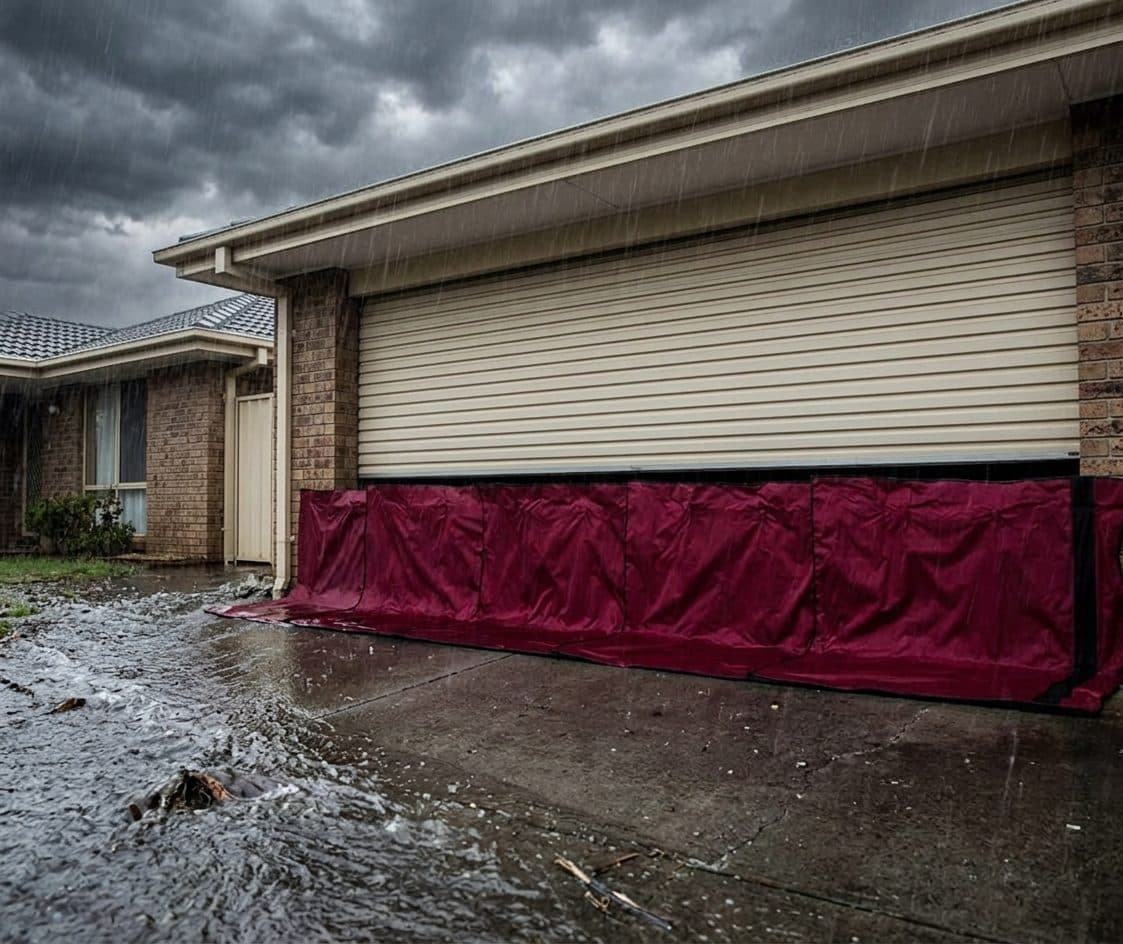
Water-activated sandbags are the fastest-deploying flood protection product available for household and small-business use. Each bag stores flat at 270 g and swells to 18–22 kg within 2–3 minutes of contact with fresh water, forming a compacted dam. No sand, shovels, or filling equipment is required.
Specifications:
- Pack size: 6 bags
- Pre-activated weight: 270 g per bag
- Activated weight: 18–22 kg per bag
- Activated dimensions: 600 × 400 × 120 mm
- Activation time: 2–3 minutes in fresh water
- Shell: UV-protected non-woven polypropylene
- Core: 100% sodium polyacrylate
- Price: $59 per pack of 6, free Australia-wide shipping
The key limitation is the 120 mm per-layer height. Covering a standard doorway requires three bags placed end-to-end per course, with multiple courses stacked to build height. Sandbags are most effective as a gap-sealing supplement to a rigid or fabric barrier — not as a standalone solution for openings over 300 mm deep.
Note that water-activated sandbags require fresh water to activate. Salt water significantly reduces the swelling response, so keep a fresh water supply on hand for coastal properties.
Water-activated sandbags are reusable. After an event they can be dried out and used again, and how many times depends on how they are used. Dispose of bags you no longer need per your local council's waste guidelines.
According to the Bureau of Meteorology's flood knowledge centre, a Flood Watch is typically issued 12–48 hours before flooding is expected — that is the right time to activate sandbags and position your other barriers, before water is imminent and hardware stores have sold out.
Comparison table: flood barrier types at a glance
| Type | Best for | Max depth | Attended? | Price from | Reusable |
|---|---|---|---|---|---|
| Aluminium demountable | Doors, shopfronts, garage entries | Made to measure | Manual deploy | Quoted | Yes |
| Automatic hydraulic | Car parks, basements, unattended sites | Custom | Water-level sensing | Site assessment required | Yes — engineered |
| Automatic passive | Car park ramps, driveways, loading docks | 0.6 m to 1.2 m | Raised by the floodwater, no power | Quoted per opening | Yes — engineered |
| ABS portable | Wide roller doors, loading bays | ~600 mm | Manual deploy | $1,659/8-pk | Yes |
| Oxford cloth | Residential doors, garage entries | 900 mm | Manual deploy | $449/2-pk | Yes |
| Water-activated sandbags | Irregular gaps, roller door base seals | 120 mm/layer | Manual place | $59/6-pk | Yes |
Enquire about a solution for your site
How to choose the right flood barrier for your property
The right barrier depends on three factors: the opening width, the expected water depth, and whether someone will be on site to deploy it when flooding is forecast.
Residential front door: Oxford barriers handle standard door widths up to 1,300 mm and protect to 900 mm depth. For double-door or unusually wide entries, aluminium demountable panels are made to measure and give a rubber seal that is reused every season.
Residential garage roller door: Combine Oxford barriers across the door height with water-activated sandbags along the base seal gap. The cloth barrier handles the main door area; sandbags bridge the uneven ground line at the bottom of the roller door.
Commercial shopfront: Aluminium flood barriers are the standard for commercial entries. One person deploys the full set in under 10 minutes, and the panels hold to the height they were built for with no shifting under pressure.
Wide loading bay or warehouse entry: ABS portable barriers suit openings that are too wide for Oxford barriers but where permanent aluminium anchor installation is not warranted. The modular format means coverage can be extended by ordering additional 8-panel packs.
Unattended site — car park, basement, storeroom: Automatic flood gate systems can be assessed where a water-level-sensing, electrically powered hydraulic installation is appropriate. The site assessment confirms whether the system suits the location. Where the entry has no dependable power, a self-activating passive flood barrier is raised by the floodwater itself.
For detailed timing guidance on when to deploy each barrier type at each Bureau of Meteorology alert stage, the flood preparation checklist covers Watch, Warning, and Emergency Warning steps in sequence.
If the core question is whether rigid barriers or sandbags suit your situation, the flood barriers vs sandbags comparison covers depth ratings, cost per event, and which scenarios favour each approach.
Recommended next step
Match the guide to a flood barrier option.
These are the product pages and guides most relevant to this topic. Use them to compare flood barriers Australia-wide, then request a site-specific recommendation.