
Article · 11 June 2026
Flood Barriers for Rental Properties
Flood barriers for Australian rental properties: what landlords must install, which barriers tenants can deploy, and when automatic gates make sense.

A rental property flooded while a tenant is in residence — or while a unit sits empty between tenancies — can generate repair bills that outstrip a full year's rent in a single event. For Australian landlords and property managers, the right flood barrier either works automatically when no one is home, or is simple enough for a tenant to deploy from a hallway cupboard without any training. Both options exist and both are available off the shelf.
Who carries flood protection responsibility in a rental tenancy?
Under tenancy legislation in New South Wales, Queensland, and Victoria, landlords have a general obligation to provide a property that is safe and fit for habitation. Where a flood protection system has already been installed — permanent anchor points for a demountable barrier, a perimeter drain, or an automatic flood gate — the landlord is responsible for ensuring it is functional at the start of each tenancy.
Tenants cannot be required to purchase or install permanent flood mitigation as a condition of the tenancy. That said, tenants who want to protect their own belongings may deploy removable barriers provided they leave no marks and make no modifications to the building structure. Landlords who want their tenants to have an easy option should supply a 2-pack of Oxford barriers and leave them at the property.
The practical consequence for a landlord is this: once a property is known to be in a flood-prone location, the argument for flood protection is not only financial. In a claim dispute, an insurer or tenancy tribunal may take the view that a landlord with documented flood exposure and no mitigation in place bears a higher share of the liability for damage to tenant goods.
South-East Queensland and the NSW Northern Rivers — two of the most active rental markets in flood-prone Australia — have seen insurers increasingly require documented flood mitigation as a condition of ongoing coverage in the years following major flood events. The Bureau of Meteorology's Queensland Rainfall and River Conditions page lists active flood watches and warnings updated in real time — landlords in flood-prone postcodes should check it before winter and before any forecast east coast low.
Which flood barriers can tenants deploy without a landlord?
Not every rental will have a landlord-installed gate. In those cases, tenants can deploy removable flood barriers that need no tools, no installation, and no modification to the building.
Oxford barriers are the most practical tenant-ready option. A 2-pack adjusts from 150 mm to 1,300 mm wide, sets up in minutes without tools, and uses water pressure to form a seal at the base. Each pack weighs 5.3 kg and folds flat for storage in a laundry or cupboard. Tenants can protect a standard entry door, sliding glass door, or a garage access point without any landlord approval — because nothing is fixed to the building.
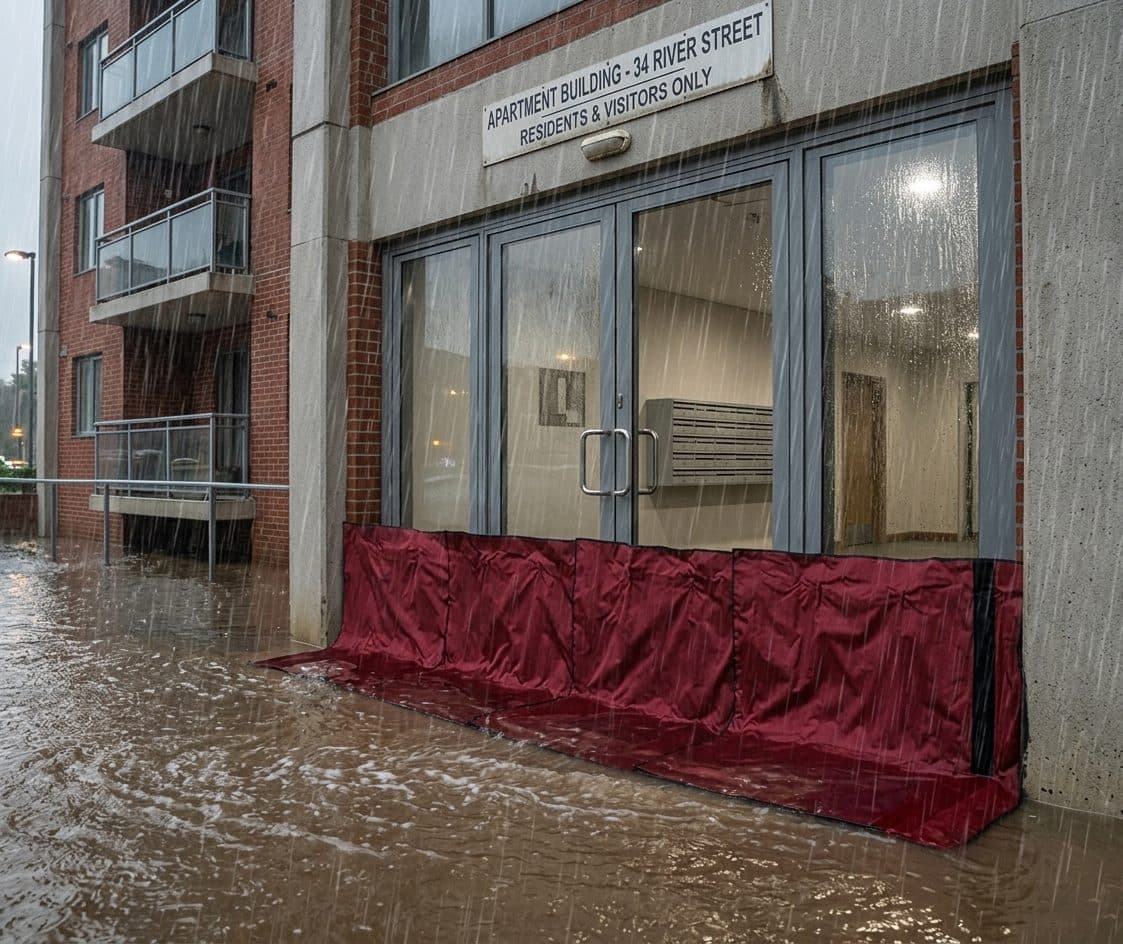
The barrier's telescopic width means it does not need to be measured or custom-ordered for a specific opening. One pack handles a standard single doorway; additional packs connect side-by-side to cover wider spans. The Oxford barrier does not need to be staked, drilled, or cemented — it relies on its own base weight and the pressure of incoming water to hold the seal against the floor.
For gaps around irregular surfaces, door thresholds, or areas where a rigid barrier cannot seat evenly, water-activated sandbags fill the gap. Each bag in a pack of 6 activates in 2–3 minutes on contact with fresh water, swelling from 270 g to 18–22 kg. They are reusable and best suited to emergency response — a pack in the garage or storage room, used to seal around or under a barrier rather than as the primary line of defence.
When does a rental property need automatic flood gates?
Some properties are simply not suited to tenant-deployed barriers. Holiday lets that change occupancy frequently, basement units accessed via a separate stairwell, and properties managed remotely all share the same problem: no one reliable will be available when floodwater arrives.
Automatic flood gates can be assessed for these sites. Water-level sensing triggers an electrically powered hydraulic lift at the configured level; remote or central controls lower and reset the barrier.
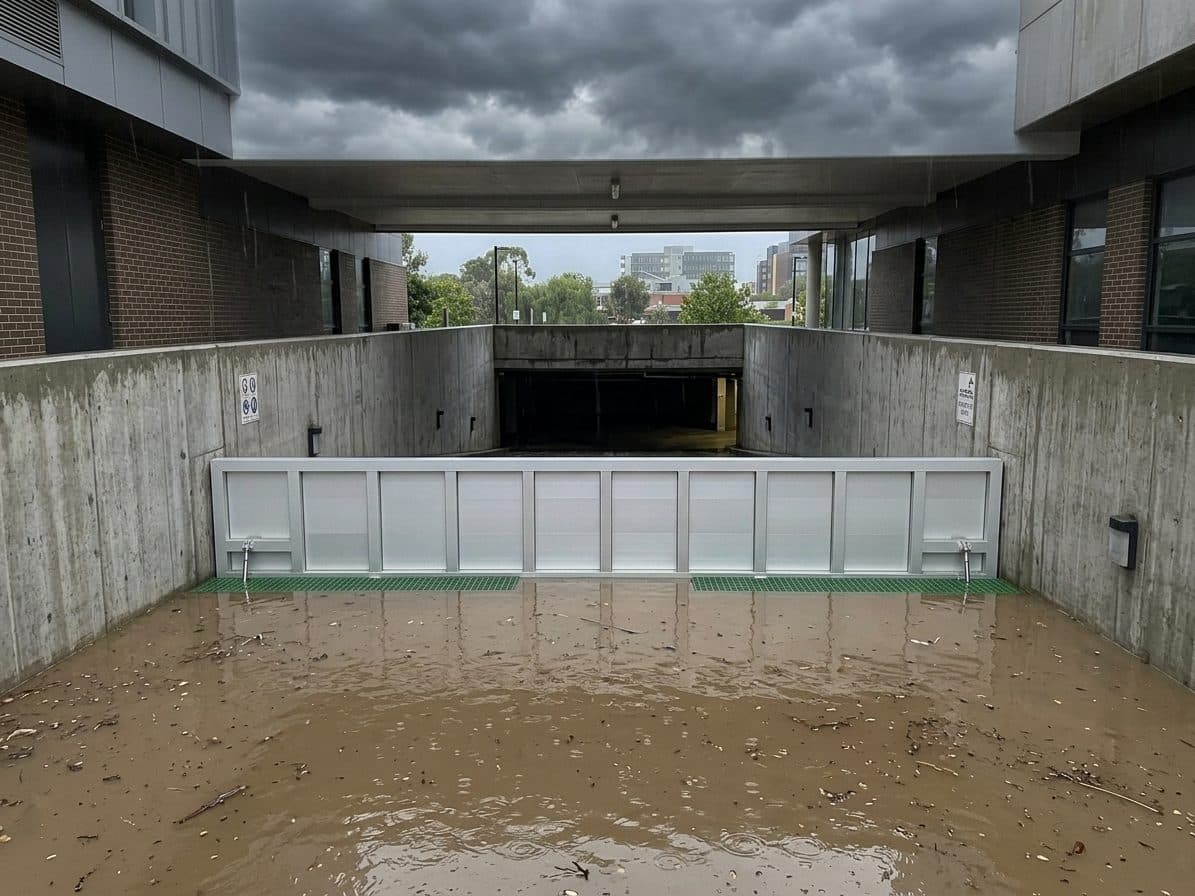
Custom-engineered to the opening dimensions, automatic gates handle widths up to 6 m and heights up to 2 m. The construction is stainless steel or marine-grade aluminium, suited to permanent outdoor installation in coastal and riverine environments. They are used at basement carpark entries, ground-floor commercial tenancies, and holiday rental properties from the New South Wales central coast to Queensland's Sunshine Coast.
Installation requirements and product pricing are confirmed after a site assessment. An installation guide is supplied with the system. For an investment property in a flood-prone suburb generating $40,000 or more per year in rent, compare the site-specific proposal with the potential cost of a flood event.
Which entry points in a rental property are most vulnerable?
The most common flood entry points in Australian rental properties are:
Ground-floor entry doors — the primary entry point in most dwellings. Standard timber or uPVC door frames offer no resistance to even 50 mm of surface water without a threshold barrier or Oxford barrier deployed across the opening.
Internal garage access doors — in terrace houses and townhouses, the door connecting the garage to the living area is a direct path for floodwater that has already entered via the roller door. Protecting only the external garage door without also protecting the internal connecting door leaves the living area exposed.
Basement and sub-floor stairwells — these funnel surface water from street level straight to the lowest point of the building. A barrier at the top of the stairwell is far more effective than attempting to pump out a flooded basement after the event.
Rear sliding doors and ground-floor balconies — rear access points are commonly overlooked during flood preparation, particularly when a flood arrives as stormwater runoff rather than an overflowing waterway. Properties backing onto a laneway or low-lying courtyard are especially exposed.
For a multi-storey investment property with a basement carpark, the priority sequence is: protect the basement ramp first, then the ground-floor entry, then any rear or side access points.
What does a flood event actually cost a landlord?
The Bureau of Meteorology's historical flood records identify the Hunter River catchment in NSW and the South-East Queensland coast as two of the most frequently inundated rental markets on the eastern seaboard. In both regions, a flood event at 100–300 mm depth typically triggers the following costs in a standard ground-floor residential rental:
- Structural drying and mould treatment: $3,000–$8,000
- Floor replacement (carpet, tiles, or timber): $4,000–$15,000
- Wall lining and repaint below the flood line: $2,000–$6,000
- Electrical inspection and repair: $1,500–$4,000
- Lost rent during repairs (typically 4–8 weeks at vacancy): $4,000–$12,000
- Replacement of landlord-supplied fixtures and white goods: $2,000–$10,000
Total per event: $16,500–$55,000.
An insurance claim of this size typically results in a premium increase across the following 3–5 policy years, reducing the net financial benefit of any payout. Where a landlord can demonstrate documented active mitigation — installation records, maintenance receipts, and photo evidence of barriers in place — some insurers offer a flood resilience endorsement with a reduced excess. Properties that flood more than once in 10 years will find the payback maths on barrier investment straightforward.
How to choose flood barriers for your rental property
The decision comes down to two questions: will someone reliable be present to deploy the barrier, and how wide is the opening?
Standard doorways in a permanently occupied rental — an Oxford barrier 2-pack (from $449) is the most cost-effective landlord-provided option. Leave a pack at the property with a one-page instruction sheet. No tools required, and a tenant can deploy it in under five minutes from reading the instructions for the first time.
Wider openings — a double garage, a shopfront, or a commercial tenancy — aluminium demountable flood barriers are made to measure for the opening, with a rubber seal against the frame and the height built up in 200 mm panel steps. One-off anchor installation, then single-person deployment in under 10 minutes. Sets are made to measure and quoted per opening.
Unattended properties, or situations where tenant deployment cannot be relied on — automatic flood gates are the correct solution. The upfront cost is higher, but the gate deploys every time — whether the tenant is home, asleep, or on a four-week overseas trip.
ABS portable barriers — the 8-panel pack from $1,659 suits driveways, loading bays, and wide shopfront openings where modular flexibility is needed and a permanent gate is not practical.
A combined approach works well for a mixed residential and parking investment: automatic gates on the basement entry, an Oxford barrier for the apartment front door. That gives full coverage across both entry types, with the gate quoted per opening. Contact us to discuss the right configuration for a specific opening.
For the full entry-point audit, product sizing by opening, and cost by property scenario, see residential flood barriers.
Recommended next step
Match the guide to a flood barrier option.
These are the product pages and guides most relevant to this topic. Use them to compare flood barriers Australia-wide, then request a site-specific recommendation.