Article · 10 May 2026
Retail Shopfront Flood Barriers AU
How to protect a retail shopfront from flooding in Australia — comparing aluminium, ABS, and Oxford barriers for leased premises and owned shopfronts.

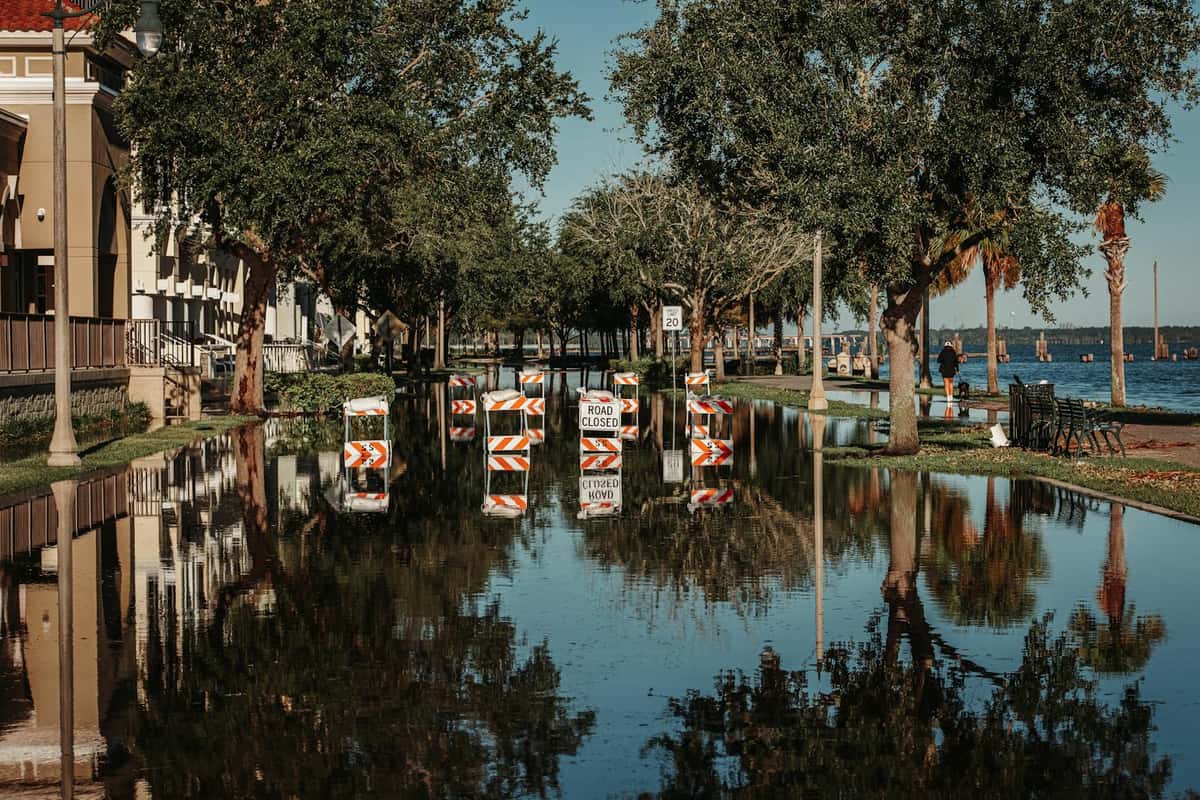
A flooded retail shopfront is not just a stock loss event — it is weeks of disruption, fitout repair costs, lease disputes over flood protection responsibility, and the brand impact of a shuttered storefront. Most retail flood damage in Australia is preventable. Proven barriers exist for nearly every retail opening type, at price points well below the cost of a single flood claim.
Why are retail shopfronts more vulnerable to flooding than residential properties?
A standard retail shopfront has several characteristics that increase flood exposure compared to a domestic property:
- Wide glazed frontages — often 2–4 m wide with minimal threshold height, designed for visual appeal and accessibility rather than water resistance
- Low door thresholds — designed for foot traffic accessibility, which limits the natural barrier the building structure provides
- Recessed or below-pavement entries — sunken shopfronts collect surface water faster than flush frontages
- Multiple entry points — front, side access, and rear receive doors all need assessment, not just the primary shopfront
- Tenant vs landlord ambiguity — flood protection responsibility is often unclear in retail leases, which delays action until the water is already at the door
A 50–200 mm flood depth inside a retail tenancy is enough to destroy floor finishes, display units, floor-level stock, and point-of-sale hardware. The repair bill for a 100 mm inundation across a standard shopfront fitout regularly runs into tens of thousands of dollars — far exceeding the cost of a quality barrier system.
Which demountable aluminium barrier suits a retail shopfront?
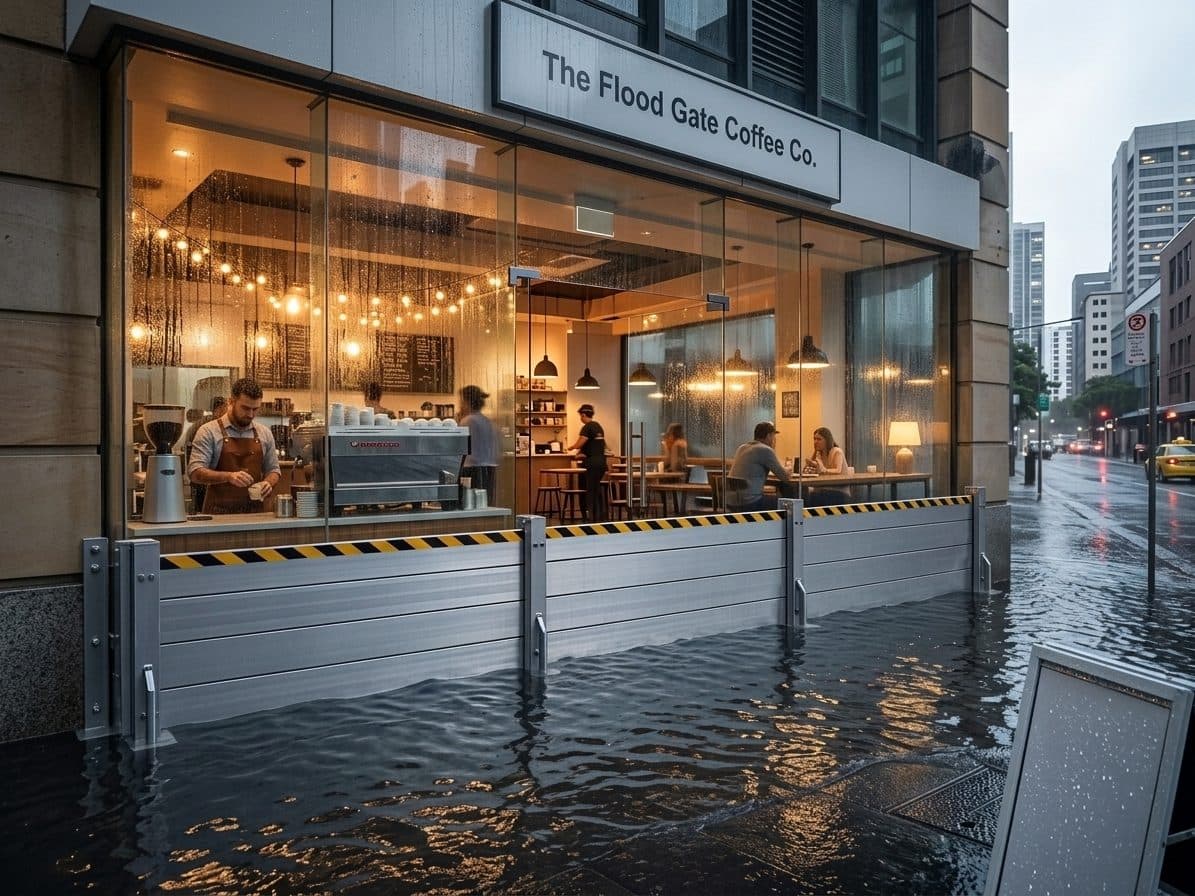
Aluminium demountable flood barriers are the most capable option for retail shopfronts that face regular flood risk. Made to measure and quoted per opening, marine-grade aluminium panels slot between side posts fixed permanently to the wall either side of the opening. The posts are drilled in once, so a tenant needs the landlord's written consent before installing them.
Key advantages for retail:
- One person can deploy the full set in under 10 minutes once familiar with the sequence
- The assembled barrier has a clean, low-profile appearance that suits a retail environment without looking makeshift
- Made to measure for the opening, with the height set by panel count in 200 mm steps
- Reused season after season — the capital cost amortises quickly against recurring flood risk in identified flood-prone areas
The aluminium system makes most sense for shopfronts in areas with a documented history of flooding, businesses in low-lying CBD locations, or tenancies near stormwater mains and drainage channels that are known to overflow during intense rain events.
Best for: primary glazed shopfront entries, double-leaf doors, and side-by-side tenancies where a consistent barrier height is needed across multiple openings.
When do ABS portable barriers make sense for retail?
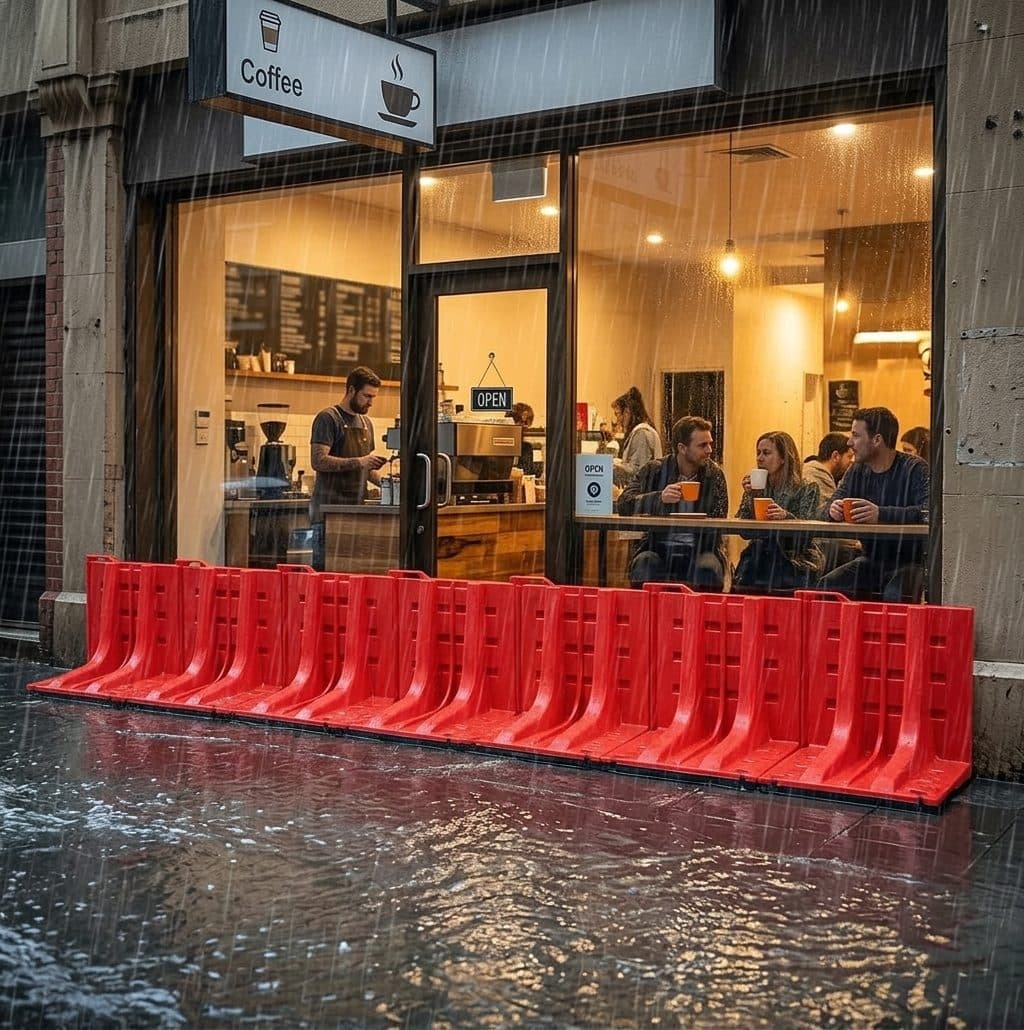
ABS portable flood barriers suit retail tenants who need a modular system they can configure around irregular opening shapes or redeploy when they move premises. Sold as an 8-panel pack, customers who need 16 panels can order two packs and join the systems.
The L-shaped ABS construction uses water weight as a stabilising force: as water presses against the barrier during a flood, the accumulated weight increases structural stability rather than compromising it. This means the barriers can contain substantial water volumes without any permanent installation or anchoring.
ABS barriers are quicker to source than custom aluminium systems, and the lower price point suits tenants who are not certain about how long they will occupy a given space or who want a system that travels with them at end of lease.
Best for: budget-conscious tenants, irregular-width openings, and tenants who plan to move within a few years or who want a fully portable system with no dependency on any installation hardware at the premises.
Where do Oxford barriers fit in a retail flood protection plan?
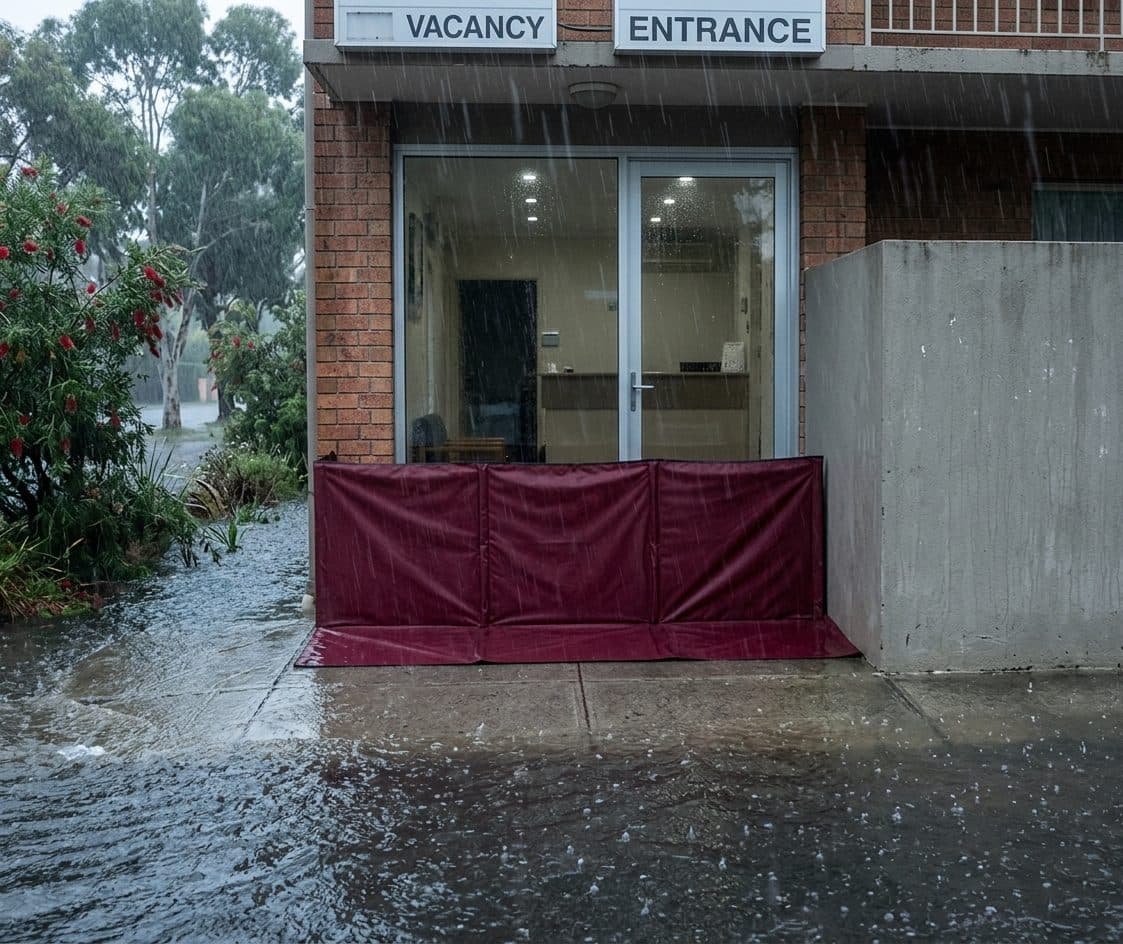
Oxford barriers are a compact, lightweight option suited to narrower retail doorways, side access points, and service entries. Priced from $449 for a 2-panel pack with free Australia-wide shipping, they offer an accessible entry point into reusable flood protection for retail without the capital commitment of a full aluminium system.
The telescopic design adjusts from 15 to 130 cm and the barriers are freestanding with no drilling required, making them well-suited to tenants who want quick supplementary protection at secondary openings without the complexity of a custom-sized system.
Best for: secondary entrances, narrow service doors, and supplementary protection at the side or rear of a retail tenancy where the primary risk is lower than the main shopfront.
How do you match barrier depth to realistic flood risk at a retail site?
Not all retail flood risk is equal. A shopfront in a well-drained suburban centre faces a different exposure than a ground-floor tenancy beside a stormwater main in a low-lying area.
| Risk level | Likely flood depth | Recommended barrier |
|---|---|---|
| Low (occasional heavy rain, overland flow) | 50–150 mm | Oxford barriers or ABS system |
| Moderate (stormwater overflow, creek proximity) | 200–400 mm | ABS barriers or aluminium demountable |
| High (identified flood-prone area, regular events) | 400–800 mm | Aluminium demountable barriers at full depth |
When in doubt, specify one level higher than your best estimate. A barrier rated at 600 mm provides far more confidence than one rated at 300 mm if the actual event reaches 350 mm. The cost difference between adjacent tiers is modest compared to the cost of a flood that overtops an undersized barrier.
Councils and state flood mapping tools can provide guidance on expected inundation depths for your address. The Bureau of Meteorology publishes real-time flood warnings and forecasts by location; registering for alerts before the wet season is straightforward and free.
What does a practical retail deployment plan look like?
The most common reason a flood barrier is not deployed is not that the business lacks one — it is that nobody knew it was their job, or the barrier was buried behind stock. A deployment plan needs four things:
- Named responsibility — a primary person and a backup, both of whom have completed at least one practice run in the actual store conditions
- Fixed storage location — as close to the shopfront entry as practical; behind the counter or in a back-of-house cupboard, not the storeroom at the rear of the building
- Defined trigger — a Bureau of Meteorology severe weather warning, a specific rainfall threshold, or visible water rising at the entry threshold
- Deployment sequence — front entry first, then side doors, then rear access; write it down and keep it visible at the point of need
A 10-minute deployment window exists between "this looks like it could become a problem" and "there is water at the door." A practice run once a season keeps that window real and gives staff the confidence to act without hesitation.
What steps should retail tenants take before the wet season?
A practical pre-season checklist:
- Inspect the shopfront threshold and confirm there are no cracks or gaps that will undermine a barrier seal
- Locate and check the condition of your flood barrier set — seals, panels, and side posts should be undamaged and complete
- Confirm your insurance policy covers flood damage and note what documentation is required for a claim
- Brief all relevant staff on deployment — where the barriers are stored, who deploys them, and what the trigger is
- Check the Bureau of Meteorology flood watch area for your suburb and register for alerts if available
- Consider your rear and side access points — primary shopfront protection without secondary entry coverage leaves a gap
How do retail flood barriers intersect with lease and insurance obligations?
Retail leases vary in how they assign responsibility for flood protection. Common positions include:
- Landlord provides the building in a weatherproof condition; tenant is responsible for contents protection
- Flood protection of structural openings is treated as a building matter, generally the landlord's scope
- Portable or demountable protection that does not modify the premises is typically the tenant's responsibility and travels with the tenant at end of lease
Check the lease schedule before purchasing. In most tenancies, portable barriers are clearly within the tenant's scope because they require no permanent modification to the building. Freestanding systems like Oxford barriers and base-plate-mounted ABS barriers fall into this category for the majority of standard retail leases.
For insurance purposes, document flood protection assets and their specifications. Some insurers respond more favourably to demonstrated mitigation measures when processing claims, and having evidence of proactive protection can simplify the claims process.
Which Australian retail environments have the highest flood exposure?
Certain retail contexts carry structural flood risk that should prompt a higher level of preparedness:
- CBD ground floor tenancies in Sydney, Brisbane, and Melbourne — drainage infrastructure in dense urban areas is often undersized relative to modern rainfall intensity, particularly in low-lying precincts
- Shopfronts adjacent to waterways, stormwater channels, and drainage reserves — these locations see faster inundation than open-ground sites
- Shopping centres with basement carparks — water that overtops carpark entry ramps can reach ground-floor retail through service corridors
- Strip retail in outer suburban areas — often built close to natural drainage paths that are progressively modified by surrounding development
If your tenancy is in any of these categories, assessing flood risk before the wet season and having a barrier system in place is materially more important than it might seem from street level.
For advice on which barrier suits your shopfront, contact us. We work with retail tenants, property managers, and shopping centre operators across Australia.
For barrier selection across every opening on a commercial site — design depth bands, deployment roles, and lease and insurance responsibility — see commercial flood barriers.
Recommended next step
Match the guide to a flood barrier option.
These are the product pages and guides most relevant to this topic. Use them to compare flood barriers Australia-wide, then request a site-specific recommendation.