Article · 16 July 2026
Portable Flood Barriers for Australian Homes
Portable flood barriers protect Australian homes and businesses from flash floods — compare ABS panels and Oxford barriers for fast deployment.

ABS portable flood barriers and Oxford barriers outperform traditional sandbags for most residential and commercial applications: they deploy in minutes without tools, hold back rising water, and pack away for reuse season after season. With the Bureau of Meteorology issuing severe weather warnings for Victoria through mid-July — including a Watch-and-Act Flash Flood alert for Wodonga and elevated river levels on the Ovens and King Rivers — property owners across southern Australia are being reminded that flood preparation is a winter task, not just a summer one. This guide covers what each barrier type does, where it performs best, and how to choose between them.
What is a portable flood barrier and how does it work?
Portable flood barriers are purpose-built flood protection products that can be moved to where they are needed, deployed without fixed installation, and packed away for storage when the threat has passed. The two main types sold in Australia for residential and commercial use are rigid ABS panel systems and flexible Oxford-cloth barriers.
Rigid ABS panel barriers consist of interlocking polymer panels that you stack across an opening to create a continuous wall against incoming water. The panels are modular, so they can be reconfigured to match different opening widths. No anchoring into walls or floors is required for most configurations — the water pressure and the panels' own weight keep them in place once deployed. This makes them suitable for openings you cannot or do not want to modify, such as roller doors, loading bay entries, and commercial shopfronts.
Oxford barriers use a different mechanism: the PVC-coated Oxford cloth is held in a rectangular frame by a reinforced steel pipe structure, and the barrier uses the water pressure itself to push the flexible base against the floor and create a seal. As water builds up against the barrier, the seal becomes progressively tighter. Because the width is telescopic — adjusting from 150 mm to 1,300 mm — a single unit fits a standard doorway, a garage entry, or a basement stairwell without any adjustment of the frame.
Both types contrast sharply with sandbags. A sandbag barrier relies on the weight of wet sand to resist hydrostatic pressure, but filling, stacking, and sealing a sandbag line is labour-intensive and slow. The bags cannot be easily reused after contact with floodwater, and inconsistent filling leads to gaps in the seal. Portable flood barriers are quicker to deploy, more consistent in their performance, and genuinely reusable across multiple seasons.
Why are July cold fronts flooding Victorian homes this year?
Victoria's winter cold front season runs from June through August, with successive low-pressure systems drawing moisture from the Southern Ocean across the state. July 2026 has seen a particularly active sequence of these fronts, driving flooding across both regional and suburban areas.
On 13 July, the Bureau of Meteorology issued a Severe Weather Warning for northeast Victoria and Gippsland, covering damaging winds and heavy rainfall across alpine catchments. The Ovens and King Rivers — key tributaries of the upper Murray system — reached the minor flood threshold during this cycle, and VicEmergency issued a Watch-and-Act Flash Flood alert for Wodonga and surrounding areas. According to the Bureau of Meteorology's national flood warnings and watches, flood watches for northern and central Victoria remained active through mid-July as catchments stayed saturated from earlier rainfall.
The specific risk to urban and suburban properties during cold-front events is primarily stormwater surcharge rather than riverine flooding. When rainfall intensity exceeds the capacity of the local drainage network, water backs up and flows across low-lying ground before the drains can carry it away. This is a short, sharp event — water levels can rise to a door threshold within 20 to 40 minutes of peak rainfall, and drain away just as quickly. There is rarely advance warning from SES or BoM for stormwater inundation specifically, which means properties in low-lying streets or with below-ground entries need barriers in place before the rain begins, not after.
Homeowners in regional Victoria near river systems, and those in flat suburban areas with a history of driveway or backyard ponding, should treat mid-winter cold fronts as a routine deployment trigger for their flood protection equipment.
What are ABS portable flood barriers suited for?
ABS portable flood barriers are designed for medium to large commercial openings — the entry configurations that traditional sandbags struggle with most. A standard pack of eight ABS panels covers a garage door, a warehouse loading bay, a retail shopfront, or a car park entry, giving property owners a reusable barrier that can be reconfigured from site to site as needed.
The ABS polymer construction is resistant to the contaminants and debris typically present in floodwater — mud, oil, chemical residues, and organic material — which makes these barriers well suited to industrial and commercial environments as well as residential garages. Panels deploy without tools, and one person can typically move the full set of eight panels to the opening and position them in a single trip without mechanical assistance.
For residential use, the 8-panel pack works best for double garage openings and wide driveway entries. Single-door widths are more economically served by Oxford barriers, but where the opening is wide and the risk of regular events justifies a higher initial investment, ABS panels deliver a robust, multi-season solution.
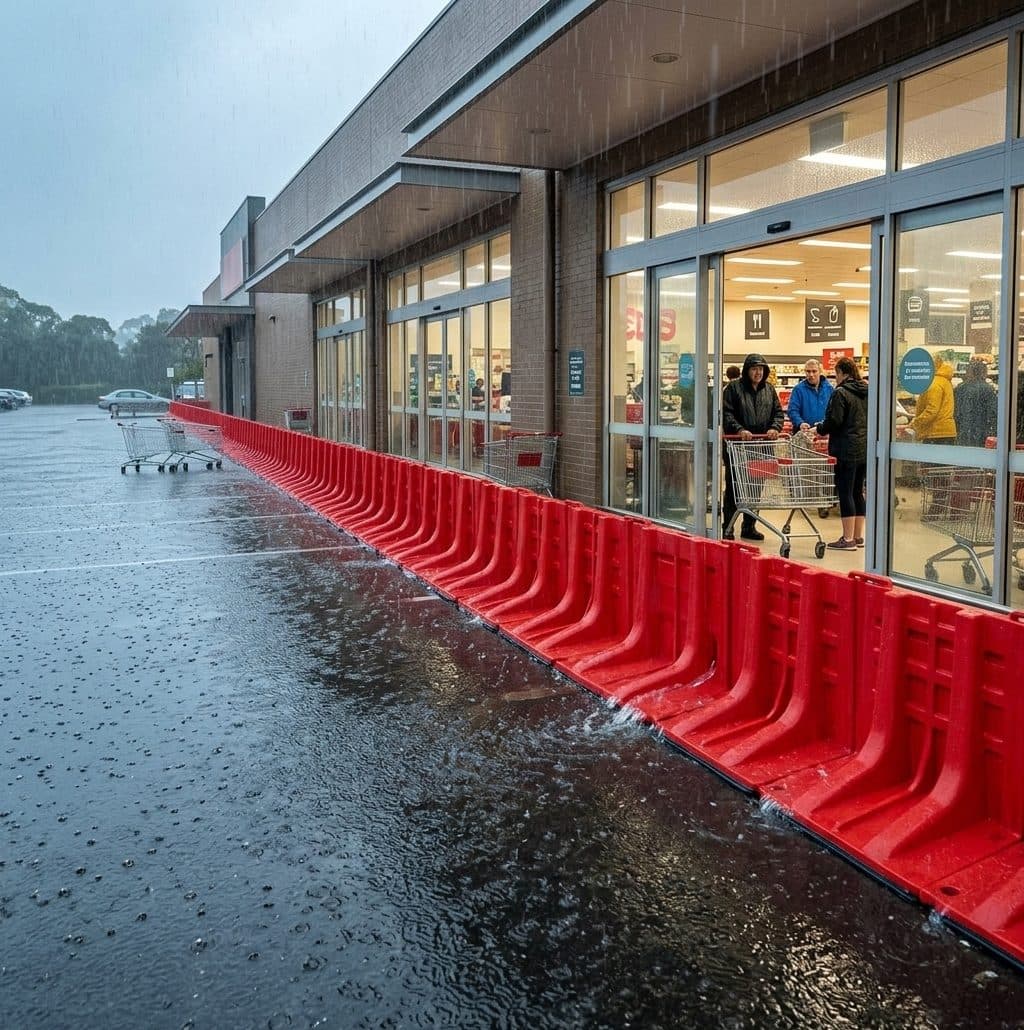
At $1,659 per 8-panel pack with free Australia-wide shipping, ABS portable barriers are a single purchase that replaces a recurring expenditure on sandbags. Over two or three flood seasons, the effective cost per deployment is substantially lower than equivalent sandbag volumes, and the deployment is considerably faster.
How do Oxford barriers compare to ABS flood panels?
Oxford flood barriers cover a different use case: single doorways, narrow garage entries, basement stairwells, and residential entrances where the opening is 1,300 mm or narrower. The telescopic frame adjusts continuously from 150 mm to 1,300 mm, so the same unit fits a front door at 900 mm and a side passage at 1,200 mm without modification.
The PVC-coated Oxford cloth and steel pipe frame weigh 5.3 kg per unit — light enough for one person to carry and deploy in a few minutes. The water-pressure-activated seal means there is no separate sealing tape or foam strip to apply; the barrier self-seals as floodwater accumulates against the face of the barrier. Each unit protects to 900 mm of flood height, which is sufficient for the vast majority of residential door and garage threshold configurations.
Two units from the 2-pack can be joined end-to-end to cover openings wider than 1,300 mm, extending total coverage to 2,600 mm. This makes the 2-pack at $449 a competitive solution for standard double doors or moderate-width garage entries, at a considerably lower entry cost than an 8-panel ABS system.
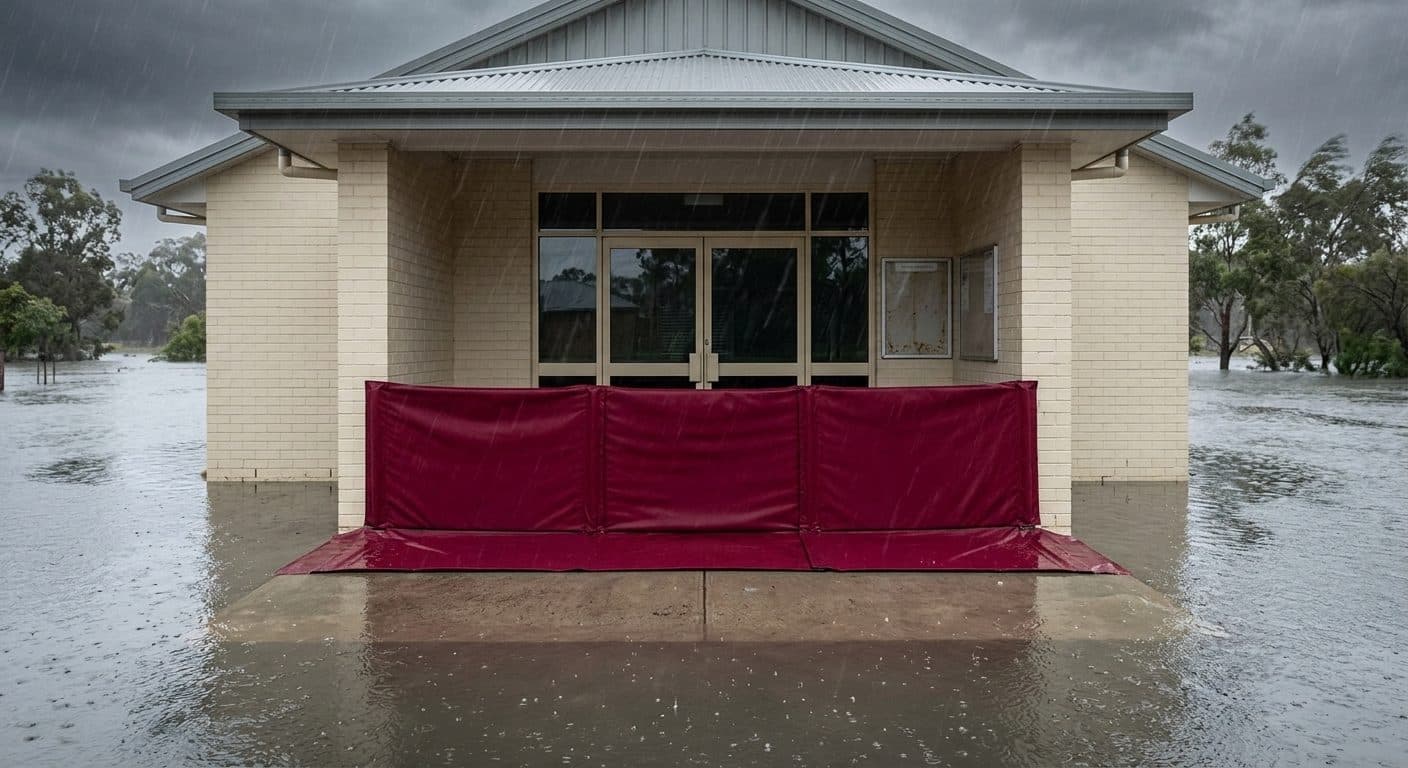
The key difference from ABS panels is floor sensitivity. Oxford barriers perform best on smooth, flat flooring — tiled, smooth concrete, or hardwood — where the flexible base fabric can form clean contact across its full width. On heavily textured or significantly uneven surfaces, a rigid rubber-sealed system such as aluminium demountable flood barriers tends to give a more consistent seal, because the rubber seal conforms to minor surface variations rather than relying on fabric-to-floor contact.
How quickly can you deploy a portable flood barrier before floodwater arrives?
Deployment speed is one of the main practical advantages of portable flood barriers over sandbags. For both ABS and Oxford systems, a single person can have a complete barrier in place at a standard opening within 10 to 15 minutes — which fits within the warning window available for most cold-front flood events where water enters gradually rather than as a flash.
For ABS panels, the practical sequence is: move panels from storage to the opening, begin at one side and interlock panels across the full width of the opening, check alignment and base contact, and the barrier is in position. No water is needed for activation, and no mixing or filling is involved. The time from storage to deployed is almost entirely transit time and positioning.
For Oxford barriers, deployment involves: unwrap the unit from flat storage, position the collapsed frame at the doorway opening, telescope the frame to the correct width, and lower the barrier into place so the base sits flat against the floor. The first few centimetres of water against the barrier face then activate the pressure seal.
Both systems benefit strongly from being deployed before water appears. Once water is flowing across the threshold, deploying a portable barrier becomes significantly more difficult — incoming flow can displace panels before they are locked in place, and the Oxford cloth is harder to position flat against the floor when wet. The practical rule is to deploy at the first sign of heavy rainfall if your property has a history of stormwater flooding, rather than waiting for water in the street.
Pre-event preparation helps considerably: knowing exactly where barriers are stored, designating one person responsible for deployment, and doing a practice run before winter begins all reduce the time from decision to protection in a real event.
Which portable flood barrier is right for your property?
The choice between ABS portable barriers and Oxford barriers comes down to opening width, floor surface type, and the number of openings you need to protect.
For a single standard doorway or narrow garage entry up to 1,300 mm wide, Oxford barriers at $449 are the practical starting point. For wider commercial openings, retail shopfronts, warehouse entries, and loading bays, the 8-panel ABS pack at $1,659 is the appropriate choice. If you have both a wide garage and a standard doorway to protect, the two products are complementary — the ABS pack for the garage and an Oxford 2-pack for the door.
Properties with multiple moderate-width openings and a limited budget may find that two Oxford 2-packs at $898 total covers more entry points than a single ABS pack, at a lower combined cost. For properties where flood events are predictable and the access configuration is complex — sloping ramps, very wide openings, or sites that need protection permanently rather than seasonally — comparing portable options against a permanent aluminium installation is worth doing before purchasing.
For any property at flood risk, the most important step is choosing a product and having it ready before the next cold front arrives, rather than waiting for a flood event to confirm the need. Contact the team at Flood Control to discuss which configuration suits your site.
Recommended next step
Match the guide to a flood barrier option.
These are the product pages and guides most relevant to this topic. Use them to compare flood barriers Australia-wide, then request a site-specific recommendation.