Article · 9 June 2026 · Updated 6 October 2026
Flood Barrier Cost in Australia
How much do flood barriers cost in Australia? Compare published product prices and learn why automatic flood barrier systems require a site assessment.
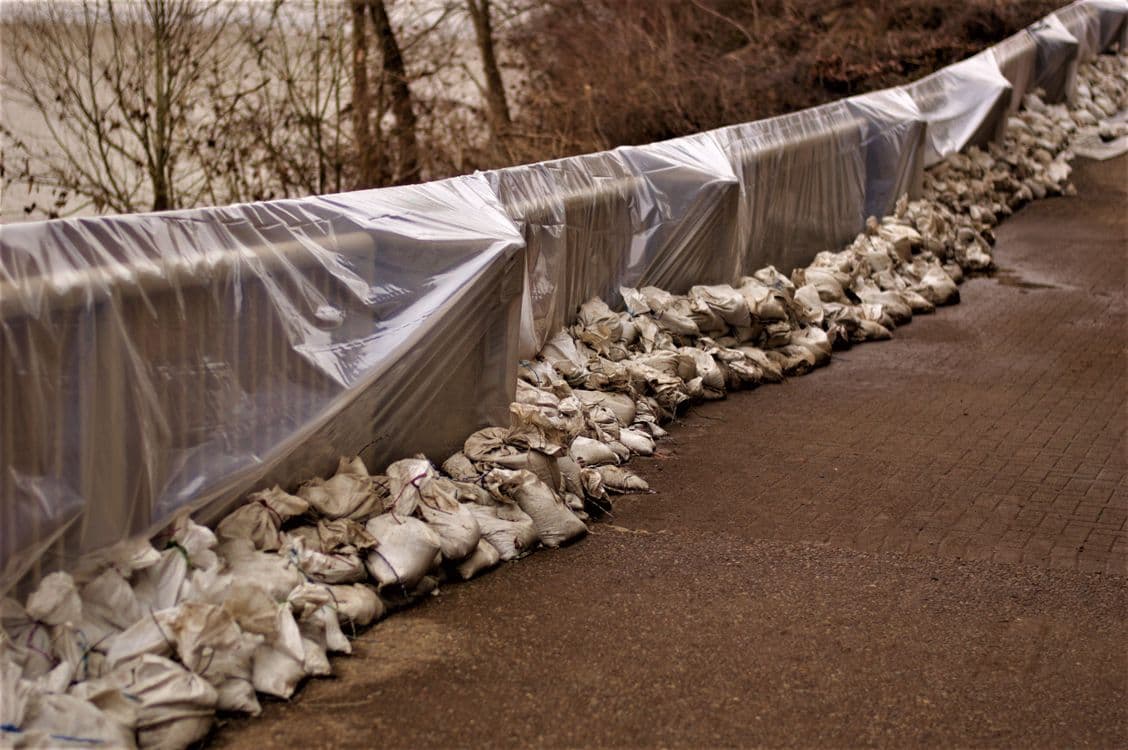
Flood barrier costs in Australia range from $59 for a pack of 6 water-activated sandbags to $1,659 for an 8-panel ABS portable barrier pack. Automatic flood barrier systems are custom-engineered and quoted after a site assessment. The right product for your property depends on opening size, expected flood depth and whether anyone will be on-site to deploy it.
How much do flood barriers cost in Australia?
The main flood barrier types available in Australia cover a wide price range. Here is a quick-reference comparison before we step through each in detail.
| Barrier type | Price | Unit | Best for |
|---|---|---|---|
| Water-activated sandbags | $59 | pack of 6 | Doorways, gaps, irregular surfaces — rapid response |
| Oxford barriers | $449 | 2-pack | Standard doors, garages, entries up to 1,300 mm wide |
| Aluminium flood barriers | Quoted per opening | set | Shopfronts, doorways, commercial entries — made to measure |
| ABS portable flood barriers | $1,659 | 8-panel pack | Wide entries, loading bays, commercial use |
| Automatic flood gates | Site assessment required | custom hydraulic system | Unattended sites, underground carparks, basements |
| Hydrodynamic passive flood barrier | Quoted per opening | made to the measured opening | Car park ramps, driveways and loading docks with no power or operator |
All prices are ex-GST. Free Australia-wide shipping applies to sandbags, Oxford barriers, and ABS barrier packs. Automatic flood gates are custom-engineered for each site, with product pricing based on the opening dimensions and site conditions.
For a spec-by-spec comparison of what each barrier type can handle, see our types of flood barriers guide.
Water-activated sandbags: $59 per pack of 6
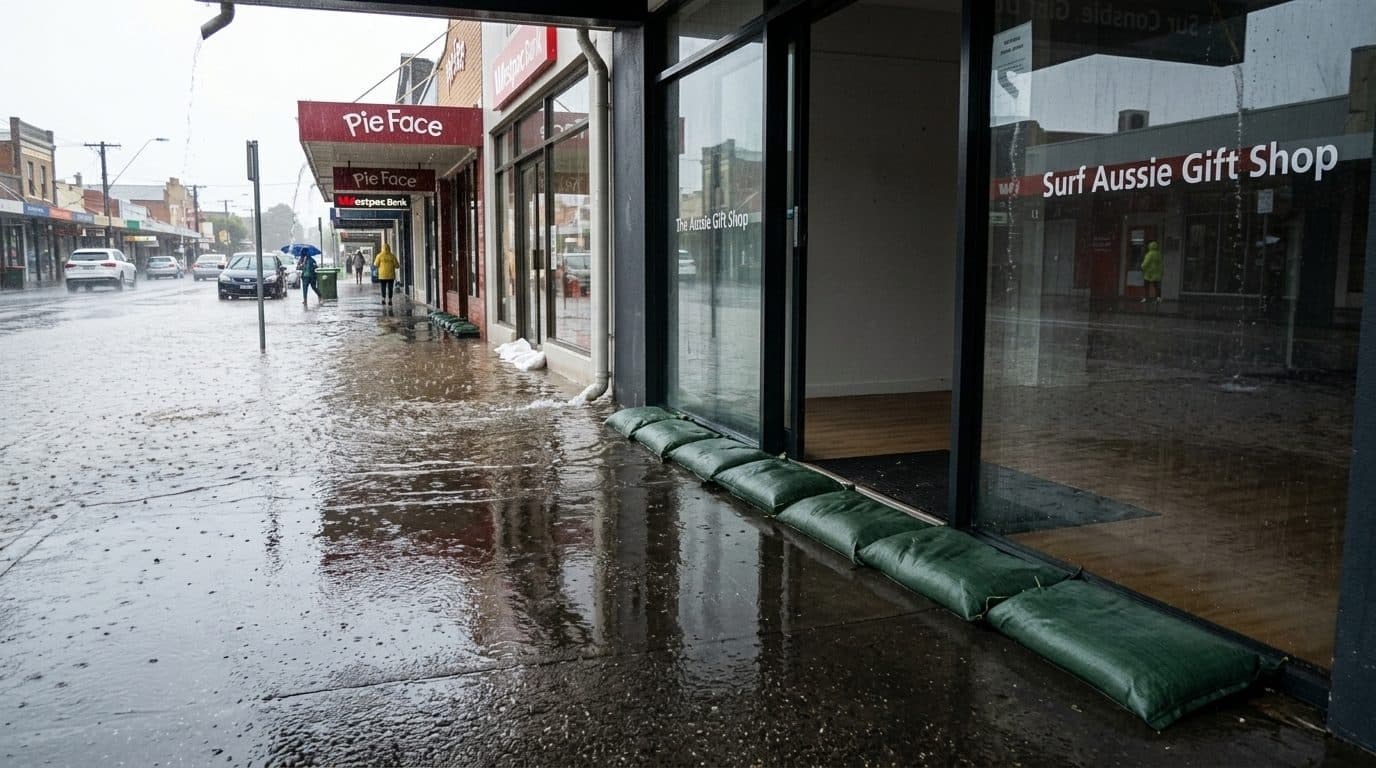
Water-activated sandbags are the entry point for flood barrier cost in Australia. Each pack of 6 contains bags that store flat at 270 g each and swell to 18–22 kg within 2–3 minutes of contact with fresh water, forming an instant dam at doorways, drains, and low entry points.
They are also reusable. After an event the bags can be dried out and used again, and they absorb water again next time. How many times depends on how they are used.
For wider coverage — a shopfront entry or a garage door — a single pack of 6 may not be enough. Two packs cover a wide entry effectively; a loading bay can require four or more. Factor the quantity into your cost comparison before moving to rigid barriers.
Reusable barriers: Oxford and aluminium
Oxford barriers and aluminium flood barriers occupy the reusable mid-range. Choosing between them comes down to opening width and use type.
Oxford barriers at $449 per 2-pack are a telescopic textile barrier that adjusts from 150 mm to 1,300 mm wide and protects to 900 mm in height. The PVC-coated Oxford cloth frame sets up in minutes without tools. Two barriers connect to cover wider openings. They suit residential garage doors, property entries, and standard commercial doorways.
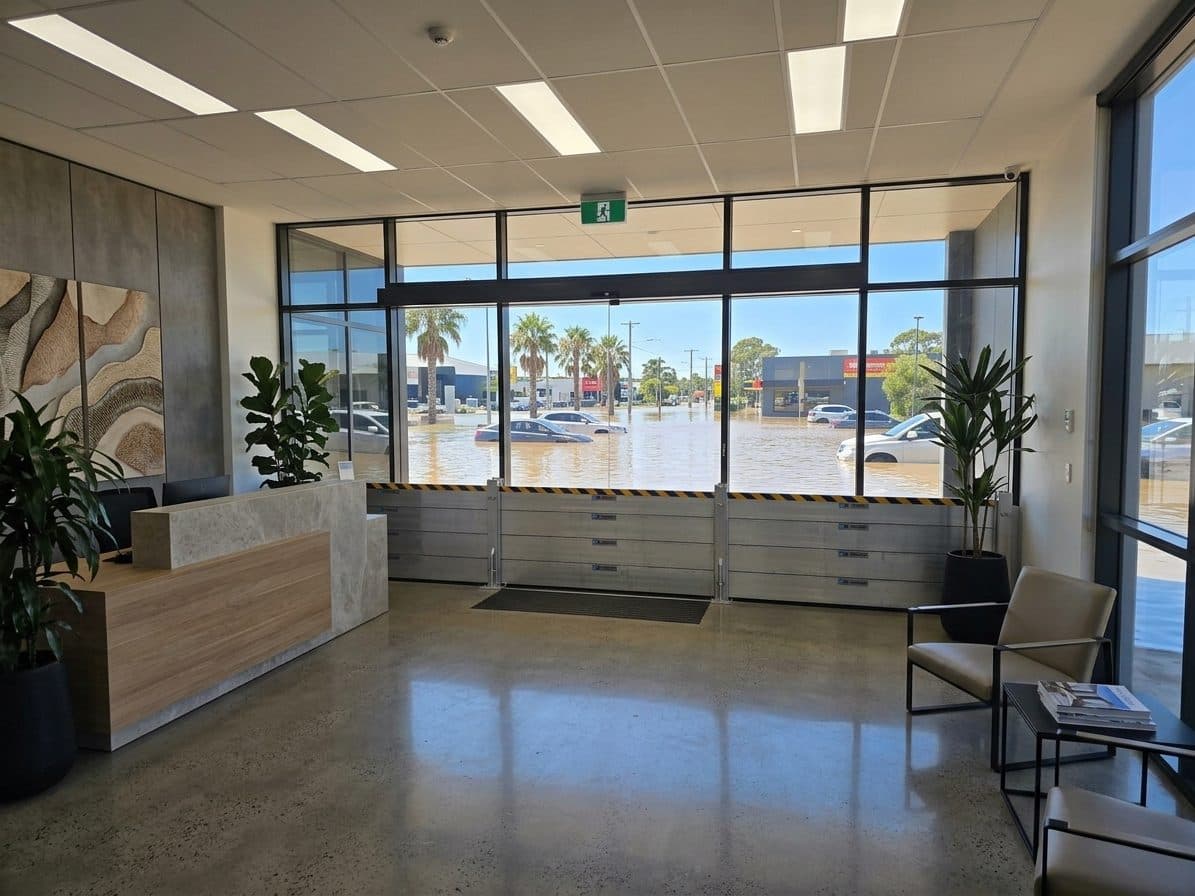
Aluminium flood barriers are precision-engineered panels made to measure for each opening — there is no standard size, the width is built to the entrance and the height is set by panel count in 200 mm steps, and every set is quoted after measurement. A rubber seal closes each set against the frame and floor. One person can deploy the full set in under 10 minutes. They suit shopfronts, wide garage openings, and commercial entries where the Oxford barrier's maximum width is insufficient.
Five-year total cost of ownership:
| Product | Upfront cost | After 5 events | After 10 events |
|---|---|---|---|
| Oxford barriers (2-pack) | $449 | $449 | $449 |
| Aluminium barriers (set) | Quoted | Quoted | Quoted |
Both are a single purchase, so the cost per event falls each time the set is deployed. The advantage of aluminium barriers, quoted per opening, is being made to measure for the opening, and commercial-grade durability across many seasons of service.
ABS portable barriers: $1,659 per 8-panel pack
ABS portable flood barriers at $1,659 per 8-panel pack are designed for wider openings that exceed what a single Oxford or aluminium set can cover. The modular ABS polymer panels configure to fit garage doors, warehouse loading bays, wide shopfronts, and commercial access points.
The modular advantage is flexibility: one 8-pack can cover a single wide entry or split across two narrower entries depending on the event. Deployment is manual and requires no tools. Like Oxford and aluminium barriers, they are fully reusable across multiple flood seasons, which spreads the $1,659 upfront cost over each deployment.
This product suits commercial operators who need adjustable coverage across a building perimeter — a loading bay on one side, a shopfront on another — from a single kit. Warehouses, retail centres, and body corporate managers for mid-rise strata buildings are the typical buyers.
Automatic flood gates: site-specific quotation
Automatic flood gates are custom-engineered systems for sites that cannot rely on someone being present to deploy a barrier. Water-level sensing triggers an electrically powered hydraulic lift when the configured activation level is reached.
Automatic flood gates are custom-engineered systems. The site assessment confirms the opening dimensions, flood conditions, water-level sensing, electrical supply, hydraulic controls and installation requirements before a supply price is provided.
The cost comparison that matters most for unattended sites: a basement carpark flood event can cost $500,000 or more in vehicle damage, structural remediation, and liability exposure. Spread over the years a gate stays in service, its quoted price is a small fraction of that each year — a straightforward calculation for any building manager or body corporate treasurer.
Automatic gates are a common choice for underground carparks, strata basement entries and critical infrastructure. Our carpark flood gate guide explains water-level sensing, hydraulic operation and the site-assessment process, and the strata flood barriers guide covers considerations for body corporates.
Where an entry has no dependable power, the Hydrodynamic Passive Flood Barrier, a self-closing mechanical flood barrier, does the same job without it: the floodwater raises the barrier, and it lowers under its own weight as the water recedes. It is made to the measured opening and quoted per opening.
What affects the cost of flood barriers in Australia?
Several factors drive cost differences across products and sites:
- Opening width — wider openings require more product: additional panels, a wider custom aluminium set, or a larger automatic gate fabrication. All barrier categories cost more as opening width increases.
- Flood depth rating — automatic gates engineered to seal against deeper water require heavier construction and higher-rated seals. Deeper ratings increase fabrication cost.
- Custom sizing — aluminium barriers are available in custom widths and heights beyond the standard range. Non-standard frames add to fabrication cost.
- Installation — only automatic gates require professional installation by a licensed contractor. An installation guide is supplied with the system. Sandbags, Oxford barriers, ABS panels, and aluminium sets are DIY-deployable.
- Shipping — sandbags, Oxford barriers, and ABS portable packs ship free Australia-wide. Freight and delivery arrangements for automatic gates are confirmed in the supply quote.
Are there government rebates for flood barriers in Australia?
There is no national rebate program for flood barriers as of 2026. The Australian Government's Resilient Homes Fund — active in Queensland's 2022 flood-affected areas — covered structural modifications to properties, not portable barriers.
Some councils in high-risk areas have offered resilience grants following major flood events. Councils in the NSW Northern Rivers region and Hawkesbury-Nepean Valley have run programs post-2022. These programs change annually and are not uniformly available across local government areas.
According to the Bureau of Meteorology's flood awareness resources, understanding your local flood risk is the first step. From there, check your local council's emergency management or resilience pages to see whether any current grant programs apply to your property. Do not rely on a grant being available before committing to flood protection — the cost of a flood event almost always exceeds the cost of the barrier.
What to buy for your budget
Most residential properties with a single doorway or garage entry are well served in the $59 to $449 range: sandbags for rapid response, Oxford barriers for recurring flooding. Commercial properties with wider entries or high flood frequency should consider aluminium or ABS. Any unattended site — an overnight carpark, a basement without a concierge, a remote pump station — needs an automatic barrier, powered or passive.
The cheapest flood barrier is always the one already in storage when the Flood Watch is issued. For a product recommendation based on your specific opening dimensions and expected flood depth, contact us for a free quote.
For a broader overview of how different barrier types are used across Australian properties, see our flood barriers buyer's guide.
Recommended next step
Match the guide to a flood barrier option.
These are the product pages and guides most relevant to this topic. Use them to compare flood barriers Australia-wide, then request a site-specific recommendation.