Article · 14 July 2026 · Updated 2 October 2026
Flood Barriers Newcastle: Suburb Guide
Newcastle homeowners face Hunter River flooding, Paterson River risk, and stormwater surge — here's which flood barriers suit each suburb type.

Aluminium demountable barriers and water-activated sandbags outperform traditional sandbags for Newcastle properties in almost every scenario — faster to deploy, better sealed, and ready before SES issues its first warning. Newcastle's flood geography is more complex than it looks: the Hunter River corridor stretches from Singleton through Maitland and into lower Hunter suburbs, but flat inner-city areas like Hamilton and Islington face a completely different stormwater problem with no advance warning at all.
Which Newcastle suburbs flood most often?
Newcastle's flood risk runs across three distinct geographic systems, each with its own flooding mechanism and warning lead time.
Hunter River corridor — Maitland, Morpeth, East Maitland, Cessnock, Hexham, Woodberry
The Hunter River corridor is the highest-risk zone. Rainfall over the Upper Hunter and Liverpool Ranges feeds the Hunter River and its tributaries, raising water levels at Maitland and Morpeth typically 24 to 48 hours after peak catchment rainfall. Major floods in 1955, 2007, and 2021 inundated Maitland repeatedly, and the low-lying suburbs of Hexham and Woodberry near the river mouth remain in the river's natural floodplain. Properties in this corridor benefit most from deployable aluminium flood barriers set up when the Bureau of Meteorology issues a Flood Watch — the warning lead time is long enough to make pre-deployment practical.
Paterson River corridor — Paterson, Dungog, Gresford
The Paterson River drains the Barrington Tops and joins the Hunter near Morpeth. Dungog and Paterson are repeatedly affected by flash flooding when intense rainfall hits the upper Paterson catchment, with less warning than the main Hunter system. The 2021 Hunter Valley floods caused severe damage to Dungog. For rural and semi-rural properties along the Paterson, ABS portable barriers covering wider entries and gates are a practical option where the flood onset is too fast for a delayed response.
Inner-city stormwater zones — Hamilton, Islington, Hamilton North, Waratah North, Adamstown
Flat inner suburbs between the city centre and the rail corridor sit at low elevation with ageing drainage infrastructure. These areas do not flood from the Hunter River — they flood when local stormwater drains reach capacity during intense rainfall events. There is no structured warning: visible ponding on roads is often the only signal, and water can be at door level within an hour. Pre-season placement of water-activated sandbags at entry points is the only reliable protection for these properties.
Lake Macquarie coastal fringe — Swansea, Belmont, Toronto, Booragul
Lake Macquarie suburbs face a combined threat: stormwater drainage backing up during heavy rain, and lake levels rising when extended rainfall and wind-driven water prevent outflow at Swansea Heads. During East Coast Low events, which bring sustained onshore winds and heavy rainfall to the NSW coast, this system can cause prolonged inundation. The Bureau of Meteorology's NSW rainfall and river conditions page carries lake level data for Lake Macquarie during flood events.
Mid North Coast exposure — Raymond Terrace, Singleton, Cessnock
Raymond Terrace at the tidal Hunter mouth faces both river and tidal backflow flooding. Singleton and Cessnock are in the upper catchment and receive earlier warning but can still be cut off from road access when Hunter River tributaries — Wollombi Brook, Wybong Creek — flood their crossings.
What flood barrier suits a Newcastle home?
Product selection for Newcastle depends on property type and which flooding mechanism applies.
Standard brick or weatherboard home, single doorway (Hunter River or stormwater zone)
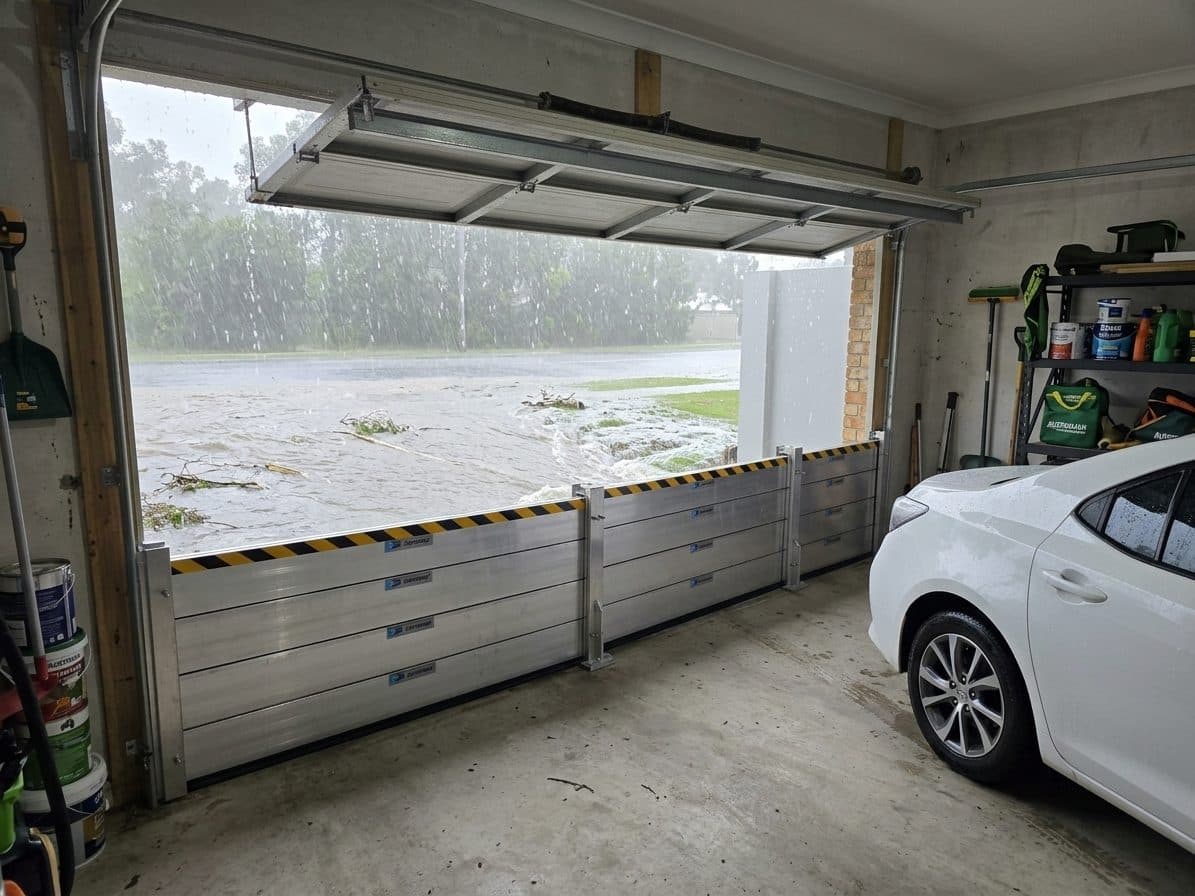
Aluminium flood barriers are the best fit for a fixed doorway, made to measure for whatever the opening happens to be. Marine-grade aluminium panels with a rubber base seal compress tightly against concrete paths and brick thresholds common in Newcastle's suburban housing stock. Deployment takes one person less than 10 minutes, and the set is reused season after season — the same set handles both the short-notice stormwater event and the pre-warned Hunter River flood.
For homes in stormwater-prone streets where there is no advance warning, the practical approach is to install the brackets before flood season begins and keep the panels in an accessible location. When heavy rain is forecast, the panels go up in minutes.
Garage doors and wider openings
Newcastle homes with double garages or roller doors wider than 3 metres need a modular solution. ABS portable flood barrier panels (ABS portable barriers) cover wider openings by configuring multiple 8-panel packs end-to-end. These do not require wall fixings and suit garages with a flat concrete apron for the panels to sit on.
Rental properties and stormwater-prone flats
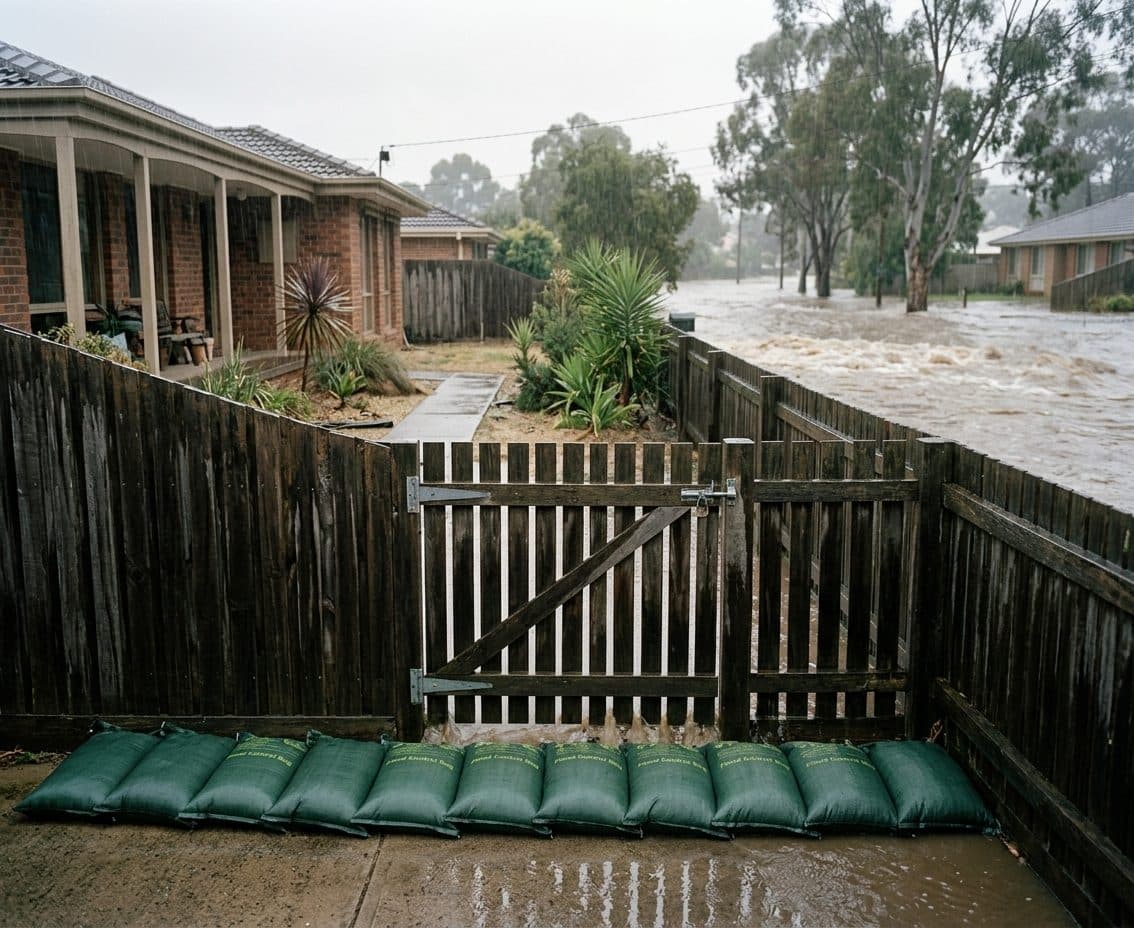
Water-activated sandbags are the first step for renters or properties where landlord approval for wall fixings is unavailable. Each bag stores flat at 270 g and swells to 18–22 kg within two to three minutes of contact with fresh water. A pack of 6 covers a standard doorway gap for low-head stormwater events. Order before the season and keep them in a cupboard — by the time a weather warning is issued in Hamilton or Islington, stormwater is already rising.
How much warning does Newcastle get before a flood?
Warning lead times vary sharply depending on which flooding mechanism applies to your property.
For Hunter River catchment events, BoM issues a Flood Watch when significant rainfall is forecast over the Upper Hunter — typically 24 to 48 hours before Maitland reaches flood level. The NSW State Emergency Service (SES) activates community alerts and publishes bulletins through ses.nsw.gov.au. Residents in Maitland, Morpeth, and Hexham should subscribe to Hazards Near Me notifications and monitor BoM's Hunter River gauge data.
For East Coast Low events affecting Lake Macquarie and the coastal strip, track forecasts typically give 24 to 48 hours of warning before the system intensifies offshore. Coastal flooding and lake-level rises develop over 12 to 24 hours once the system is established — time enough to deploy barriers if materials are on hand.
For inner-city stormwater events in Hamilton, Islington, Waratah North, and similar flat areas, there is no structured warning. The practical approach is to position protection before any forecast of heavy rain, not after.
How does an East Coast Low affect Newcastle differently from a Hunter River flood?
East Coast Lows are the most unpredictable flood driver for Newcastle and the coastal strip north and south of the city. Unlike Hunter River floods, which build from upstream rainfall over 24 to 48 hours, an East Coast Low sits offshore and delivers sustained heavy rain directly onto coastal catchments — including Lake Macquarie, Swansea Channel, and the beaches between Newcastle and Forster. Wind-driven waves compound the problem along exposed ocean frontages and push water levels up against drainage outlets, slowing runoff.
The Bureau of Meteorology tracks East Coast Lows from formation and typically issues coastal flood warnings 12 to 24 hours before the system reaches peak intensity. In July 2026, a complex low pressure system brought more than 100 mm to parts of coastal NSW, with the NSW SES responding to hundreds of incidents from the Hunter to the South Coast. The NSW SES flood preparedness guidance recommends having barriers in place before a coastal low makes landfall — once a system is offshore and intensifying, hardware stores and online orders cannot keep up with demand.
For Lake Macquarie suburbs, an East Coast Low that coincides with a spring high tide extends the risk window significantly. Water that would normally drain through Swansea Heads into the ocean backs up when ocean levels are elevated, raising the lake surface across Belmont, Toronto, Booragul, and Wangi Wangi. Aluminium demountable barriers installed at ground-level entry points before the event arrives provide the most effective protection in this scenario.
Newcastle flood barrier selector by suburb type
| Suburb type | Flooding mechanism | Recommended barrier | Key consideration |
|---|---|---|---|
| Maitland, Morpeth, Hexham | Hunter River overflow | Aluminium demountable | Deploy on Flood Watch — 24–48h lead time |
| Dungog, Paterson | Paterson River flash flood | ABS portable panels | Fast onset — pre-season set-up recommended |
| Hamilton, Islington, Waratah North | Stormwater overload | Water-activated sandbags | No advance warning — pre-position before rain |
| Swansea, Belmont, Toronto | Lake Macquarie + stormwater | Aluminium demountable | Also consider coastal backflow from east |
| Raymond Terrace | Tidal Hunter River | Aluminium demountable | Combined river + tidal timing |
| Cessnock, Singleton | Upper Hunter catchment | ABS portable or aluminium | Road access cut before doorstep flooding |
What to do if your Newcastle property is at flood risk
Pre-season preparation is more effective than last-minute deployment. The Bureau of Meteorology's Seasonal Climate Outlook for New South Wales is released monthly and gives an indication of rainfall outlier risk for the coming season — higher rainfall probability in autumn and winter typically signals elevated flood risk for the Hunter catchment.
Before flood season (May–August):
- Identify which flooding mechanism applies to your property (river, stormwater, or coastal) and get the right barrier type.
- Install anchor brackets for aluminium demountable barriers before the season begins.
- Order water-activated sandbags and store them dry until you need them.
- Sign up for Hazards Near Me alerts at the NSW SES and set your location to your suburb.
When heavy rain is forecast:
- For Hunter River properties: monitor BoM's river gauge at Maitland (gauge 210040) and deploy barriers when a Flood Watch is issued.
- For stormwater-prone suburbs: position sandbags or deploy aluminium panels when the 48-hour rainfall forecast exceeds 50 mm — do not wait for visible ponding.
- Clear leaf litter from downpipes and stormwater grates around the property to slow drain surcharge.
After a flood:
- Aluminium barriers and ABS plastic panels clean and dry for reuse. Rinse with fresh water, dry before storage.
- Water-activated sandbags that have been used deactivate slowly as they dry. Follow council guidelines for disposal — do not place activated polymer sandbags in general waste streams.
For advice on which barrier configuration suits your property layout, contact us — we supply flood barriers to residential and commercial properties across the Hunter and Mid North Coast.
Flood barrier guides for other Australian cities
- Flood barriers for Sydney homes and apartments: sloped driveways, entry doors and apartment underground car parks.
- Flood barriers in Melbourne: the Maribyrnong and Yarra risk zones, underground car parks in Docklands and Southbank, and which barrier suits each property type.
- Flood barriers in Brisbane: Brisbane River and creek flooding, Queenslander lower levels, and apartment car parks.
- Flood barriers in Adelaide: winter stormwater off the Mount Lofty Ranges and the Torrens River, and barriers for stone homes and shopfronts.
- Flood barriers in Perth: Swan and Canning River flooding, winter stormwater, and barriers for Perth homes and strata buildings.
Recommended next step
Match the guide to a flood barrier option.
These are the product pages and guides most relevant to this topic. Use them to compare flood barriers Australia-wide, then request a site-specific recommendation.