Article · 18 September 2024 · Updated 6 October 2026
Flood Barriers for Sydney Homes & Apartments
Flood barriers for Sydney homes and apartments: how to protect garages, driveways, entry doors, and underground car parks from residential flooding.

Sydney residential properties face genuine flood exposure — from the Northern Beaches to the Hawkesbury floodplain, hundreds of suburbs sit in areas where overland flow, stormwater overflow, and catchment flooding can drive water through garages, driveways, and ground-floor entries within minutes of a heavy rain event. Choosing the right flood barrier means matching the product to the specific opening type, not buying the cheapest option and hoping it fits.
How does flooding enter Sydney homes during heavy rain?
Understanding the entry paths is the starting point for any barrier plan. Sydney homes and apartments lose to flooding in a consistent set of ways:
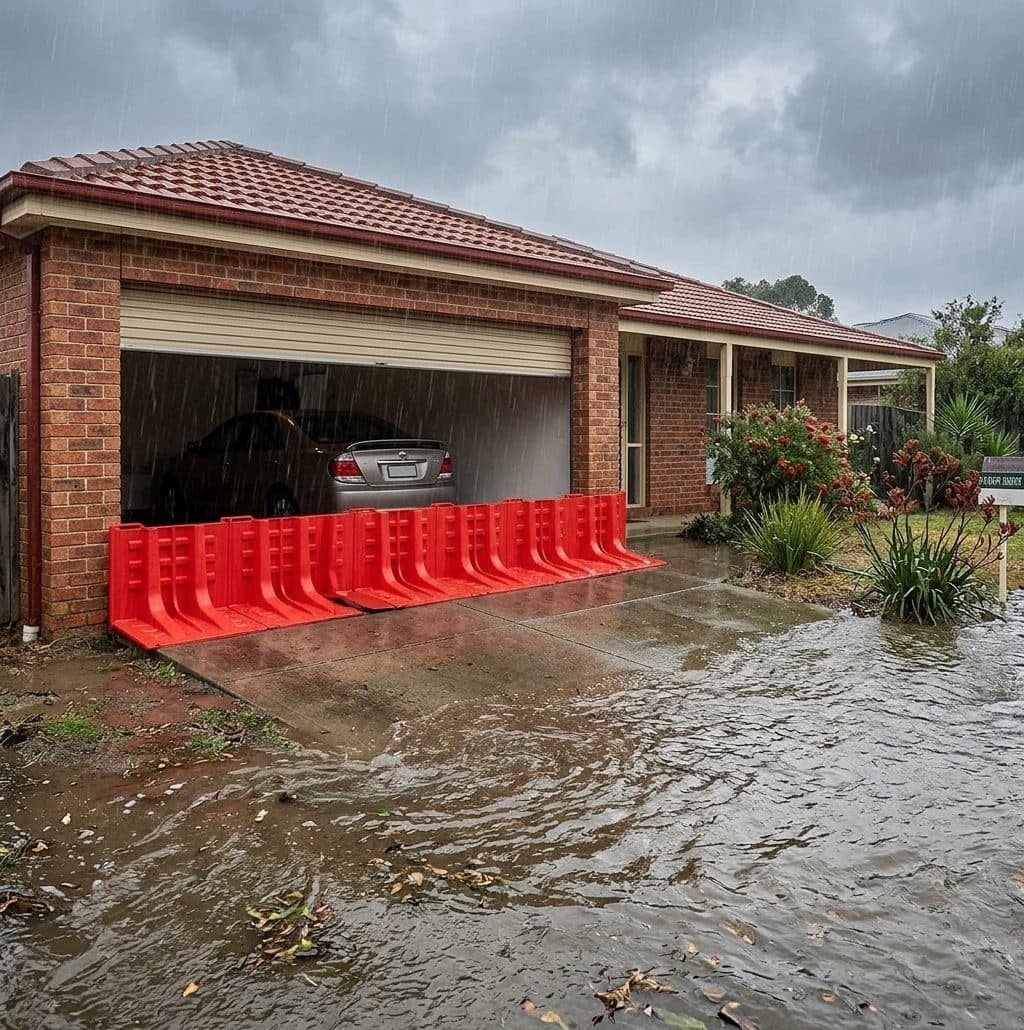
Garage doors and driveways: The garage door base seal is rarely waterproof. On a sloped driveway, surface runoff from the street concentrates at the garage entry. Even 100–150 mm of water pooling at the threshold can enter under the door seal and damage vehicles, stored goods, and the garage slab.
Front and rear entry doors: Ground-floor entry doors in older Sydney homes often sit at or near street level. Overland flow from heavy rainfall can back up against the door threshold faster than a homeowner can respond.
Side gates and passageways: These narrow, irregular openings are frequently overlooked in barrier planning but are common water entry paths. A gap beside a side fence or a passageway between buildings channels concentrated flow directly toward the house structure.
Apartment underground car parks: Multi-storey residential buildings in inner Sydney suburbs face concentrated risk at the underground ramp entry. The ramp acts as a collection point for street runoff, and once water clears the ramp lip it accelerates into the car park. The Bureau of Meteorology regularly issues flash flood warnings for inner-Sydney catchments, and the response window for a car park ramp can be 20 minutes or less.
Stormwater drain backflow: Overloaded stormwater systems can reverse flow through household drainage during extreme events. Floor drains inside garages are a common backflow entry path that barriers alone do not address — backflow prevention valves are a separate, inexpensive measure.
Which flood barrier suits a Sydney house with a sloped driveway?
A sloped driveway concentrates surface runoff at the garage entry. The correct solution positions a barrier at the base of the slope — before water reaches the garage door — rather than across the garage door itself. This redirects flow around the property rather than damming it against the structure.
Aluminium demountable barriers are the first-choice product here. Made to measure and quoted per opening, they are built to the width you measure and deploy in under 10 minutes by sliding the panels between side posts fixed permanently either side of the opening. The marine-grade aluminium construction does not corrode after repeated wet events, and the same set is redeployed every season, which makes them a long-term investment rather than a recurring cost.
For homeowners who want a lighter, lower-cost option, Oxford barriers start from $449 for a 2-pack. Their telescopic design adjusts from 15 to 130 cm wide, making them adaptable across different driveway profiles. They are freestanding, which means no structural modification to the property.
After the main barrier is positioned, run a row of water-activated sandbags along the garage threshold as a secondary seal. Each sandbag is a 270 g flat pack that swells to 18–22 kg on contact with water in 2–3 minutes, conforming to the irregular profile of the garage door seal where a rigid barrier cannot fully close.
How do you protect a front or rear entry door from flooding?
Standard residential entry doors open inward or outward into the flood flow, which means any barrier must anchor against the door frame or threshold rather than relying on the door itself.
A single-panel aluminium demountable barrier sealed against the door frame is the standard solution for a single entry door, made to the measured opening. It stores flat behind the door or in a cupboard, deploys in under 5 minutes, and the rubber seal at the base and sides compresses against the frame under water pressure for a reliable seal.
For sliding doors and wider rear patio openings, ABS portable flood barriers provide modular coverage. The L-shaped design increases in stability as water pressure rises — the barrier locks itself more firmly in place as the flood deepens. Each 8-panel pack covers extended openings and stores compactly between uses.
What is the right flood barrier for an apartment underground car park?
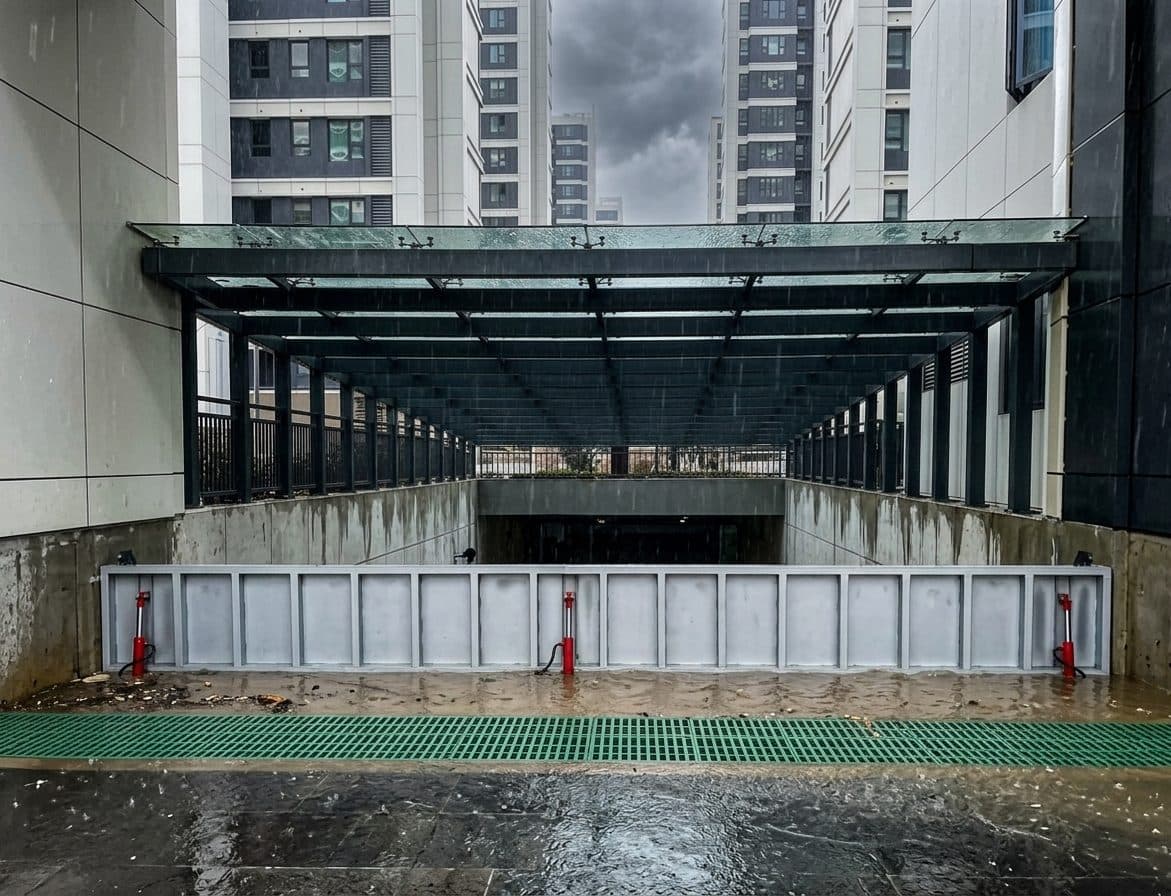
Underground car park ramps present a specific challenge: the ramp entrance is the lowest point on the property boundary, it is often unattended, and once water clears the top of the ramp it flows rapidly downhill into the entire car park level.
Automatic flood gates can be assessed for unattended ramp entries. Water-level sensing triggers an electrically powered hydraulic system to raise the barrier at its configured level, and remote or central controls lower and reset it. Pricing is site-specific and follows an assessment of the opening, flood conditions, electrical supply and controls.
Where the ramp has no dependable power supply, a self-closing passive flood barrier is raised by the floodwater itself and lowers under its own weight as the water recedes. Vehicles drive over it as normal when it is lowered, and it is made to the measured opening and quoted per opening.
For buildings that cannot justify an automatic gate at every entry, building managers can deploy ABS portable flood barriers at pedestrian entries and lobby doors. The modular system requires no permanent installation, which simplifies both building management and strata approval processes.
How do side gates and irregular openings get flood protection?
Side gates and passageways are narrow and rarely have a standard-profile threshold. Rigid panels that work well for a door frame are often impractical for a 500 mm gap between a fence and a wall.
Water-activated sandbags are the most practical option for these openings. At $59 for a pack of 6, they are inexpensive enough to keep a supply on hand for secondary sealing and irregular gaps. Stacked two or three high, they provide up to 60 cm of protection across any profile. The sodium polyacrylate core absorbs water rapidly and the bags hold their weight and shape for the duration of a flood event.
For side gate openings with a defined threshold — a standard gate frame, for example — an Oxford barrier at the telescopic minimum height provides a more rigid solution. The freestanding design suits these applications where drilling into fence posts or walls is undesirable.
What should Sydney homeowners check before the storm season?
Preparation before a warning is issued is what separates effective flood protection from a scramble. A practical pre-season checklist for Sydney residential properties:
- Walk the property boundary and identify every point where water can enter at ground level or below — garage doors, entry doors, side gates, window wells, floor drains
- Measure each opening with a tape measure and note the threshold profile (flat, bevelled, or irregular)
- Match a barrier product to each opening based on width and threshold type
- Store barriers at or adjacent to the opening they protect — not in a shed on the other side of the property
- Run a dry deployment at least once before the wet season to confirm fit and familiarise everyone in the household
- Check the NSW SES Get Ready NSW resources for suburb-specific flood risk and warning sign-up
The NSW SES flood warning system sends alerts by suburb and council area. Registering for alerts extends your response window from minutes to hours in many cases.
How do aluminium flood barriers compare with sandbag alternatives for residential use?
| Product | Best for | Deploy time | Reuse | Starting cost |
|---|---|---|---|---|
| Water-activated sandbags | Gaps, irregular edges, secondary sealing | 2–3 min per bag | Up to 5× | $59 / pack of 6 |
| Oxford barriers | Door openings, freestanding use | Under 5 min | Long-term | From $449 / 2-pack |
| ABS portable barriers | Garages, patios, wider openings | 10–15 min | Multiple seasons | By pack |
| Aluminium demountable barriers | Driveways, entries, long-term repeated use | Under 10 min | Reused every season | Quoted per opening |
| Automatic flood gates | Unattended ramp entries, car parks | Water-level sensing | Site-specific | Site assessment required |
For most Sydney households, the practical combination is an Oxford barrier or aluminium set for the main entry, water-activated sandbags for secondary sealing and irregular gaps, and an automatic gate for any unattended car park ramp. The automatic gate is a strata or investment-property decision; the remaining products suit individual homeowners directly.
What do insurers expect from flood protection on Sydney residential properties?
Property insurance for flood-prone Sydney suburbs increasingly distinguishes between properties with documented flood mitigation measures and those without. While no insurer mandates a specific product, having engineered barriers installed or on hand — rather than relying on improvised sandbag arrangements — signals active risk management.
Some policies include clauses around reasonable precautions before a known weather event. Owning the right barriers and knowing how to deploy them before a BOM severe weather warning is the practical standard. Storing barriers on site and running pre-season deployment drills supports any future insurance claim by demonstrating that mitigation was available and practised.
Common questions
Which flood barrier suits a Sydney house with a sloped driveway?
An aluminium demountable barrier across the garage opening, slotted between side posts fixed either side, is the standard approach. Water-activated sandbags provide the secondary seal at the garage threshold. Oxford barriers are a lighter-weight alternative for smaller openings.
Do automatic flood gates need power or sensors?
Automatic flood gates require water-level sensing, electrical controls and a hydraulic pump. They are not passive hydrostatic systems.
Are residential flood barriers reusable?
Yes. Aluminium, ABS, and Oxford barriers are all reusable across multiple events. Water-activated sandbags can be dried out and used again; how many times depends on how they are used. Inspect seals after each use and replace rubber seals on aluminium barriers when worn.
What is the best barrier for a ground-floor apartment entry?
A single-panel aluminium demountable barrier or an Oxford barrier suits standard door openings. Wider lobby entries use multiple panels or an ABS modular system.
Our team provides consultation for Sydney homeowners and strata managers. Get in touch with your address and a photo of the opening — we provide product recommendations within 1 business day, with free shipping across Australia on all orders.
Flood barrier guides for other Australian cities
- Flood barriers in Melbourne: the Maribyrnong and Yarra risk zones, underground car parks in Docklands and Southbank, and which barrier suits each property type.
- Flood barriers in Brisbane: Brisbane River and creek flooding, Queenslander lower levels, and apartment car parks.
- Flood barriers in Adelaide: winter stormwater off the Mount Lofty Ranges and the Torrens River, and barriers for stone homes and shopfronts.
- Flood barriers in Perth: Swan and Canning River flooding, winter stormwater, and barriers for Perth homes and strata buildings.
- Flood barriers in Newcastle: Hunter and Paterson River flooding, East Coast Lows, and a barrier selector by suburb type.
Recommended next step
Match the guide to a flood barrier option.
These are the product pages and guides most relevant to this topic. Use them to compare flood barriers Australia-wide, then request a site-specific recommendation.