Article · 2 July 2026
Flood Barriers Perth: Suburb Guide
Perth homeowners face winter flooding from the Swan River, Canning River, and local stormwater — here's which flood barriers suit each suburb type.

Perth homeowners deal with a different kind of flood risk to the rest of Australia — no cyclones, no summer storms, just five months of intense winter rain landing on ageing stormwater infrastructure that was never designed to handle it. The right flood barrier, stored and ready before the wet season peaks in June and July, is the difference between a dry home and a costly repair bill. This guide covers which Perth suburbs are most exposed, what flood type each faces, and which products give you the best protection.
Which Perth suburbs flood most often?
Perth's flood risk falls into four distinct geographic corridors, each driven by a different mechanism.
Swan and Avon River corridor — Guildford, Midland, Bassendean, Bayswater, and East Perth experience bank overflow flooding when heavy Wheatbelt catchment rainfall pushes the Avon River into flood stage. These events develop over 12 to 36 hours, which gives riverside residents meaningful time to deploy barriers properly before water arrives at the property boundary.
Canning River catchment — Cannington, Bentley, East Cannington, Wilson, and South Perth face stormwater-driven flash flooding as well as river overflow during prolonged winter rain. The Canning catchment responds faster than the Swan system, with suburban streets inundating within one to two hours of heavy local rainfall.
Inner-ring stormwater overload — Subiaco, Leederville, Claremont, Mount Hawthorn, and Victoria Park sit on stormwater infrastructure built in the 1950s and 1960s. During intense frontal rain, these drains reach capacity within 30 to 90 minutes. There is virtually no structured warning before water begins entering ground-level properties — visible surface runoff in the street is often the only signal that flooding is imminent.
Southern and northern corridors — Baldivis and Kwinana sit on clay-heavy soils with a shallow water table that prevents stormwater from absorbing at the rate it falls, causing ponding across properties within minutes of sustained rain. Joondalup, Wanneroo, and the Ellenbrook corridor sit above the Gnangara Mound aquifer system, where the water table rises significantly during wet winters, creating basement and sub-floor ingress risks distinct from stormwater flooding.
The DFES WA Flood Portal and your local council's flood hazard overlay are the authoritative references for your specific property. The suburb categories above describe typical patterns — a low-lying block in Subiaco can flood as severely as Bassendean, and vice versa.
What type of flooding should you prepare for in Perth?
Perth experiences four flood mechanisms, and the barriers that suit each type differ. Identifying which mechanism applies to your property is the first step.
Winter stormwater flooding is the most common. Frontal rain systems tracking in from the Indian Ocean deposit 20 to 60 mm over a few hours — far more than Perth's metropolitan drains were designed to handle when they were built. Onset can be under an hour from the start of heavy rain to water entering low-lying properties in inner suburbs. Rapid-deploy barriers — particularly water-activated sandbags — are the only realistic option when warning time is this short.
Swan and Avon River flooding develops over 12 to 36 hours from heavy rainfall in the Darling Range and Wheatbelt. According to the Bureau of Meteorology's WA river flood forecasting service, a Flood Watch for the Swan River system is typically issued up to 36 hours before peak levels at Guildford and Midland. This lead time is sufficient to deploy demountable aluminium barriers and move vehicles to higher ground before conditions deteriorate.
Coastal storm surge is infrequent but relevant for East Perth and South Perth properties close to the Swan River estuary. Indian Ocean storm systems can push water several hundred metres inland via the estuary, compounding any concurrent stormwater event.
Groundwater rise in the northern suburbs of Joondalup, Wanneroo, and Ellenbrook is a distinct problem requiring waterproofing or sump systems rather than perimeter barriers. The Gnangara Mound recharges during wet winters and the water table can rise to within one metre of the surface in low-lying blocks, causing underfloor and basement ingress that doorway barriers alone cannot prevent.
What flood barriers suit a Perth home?
Construction type varies markedly across Perth's metropolitan area by decade and location, and the most effective barrier depends on what your entry points look like.
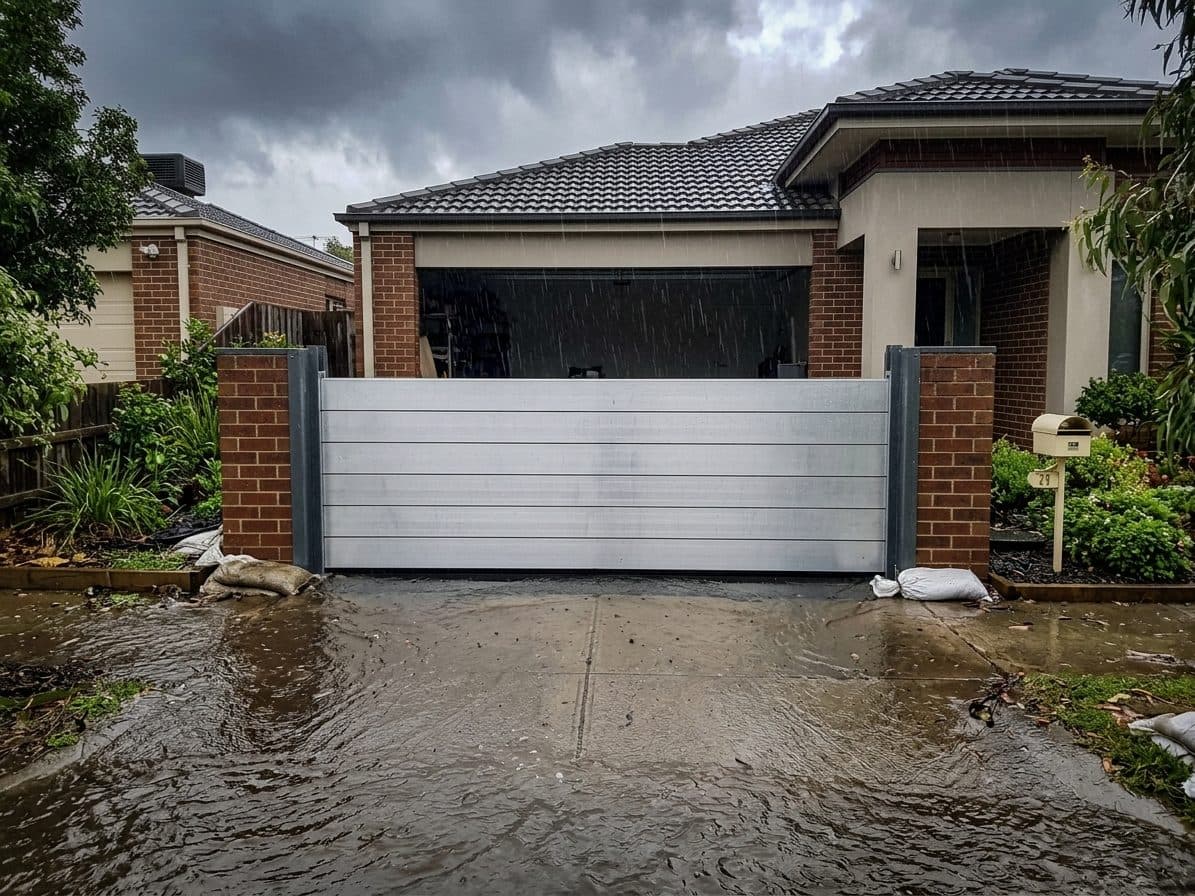
Double-brick homes dominate the inner ring from Subiaco and Claremont through to Bayswater and Bassendean. The solid brick sill is ideal for barrier sealing. Aluminium flood barriers, made to measure for the opening, use a rubber base seal that compresses firmly against the brick sill. The width is built to the doorway and the height is set by panel count in 200 mm steps. One person can deploy the full set in under 10 minutes using the quick-release anchor system, and the same set is redeployed every wet season, so the cost per deployment falls well below disposable alternatives.
California bungalows and Federation-era homes in Subiaco, Cottesloe, Fremantle, and Claremont often have timber sills and uneven thresholds that rigid barriers struggle to seal against. Oxford barriers from $449 per 2-pack are better suited here — the telescopic width adjusts from 150 mm to 1,300 mm, and the PVC-coated Oxford cloth uses water pressure to press the base down against the surface, forming a seal at the base; on uneven timber, expect minor seepage. At 5.3 kg per pair, they can be positioned quickly when rain is forecast.
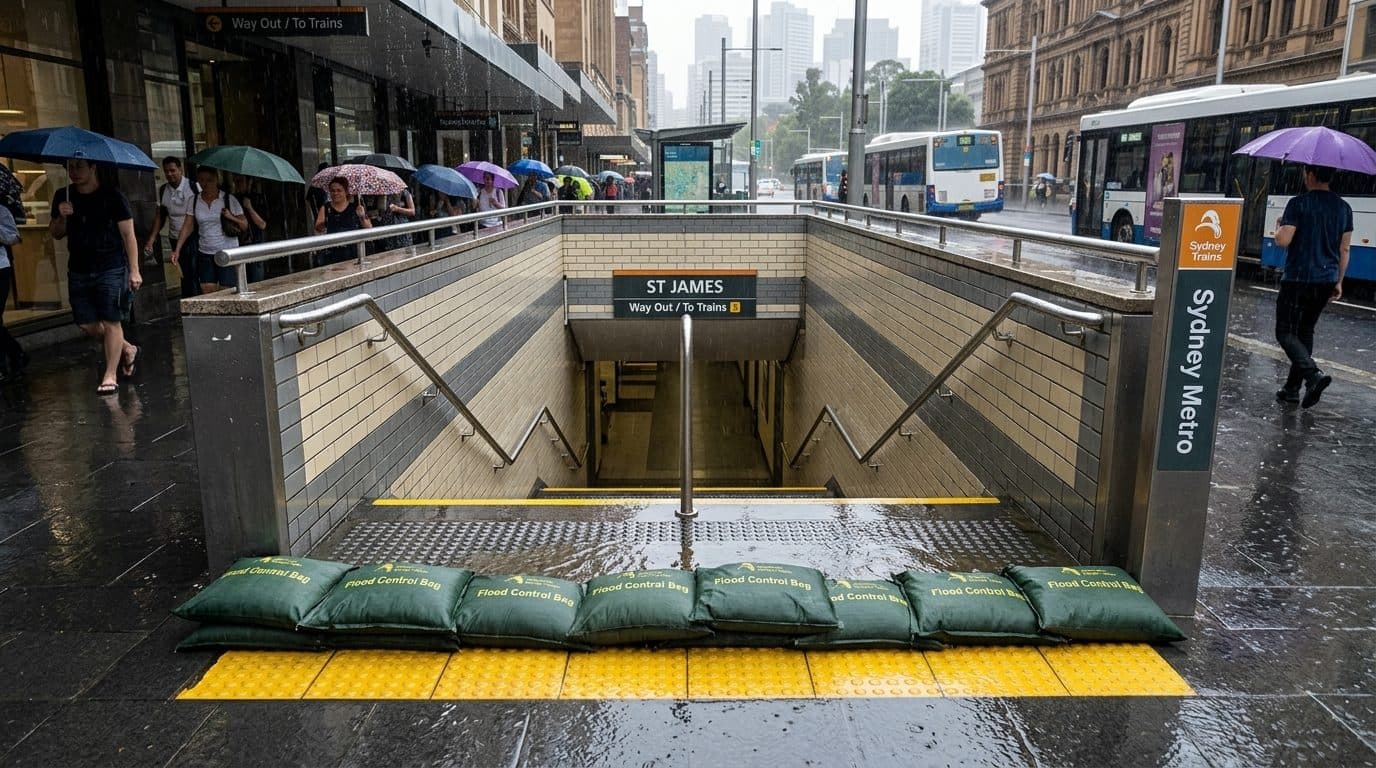
Modern slab-on-ground homes in Baldivis, Ellenbrook, and Canning Vale typically have minimal clearance between the floor level and the driveway — sometimes as little as 100 to 150 mm. Water-activated sandbags at $59 per pack of 6 are the fastest first-line option for shallow entries: each bag stores flat at 270 g and swells to 18–22 kg within 2 to 3 minutes of contact with fresh water, conforming to door frames and thresholds where rigid panels may leave gaps.
Garages are a consistent weak point across all Perth housing types. A standard two-car lock-up garage door spans 4 to 5 metres and has no effective seal against water entry at the base. ABS portable flood barriers at $1,659 per 8-panel pack cover most standard garage openings and deploy without tools or permanent fixings, making them straightforward to store and deploy as needed.
Do Perth apartments and strata buildings face flood risk?
East Perth, Northbridge, and the Perth CBD contain a high proportion of mid-rise and high-rise buildings with semi-basement or underground carparks. The carpark ramp is the primary vulnerability — water at street level runs directly down into parking decks during a stormwater overload event and can cause widespread damage to vehicles and building infrastructure within minutes.
For strata committees managing at-risk carparks, automatic flood barrier systems can provide a long-term, site-specific solution. Water-level sensing triggers an electrically powered hydraulic lift at the configured level, while remote or central controls lower and reset the barrier. Contact us for a site assessment and quote.
Fremantle's waterfront commercial precinct faces a compounding risk from tidal surge and winter stormwater that can coincide during a deep Indian Ocean low. Ground-floor commercial premises on South Terrace and the waterfront strip should use barriers rated to at least 600 mm depth, with particular attention to threshold gaps below roller doors.
How much warning will you get before Perth flooding?
Warning time depends entirely on which flood mechanism is active at your location.
Swan and Avon River events offer the most lead time — up to 36 hours from a BoM Flood Watch through to peak water levels at Bassendean and Guildford. Watch the Avon River gauge readings at Toodyay when heavy rainfall is forecast in the Wheatbelt. A sharp rise there typically means the Swan River at Perth will peak one to two days later, giving you ample time to deploy aluminium barriers and move vehicles before conditions deteriorate.
Stormwater events offer almost no warning. In Subiaco, Leederville, and Claremont, 15 mm of rain in 30 minutes is enough to overwhelm local drains. By the time water appears at a doorstep, the window for barrier deployment can be measured in minutes rather than hours. The only reliable mitigation for inner-ring suburbs is to pre-deploy barriers when heavy rain is forecast, not once flooding begins. Water-activated sandbags stored directly beside entry points are the fastest option in this scenario.
Subscribe to WA SES alerts via the Emergency WA app or ses.wa.gov.au and monitor BoM Perth radar throughout any frontal event. Winter frontal systems can produce two or three distinct rain bands with brief lulls between — the second band can arrive before drains have cleared from the first.
What flood barriers ship free to Perth and WA?
All products ship free to every WA address — metropolitan Perth, regional centres, and remote properties. Estimated delivery to Perth metro runs two to five business days for in-stock items.
- Water-activated sandbags from $59 per pack of 6 — best for stormwater events with short warning time; reusable
- Oxford barriers from $449 per 2-pack — adjustable width, reusable, suits residential and commercial entries without tools
- Aluminium flood barriers, made to measure and quoted per opening — long-term protection for double-brick doorways and standard garages, reused every season
- ABS portable flood barriers from $1,659 per 8-panel pack — suited to garage doors, loading docks, and wider commercial openings
For strata bodies, body corporates, and commercial sites requiring a site assessment or information on automatic flood gate systems for carpark ramps, contact us.
What to do when a Perth flood warning is issued
When WA SES issues a Flood Watch or Flood Warning for your local government area, act before water reaches the property rather than once it arrives.
Deploy barriers at all ground-level entries first — doorways, garage doors, and any low-lying ventilation or drainage openings that could allow water entry. Wet conditions make barrier installation harder and slower than a dry run, so practise the deployment procedure at least once before the peak of the wet season in June and July.
Move vehicles to a multi-storey car park or elevated location if a Swan or Canning River event is forecast to exceed normal river levels by more than 600 mm. Waiting until the forecast upgrades from a Watch to a Warning typically leaves too little time to move vehicles safely.
Turn off power to subfloor-level circuits and switchboards located near the ground before water is expected to rise — particularly relevant in older inner Perth homes where fusebox or distribution boards may be positioned low.
Keep at least one pack of 6 water-activated sandbags in reserve to fill gaps at entries that primary barriers may not seal completely: door reveals, threshold lips, and drainage channel inlets are common secondary ingress points.
Perth's flood season peaks between June and July each year. Ordering barriers now — before any specific forecast — means they arrive in time, rather than in response to a warning that has already been issued.
Flood barrier guides for other Australian cities
- Flood barriers for Sydney homes and apartments: sloped driveways, entry doors and apartment underground car parks.
- Flood barriers in Melbourne: the Maribyrnong and Yarra risk zones, underground car parks in Docklands and Southbank, and which barrier suits each property type.
- Flood barriers in Brisbane: Brisbane River and creek flooding, Queenslander lower levels, and apartment car parks.
- Flood barriers in Adelaide: winter stormwater off the Mount Lofty Ranges and the Torrens River, and barriers for stone homes and shopfronts.
- Flood barriers in Newcastle: Hunter and Paterson River flooding, East Coast Lows, and a barrier selector by suburb type.
Recommended next step
Match the guide to a flood barrier option.
These are the product pages and guides most relevant to this topic. Use them to compare flood barriers Australia-wide, then request a site-specific recommendation.