Article · 25 June 2026 · Updated 6 October 2026
Flood Barriers Brisbane: Suburb Guide
Brisbane's most flood-prone suburbs need barriers that work. Compare demountable, portable and water-activated options with free delivery to QLD.
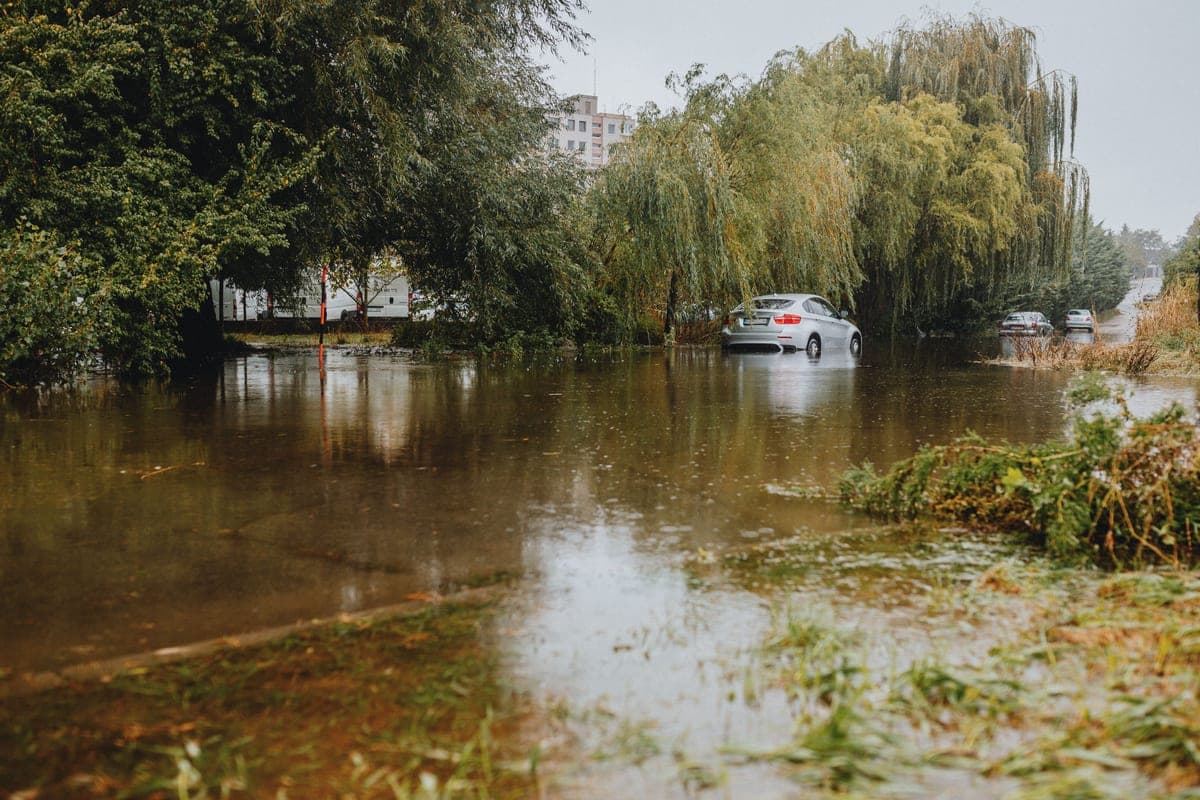
Aluminium flood barriers protect Brisbane homes and businesses more reliably than sandbags in almost every scenario: they deploy in under 10 minutes, are made to measure so the seal matches the opening, and are redeployed season after season without degrading. With 177 Brisbane suburbs affected during the February 2022 floods — and the Queensland State Emergency Service maintaining active flood risk registers across the river and creek corridors — the question for Brisbane property owners is not whether to prepare, but which barrier suits the opening, the building type, and the available warning time.
Which Brisbane suburbs flood most often?
The suburbs along the Brisbane River and Oxley Creek flood most often: Rocklea first and deepest, then Fairfield, Graceville, Chelmer, Oxley, Yeronga and Tennyson. Inner-city creek catchments and bay-side storm tide areas add two further layers of risk.
Rocklea sits at the lowest point on the Oxley Creek and Brisbane River confluence — it floods earliest and deepest in any major river event and was significantly inundated in 2011, 2017, and again in February 2022. Fairfield, Graceville, Chelmer, and Oxley share the same river-level exposure along the Oxley Creek arm. Yeronga and Tennyson face risk from the main Brisbane River channel further downstream.
The inner-city creek catchments add a separate and distinct layer of risk. Kedron Brook flooding affects Wavell Heights, Nundah, and parts of Clayfield after intense summer storms. Breakfast Creek — which flows through the inner north before joining the Brisbane River — is the primary flood driver for Newstead, Albion, and parts of Bowen Hills. Norman Creek affects inner-south suburbs including Coorparoo and Camp Hill after sustained heavy rain.
A third category is storm tide flooding, which pushes seawater up the Brisbane River during east coast low events or tropical cyclone approaches. Bay-side suburbs — Manly, Wynnum, and Tingalpa — and inner-river areas including New Farm and the CBD fringes face combined tidal and river flooding in extreme events. This category has increased in relevance as sea levels rise.
Use the Brisbane City Council's FloodWise Property Report to get flood type, likelihood, and estimated depth information for your specific address before deciding on a barrier specification. The tool is free and updated after each major event.
What type of flooding should you prepare for in Brisbane?
Brisbane experiences four distinct flood types, each requiring a different barrier response:
River flooding takes 12–48 hours to peak after catchment rainfall and gives the most preparation time. It reaches the greatest depths — 500 mm to over 1,000 mm in low-lying suburbs — but allows enough lead time to deploy full aluminium demountable barrier systems and move ground-level contents to safety.
Creek flooding follows intense localised rainfall and peaks within 2–6 hours. Kedron Brook, Norman Creek, and Bulimba Creek all respond faster than the main river channel. The warning window is tighter but still enough for portable barriers and water-activated bags at secondary entry points.
Overland flow flooding occurs within 30–90 minutes of heavy rain — faster than any early warning system can reliably predict. Stormwater runs off roads and rooftops faster than drains can handle. This is the most common flood type in Brisbane's inner suburbs and requires barriers that are ready to deploy in minutes without tools.
Storm tide combines storm surge with the incoming tidal cycle and is specific to bay-side and river-mouth areas. Barriers that seal at ground level and resist sustained hydrostatic pressure — not just splash or surface runoff — are essential for these locations.
What flood barriers suit a Queenslander-style home?
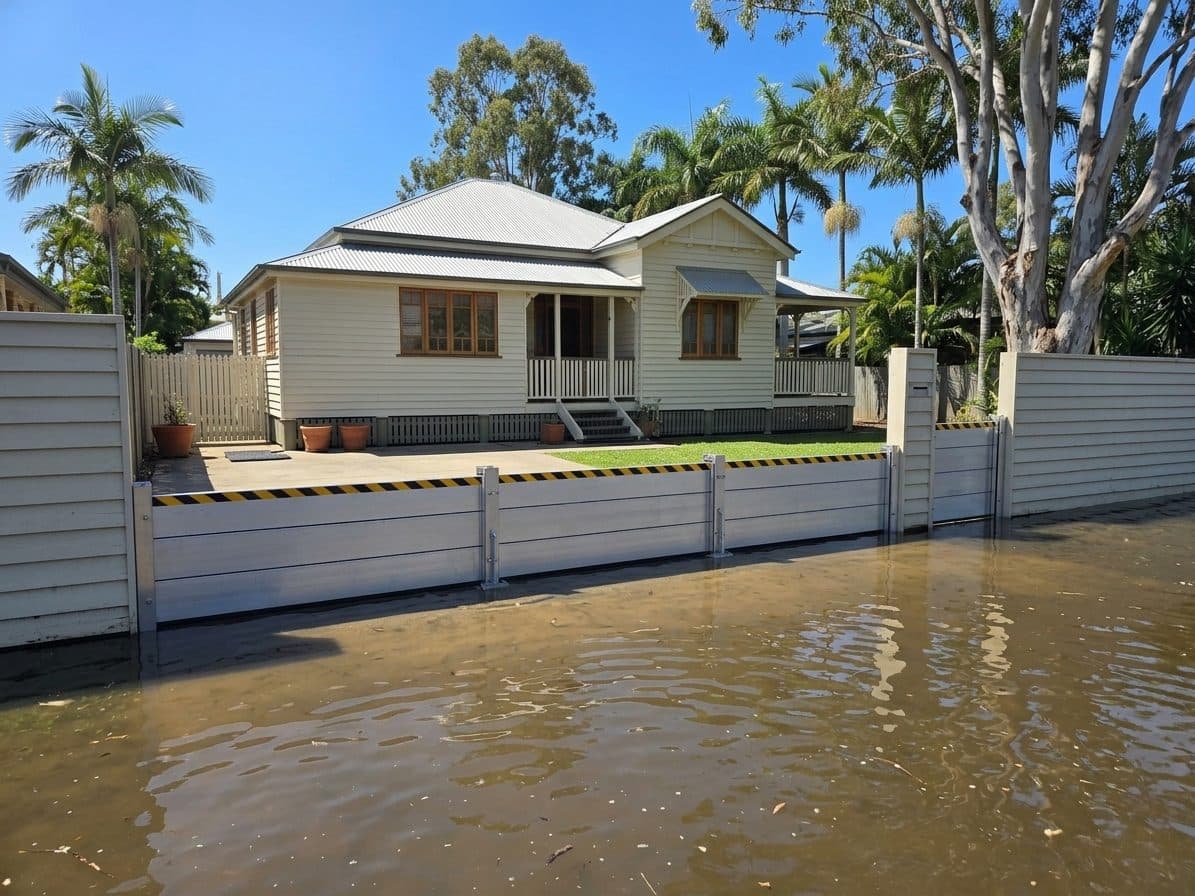
In a converted Queenslander the barrier goes on the ground-level doors of the undercroft: aluminium flood barriers for door-width openings, and ABS portable barriers or an automatic flood gate for wider garage or carport openings.
The traditional elevated Queenslander was designed with flood resilience: the ground level — originally open-air, used for storage and vehicle access — sits a full storey below the main living area. Many original Queenslanders in flood-prone suburbs such as Graceville, Chelmer, and Oxley survived the 2011 and 2022 events without floodwater reaching the main floors, exactly as they were intended to.
The complication is modern undercroft conversions. When the space beneath a Queenslander is converted into a rumpus room, guest bedroom, laundry, or media room, those spaces sit at ground level — at full flood depth, with standard door openings at the most vulnerable point. A laundry door or internal stair entry at ground level becomes the critical barrier point, and conventional building materials provide no protection.
For converted Queenslanders, aluminium flood barriers are the most effective solution for door-width openings. A single set is built to the measured opening and deploys in under 10 minutes — practical within a 24-hour Flood Watch window. The rubber base seal compresses beneath the panels under water pressure.
For larger undercroft openings — double-width garage doors or converted carport entries — ABS portable barriers or a custom automatic flood gate system suit better depending on how much advance notice you typically receive and whether the site is attended during flood events.
How do Brisbane apartments and strata complexes protect car parks?
They put a barrier on the car park ramp, which was the failure point in most of the 2022 car park damage: an automatic flood barrier can be considered where basement plant must be protected, a passive barrier where power cannot be relied on in a storm, or ABS portable barriers where staff can deploy them in time.
Most Brisbane apartments built after the 1980s include underground or semi-basement car parks, making them susceptible to subsurface flooding from stormwater and groundwater pressure before Brisbane River water even reaches the building's street level. During the 2022 Brisbane floods, dozens of apartment buildings sustained significant car park damage in suburbs that experienced only moderate surface flooding — the car park ramp was the failure point in most cases.
Body corporate managers and facilities teams have three effective options for car park entry ramps and undercroft access points:
Automatic flood barrier systems can be considered for medium and high-rise buildings where critical infrastructure — lifts, switchrooms and pumping equipment — sits in the basement. Water-level sensing triggers an electrically powered hydraulic lift; the required power, controls and approvals are confirmed through a site assessment.
Passive flood barriers, also called self-closing or self-operating flood barriers, suit ramps where power cannot be relied on in a storm. The floodwater itself raises the barrier, with no power supply and no operator, and it lowers under its own weight as the water recedes. Vehicles drive over it as normal when it is lowered.
ABS portable barriers suit strata complexes with dedicated facilities staff on call, where an attended deployment is practical within the available warning window for river flooding events. An 8-panel pack can span a standard single-lane car park ramp and deploys without tools or mechanical equipment.
Under the Body Corporate and Community Management Act 1997 (Qld), a body corporate committee can approve minor maintenance and protective work on common property without requiring a general meeting resolution. Installing removable flood barriers over an existing ramp surface typically qualifies as committee-level maintenance work — confirm with your body corporate manager or legal adviser before ordering.
How much warning will you get before Brisbane River flooding reaches your street?
For Brisbane River flooding driven by upstream catchment rainfall in the Lockyer Valley or Wivenhoe Dam spillway releases, the Bureau of Meteorology issues a Flood Watch typically 24–48 hours before forecast peak river levels. A Flood Warning narrows that window to 6–24 hours. Either window is adequate time to deploy aluminium demountable barrier systems, relocate vehicles from at-risk car parks, and move ground-level stock and contents upstairs.
For creek flooding following intense local rainfall, lead time compresses to 2–6 hours from when rain begins — not from when a warning is issued. Portable barriers and water-activated sandbags suit this shorter window: they deploy without tools in under 5 minutes per opening, require no preparation, and store flat until needed.
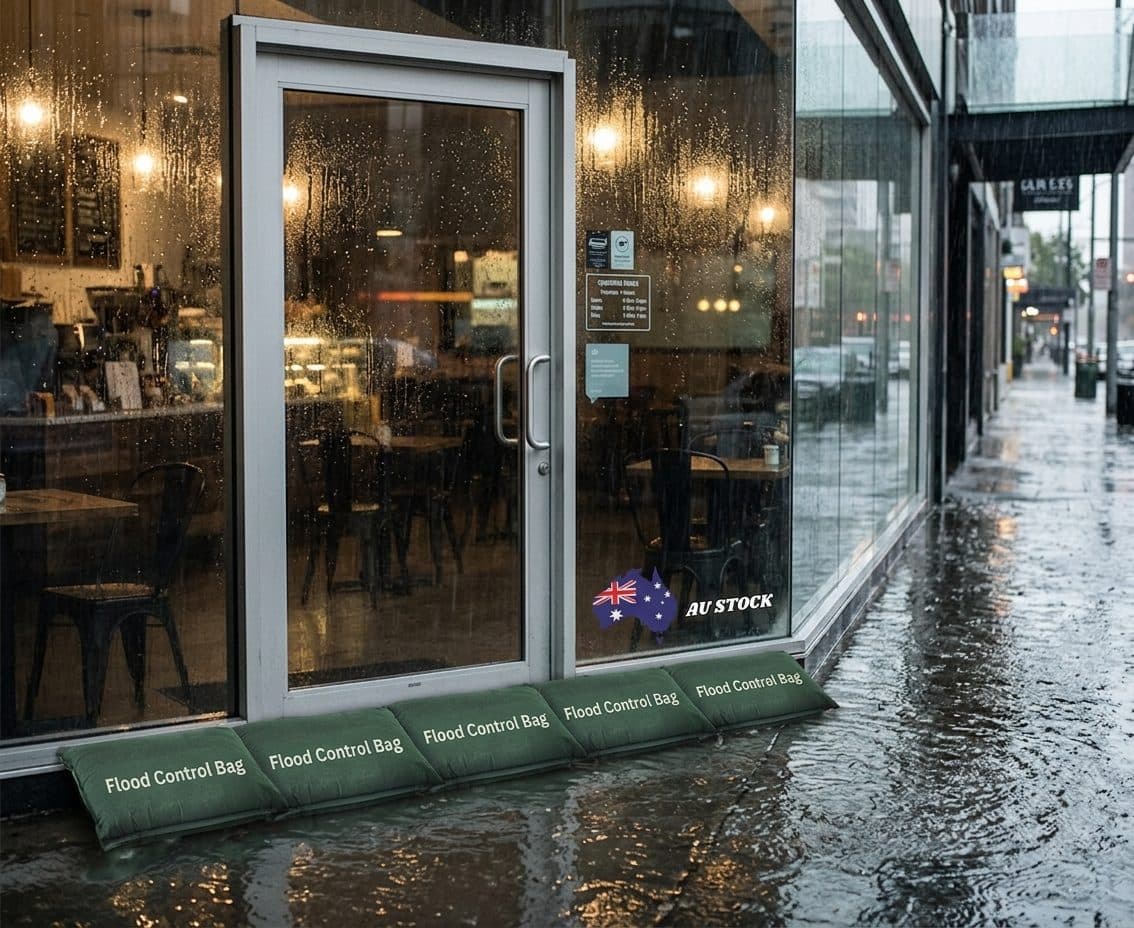
For overland flow flooding, there is almost no structured warning. The trigger is visible at street level — water pooling at the kerb faster than normal after heavy rain — not a Bureau of Meteorology bulletin. Water-activated sandbags are the only practical fast-response barrier for this scenario. Each bag activates in 2–3 minutes on contact with fresh water and swells to 18–22 kg without sand, shovels, or filling required.
According to the Bureau of Meteorology's Brisbane River Flood Warning System overview, monitoring extends from Wivenhoe Dam to Moreton Bay, with Jindalee and City gauge readings updated every 15 minutes during active flood events. Subscribe to BoM weather warnings and QLD SES alerts at disaster.qld.gov.au to maximise lead time for any flood type.
What flood barriers ship free to Brisbane and southeast Queensland?
Four products on floodcontrol.com.au ship free to all Brisbane and southeast Queensland addresses, with no minimum order:
Water-activated sandbags from $59 per pack of 6. The entry-level rapid-response barrier. Each bag activates in 2–3 minutes on contact with fresh water and swells to 18–22 kg without sand or filling equipment. Stack bags to build higher barriers around doorways, driveway edges, and low-entry points. Reusable: they can be dried out and used again.
Oxford barriers from $449 per 2-pack. A telescopic PVC-coated barrier that adjusts from 150 mm to 1,300 mm wide and protects to 900 mm water depth. Sets up without tools and folds flat for storage between events. Reusable across multiple flood seasons.
Aluminium flood barriers, made to measure and quoted per opening. Marine-grade aluminium panels made to measure for the opening, with the height built up in 200 mm steps and a rubber base seal that compresses under water pressure. One-person deployment in under 10 minutes. The standard solution for main entries, converted Queenslander lower levels, and retail shopfronts.
ABS portable barriers from $1,659 per 8-panel pack. Modular ABS polymer panels for larger openings including loading docks, car park ramps, and commercial access points. Configures to any opening width and deploys without tools.
For automatic flood barrier systems, contact us for a site-specific engineering assessment and supply quote. The assessment confirms the sensing, electrical supply, hydraulic controls and installation requirements for the opening.
What to do when a Brisbane flood warning is issued
When QLD SES or the Bureau of Meteorology issues a Flood Watch or Flood Warning for your area, act on barriers before water is visible at street level:
Deploy barriers at ground-floor and lower-level entries first. Aluminium barrier systems take under 10 minutes per opening — starting when a Flood Watch is issued gives you the best chance of sealing before water pressure makes deployment difficult. Move vehicles to high ground or above-ground car parks before the ramp becomes flooded. Turn off power to circuits serving ground-floor or basement areas before water arrives — this is the step most often skipped and the one with the most costly consequences.
Protect irreplaceable items by lifting them off the floor in any lower-level or ground-floor space. Keep water-activated sandbags on hand as a secondary measure to seal any gaps around barrier edges, floor drains, or irregular surfaces a rigid panel cannot reach.
Monitor the Bureau of Meteorology's Brisbane River gauge data and QLD SES updates at disaster.qld.gov.au throughout the event. River heights at Jindalee and the Brisbane City gauge give the most relevant readings for inner-suburban flood depth estimates.
Contact us via the contact page if you need advice on barrier selection for a specific opening size or building type. We ship free to all Queensland addresses.
Flood barrier guides for other Australian cities
- Flood barriers for Sydney homes and apartments: sloped driveways, entry doors and apartment underground car parks.
- Flood barriers in Melbourne: the Maribyrnong and Yarra risk zones, underground car parks in Docklands and Southbank, and which barrier suits each property type.
- Flood barriers in Adelaide: winter stormwater off the Mount Lofty Ranges and the Torrens River, and barriers for stone homes and shopfronts.
- Flood barriers in Perth: Swan and Canning River flooding, winter stormwater, and barriers for Perth homes and strata buildings.
- Flood barriers in Newcastle: Hunter and Paterson River flooding, East Coast Lows, and a barrier selector by suburb type.
Recommended next step
Match the guide to a flood barrier option.
These are the product pages and guides most relevant to this topic. Use them to compare flood barriers Australia-wide, then request a site-specific recommendation.