
Article · 30 June 2026
Flood Barriers for Rural Properties
Flood barriers for Australian rural properties, farms, and country towns. Portable, modular, and quick-deploying — free delivery across Australia.

Portable flood barriers outperform sandbags for most rural property applications — faster to deploy, effective across wide shed doors and homestead entries, and reusable season after season. When the Bureau of Meteorology issues a flood watch for a river catchment like the Goulburn, the Ovens, or the Fitzroy, you have a deployment window of 12 to 48 hours. That window is an advantage country property owners can use — if the right barriers are already on hand.
Why do rural and regional properties face a different flood risk to city homes?
Rural and regional properties face two distinct flood types, and both require different preparation.
River flooding — the kind affecting north-east Victoria's Goulburn, Ovens, and Mitta Mitta catchments — builds gradually as rainfall accumulates across a large upstream catchment. The Bureau of Meteorology issued a Flood Watch for these rivers in late June 2026, with minor to moderate flooding expected and isolated major flooding possible. River floods give country residents hours, sometimes more than a day, to prepare.
Overland flow flooding is different. It occurs when short-duration, high-intensity rain overwhelms stormwater drainage and water runs across the surface — this can happen with almost no warning in flat rural country.
City homes also face both types, but they tend to have smaller, more uniform entry points. A suburban doorway is typically 900 mm wide. A farm shed door is often 4 to 6 metres. A loading bay may be wider still. Rural properties also tend to have multiple vulnerable openings — homestead entries, workshop doors, storage sheds, pump sheds, and animal shelters — spread across a large site.
The other key difference is response time. If a flood reaches a city in the middle of the night, help is minutes away. On a rural property, the SES may be hours away and roads may cut before crews can arrive. Having flood barriers on site, pre-positioned and ready to deploy, is the only reliable strategy.
How much warning time does a river flood give on a country property?
River floods on Australia's major inland systems typically give the longest warning times of any natural flood type. The Murray-Darling system, which drains a fifth of the continent, can take several days to respond to catchment rain in the upper reaches. The Goulburn River, which feeds from the Victorian Alps, typically shows a 24–48 hour response lag between alpine rainfall and flood peaks downstream at Shepparton and Nagambie.
Shorter river systems respond faster. Coastal rivers in NSW and Queensland can go from normal levels to minor flood peak in 6–12 hours after heavy rain. The Manning, the Hawkesbury, and the Lockyer Valley rivers have all demonstrated this in recent years.
The Bureau of Meteorology's Australia Rainfall and River Conditions publishes river gauges for most major catchments in near real-time. Property owners in flood-prone river areas should bookmark this page and check it at the start of any significant rain event, especially those in Queensland, NSW, and Victoria.
A practical rule of thumb: if you live within 500 metres of a named river and your area has received sustained rainfall for more than 24 hours, check the BoM gauge reading for your nearest river station. Flood watches typically issue 24–48 hours before the event; flood warnings follow as the water rises.
This warning window is why pre-positioned barriers matter. You will not have time to order, receive, and deploy barriers once a flood watch is issued. The time to buy is before the season.
What flood barriers work for wide shed and barn openings?
Standard doorway-sized barriers — designed for 900 mm to 1,200 mm residential openings — cannot seal a farm shed door. A typical machinery shed door runs 3 to 6 metres wide. A double-door workshop or loading bay may be wider. For these openings, the correct solution is a modular barrier system that can be configured to any width.
ABS Portable Flood Barriers are engineered for this application. Each pack includes 8 ABS polymer panels that link together without tools. The modular design means you can configure the panel run to match almost any opening width — order two packs to cover a 6-metre shed door. The panels hold back and divert water rather than sealing watertight, so some seepage at the floor can occur.
From the product specs: ABS polymer construction, manual deployment without automated systems, free Australia-wide shipping. At $1,659 per 8-panel pack, a single pack protects most standard farm shed entries. For larger openings, two packs run continuously end-to-end.
The advantages over sandbags for wide openings:
- No sand to source, no bags to fill, no manual labour hauling weight
- Consistent height across the full opening width
- Panels reuse across multiple flood seasons — the ongoing cost is zero after the initial purchase
- Can be deployed by one person in under 30 minutes for a standard-width opening
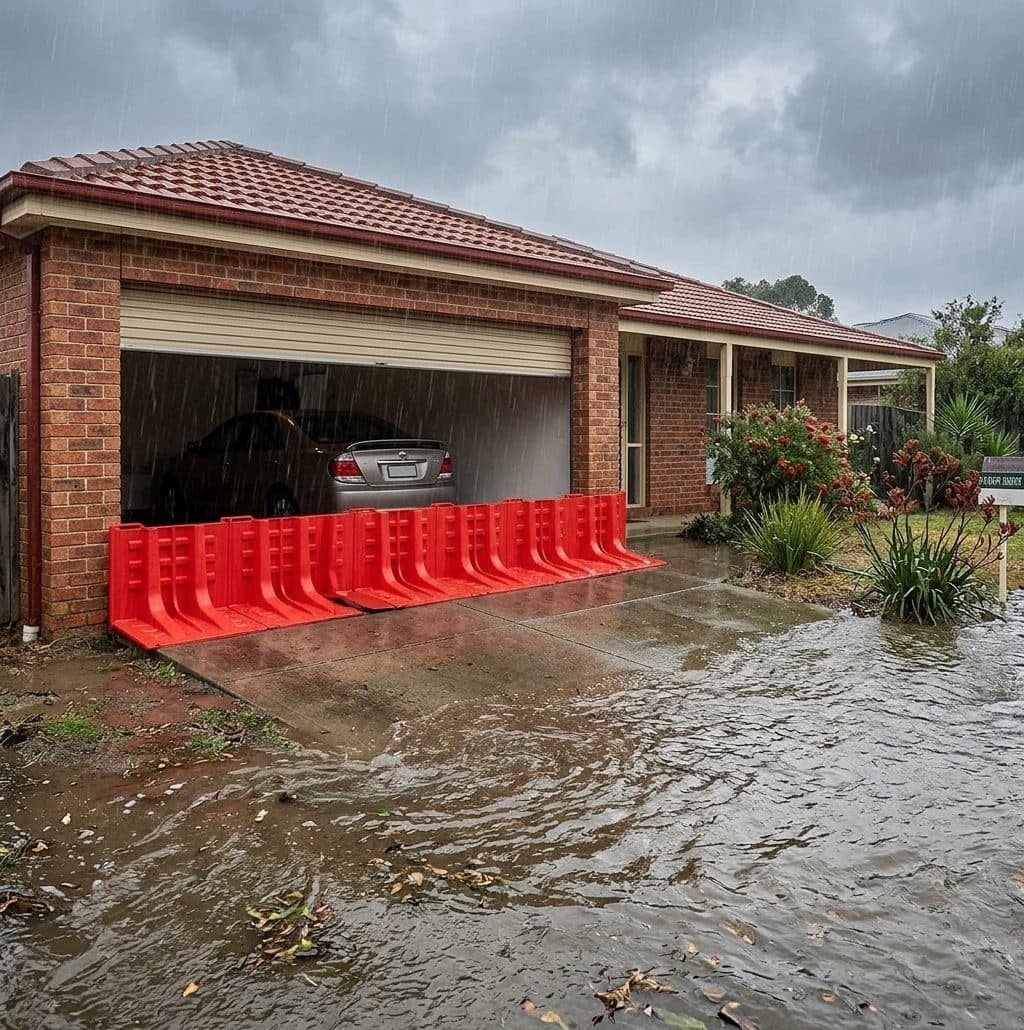
For pump sheds or smaller outbuildings, Oxford Barriers provide a telescopic alternative. The 2-pack adjusts from 15 cm to 130 cm wide per barrier, with each pair providing up to 900 mm of water-height protection. Connect multiple pairs to cover wider openings. At $449 per 2-pack with free shipping, Oxford Barriers are the practical choice for secondary outbuildings and smaller entry points.
Which flood barriers suit a farmhouse or homestead entry?
A homestead typically has three to six at-risk entry points: a front door, a back door, a sliding glass door, and potentially a laundry or garage entry. Each needs a solution, and the fastest to deploy are water-activated sandbags.
Each pack of 6 sandbags deploys in 2–3 minutes per bag — place one against the door threshold, introduce fresh water, and the sodium polyacrylate core swells to 18–22 kg within minutes. No tools, no mixing, no heavy lifting. The bags store flat at 270 g each, so a box of 12 bags (two packs of 6 at $118 total) can be stored in a kitchen cupboard and retrieved in seconds when needed.
For a standard homestead with five vulnerable entry points, a stock of 24 bags (four packs of 6, $236 total) gives you coverage for all openings with bags to spare for stacking a second layer if water rises further.
The bags are UV-protected for outdoor storage if you prefer to pre-position them in the shed or garage during flood season. They activate on contact with fresh water only — salt water significantly reduces swelling — so they are not suitable for coastal storm surge events where seawater may enter.
For homestead doorways where more durable sealing is needed across an entire season of use, aluminium demountable barriers seal against the frame at whatever height the entry is built for, and are redeployed year after year. They are best suited to a primary entry point where the ongoing risk justifies a made-to-measure set, quoted per opening.
How do you deploy flood barriers without SES assistance?
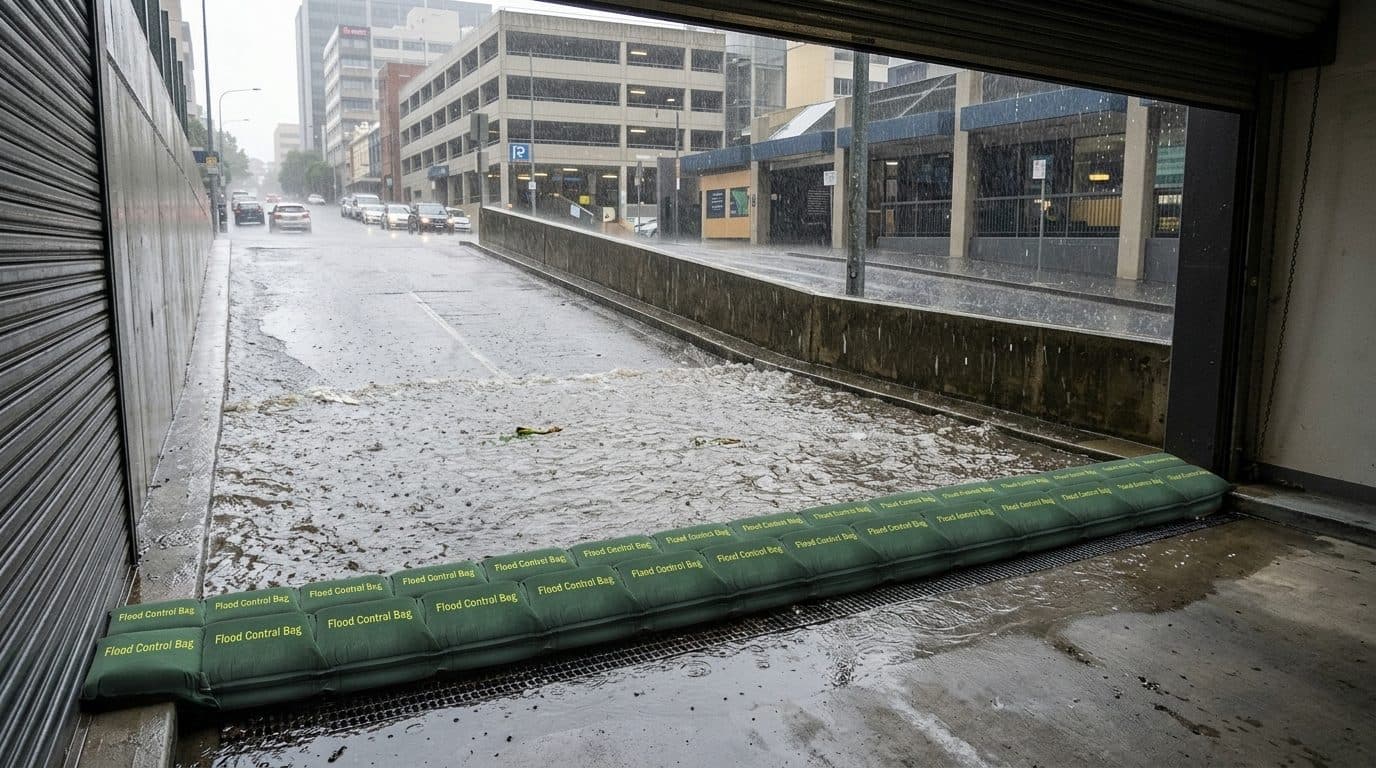
When a flood watch is issued for your area, the SES will be managing emergency calls across the entire affected region. On a rural property, waiting for SES help before deploying barriers is not a realistic plan. The correct approach is autonomous deployment, and the products in this guide are designed for exactly that.
A practical deployment sequence for a rural property:
Step 1 — Monitor BoM. Download the BoM Flood Warning Services page and your local river gauge URL before flood season begins. Set a reminder to check both at the start of any major rain event.
Step 2 — Pre-position your barriers. Store barriers in a dry shed or protected space near the entry points they will be used at. Do not store them in a location that will itself flood before you can retrieve them.
Step 3 — Assign a deployment list. Write down which barrier goes to which door, in what order. A 3 AM deployment with water already in the paddock is not the time to work out which pack goes where.
Step 4 — Deploy at Flood Watch, not Flood Warning. A Flood Watch means flooding is likely. A Flood Warning means it is imminent or already happening. Deploy while you still have a clean, stable surface to work on.
Step 5 — Check water levels every 30 minutes. If the water rises above your barrier's rated height, evacuate to higher ground. Barriers protect property, not an excuse to stay in a dangerous location.
Which rural regions of Australia flood most often?
Australia's most frequently flooded rural regions follow the continent's river systems. Understanding which catchment your property sits in tells you how much warning time to expect.
Murray-Darling Basin — the largest drainage system in Australia, covering parts of Queensland, New South Wales, Victoria, and South Australia. The Goulburn River and Murrumbidgee River corridors flood regularly. Central Victoria towns including Shepparton, Echuca, and Swan Hill have experienced major events in 2010–11 and 2022.
North-east Victoria — the Ovens River at Wangaratta, the Mitta Mitta catchment, and the upper King River all respond to alpine rain events. The region sees flood conditions three to five times in a typical decade and is one of the most consistently flood-affected rural areas in south-east Australia.
Macquarie–Castlereagh (NSW) — the Macquarie River through Dubbo and Warren, and the Castlereagh River further west, are among NSW's most flood-prone rural river systems. The 2021–22 La Niña event produced record-level flooding across this region, with road closures lasting weeks in some areas.
Fitzroy River (QLD) — Rockhampton has flooded regularly from the Fitzroy system, with the 2011 and 2022 events among the most damaging on record for rural properties and farming infrastructure in Central Queensland.
Tropical north Queensland — the monsoon season (November to April) brings widespread flooding to Gulf Country, the Burdekin, and Herbert River systems. Properties in these catchments face annual inundation risk during wet seasons.
What should rural property owners do before flood season?
The lead time before a flood is not the time to source materials. In a flood event, stock of portable barriers sells out quickly in regional towns, and delivery timelines from online suppliers extend due to carrier demand. The time to build flood resilience is the dry months before the wet season.
A practical pre-season checklist for rural properties:
- Audit your vulnerable openings — walk the property and list every doorway, shed entry, and low-lying access point that water could reach during a flood.
- Stock barriers before the season — buy sufficient panels or bags to cover your identified openings, with a 20% buffer for unexpected entry points.
- Store dry and accessible — keep barriers in a location that will not be cut off by early-arriving water.
- Register with your local SES unit — they maintain lists of vulnerable properties and can contact you when a flood watch is issued for your area.
- Review your insurance — confirm whether your home and contents policy covers river flood damage. Many standard policies distinguish between flood and storm, and exclusions vary significantly between providers.
Rural properties that take these steps before the season are significantly better positioned to limit structural damage and avoid the disruption of post-flood repairs, which in regional areas can take months due to limited tradesperson availability.
Contact us for advice on the right barrier configuration for your property size and opening widths.
Recommended next step
Match the guide to a flood barrier option.
These are the product pages and guides most relevant to this topic. Use them to compare flood barriers Australia-wide, then request a site-specific recommendation.