Article · 13 August 2026 · Updated 6 October 2026
How to Flood Proof a House in Australia
Flood proof your Australian home with the right barriers, sandbags, or gates. Compare products, costs, and steps to protect doorways and garages.
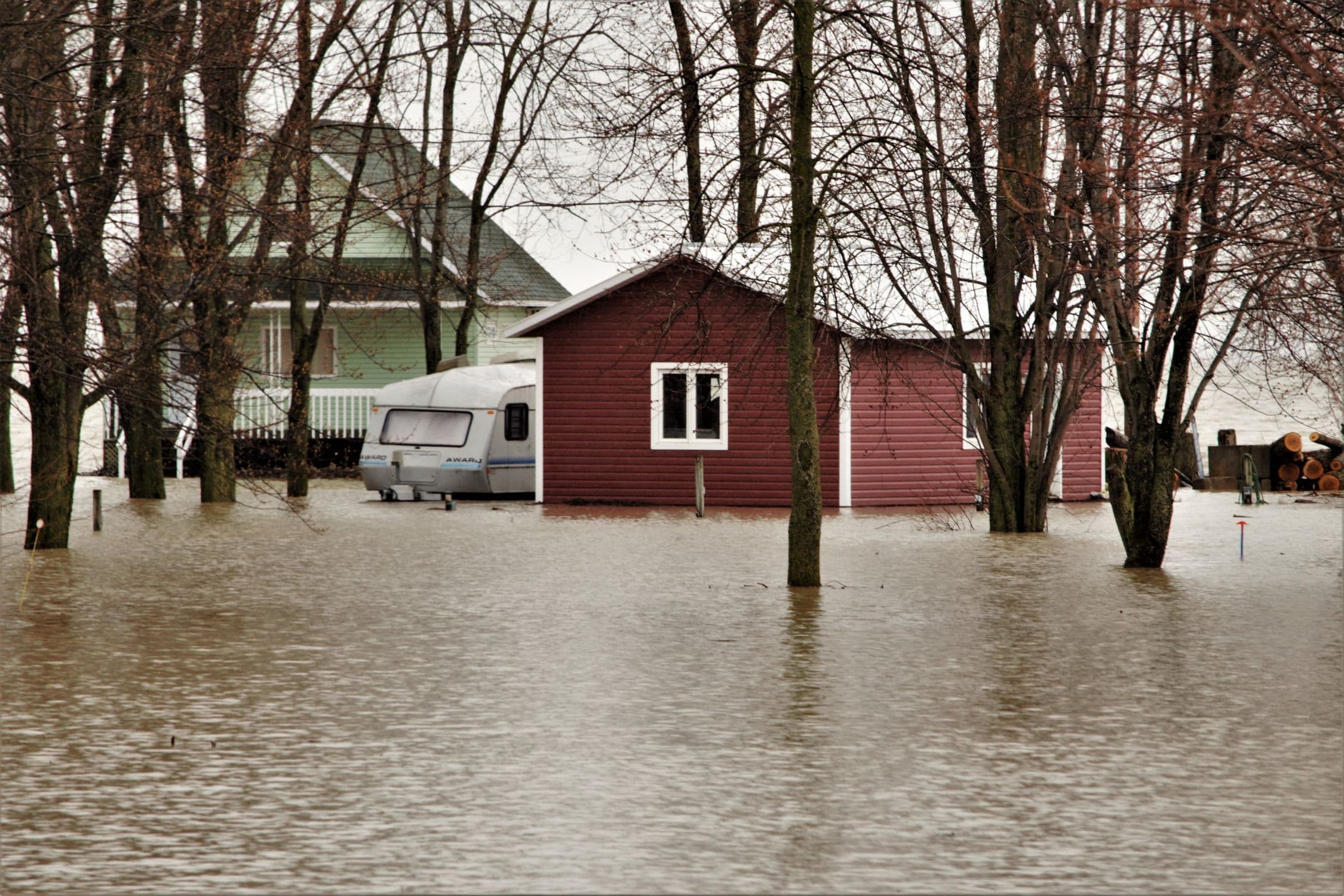
Flood-proofing a house means placing physical barriers between rising water and your interior spaces before the flood reaches your door. The most effective approach is product-based — deployable barriers rated to specific flood depths, positioned at every entry point before water arrives, not sandbags sourced from a hardware store the morning a warning goes out. When the Bureau of Meteorology issued severe weather alerts across Queensland, New South Wales, Victoria, South Australia, and Tasmania in mid-August 2026, the households that came through without interior damage were those with barriers already on the shelf. This guide covers the products that actually work for Australian homes, which entry points they protect, what the realistic costs are by property type, and the actions to take once a flood watch or warning is in effect for your area.
Why do Australian homes face growing flood risk?
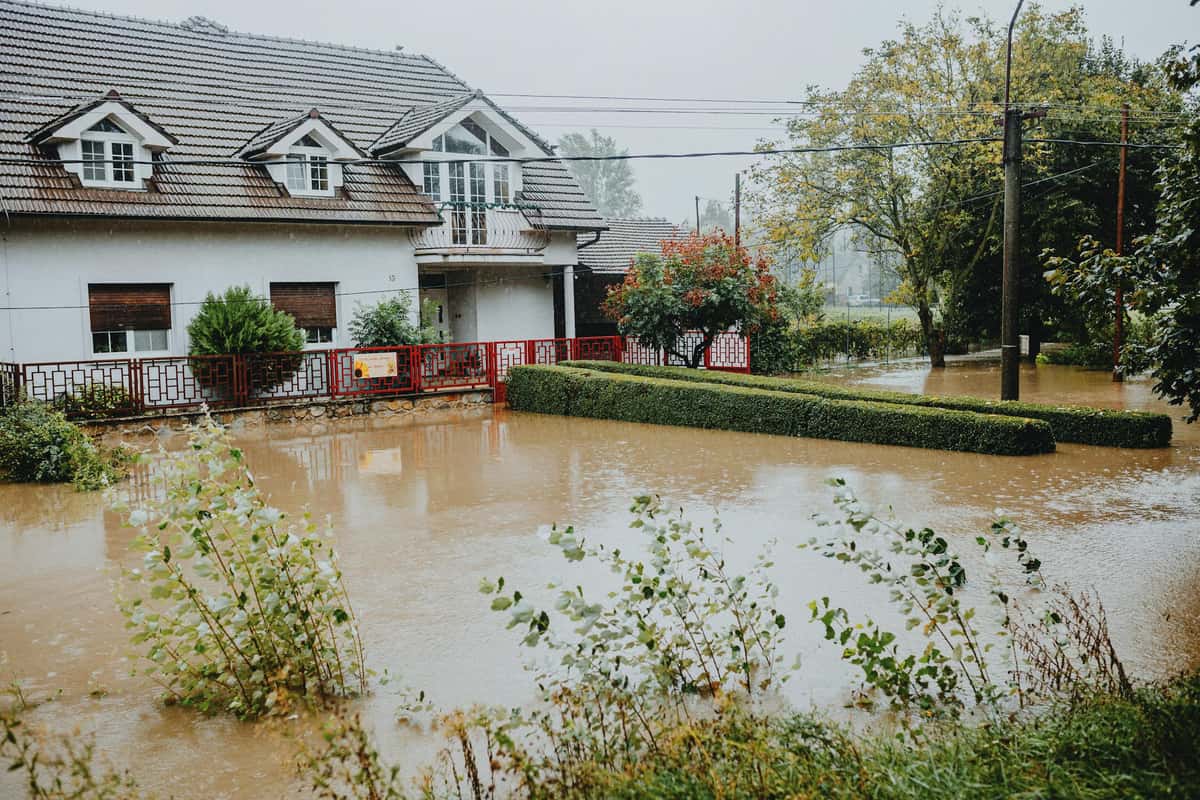
East-coast low-pressure systems, La Niña cycles, and elevated atmospheric moisture have driven more frequent and more intense rainfall events along the eastern seaboard over the past decade. Properties that had no recorded flood history are experiencing their first events, and properties that flooded every ten years are now flooding every two or three. The Insurance Council of Australia reported flood as the leading cause of insured losses from natural disasters across Australia for multiple consecutive years, reflecting how broadly flood exposure has spread beyond traditional floodplain areas.
Understanding the type of flooding your property faces matters, because it determines which products are worth spending money on.
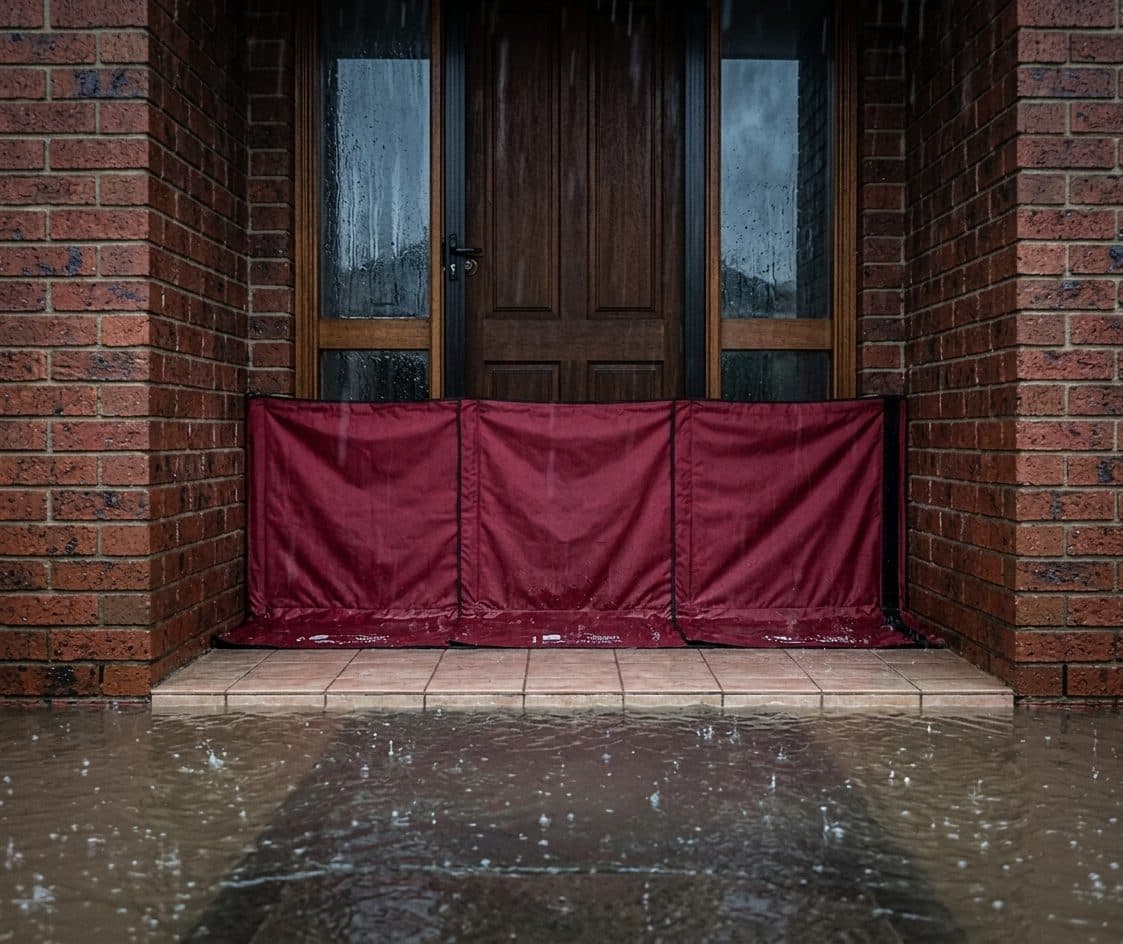
Threshold flooding is where water enters through doorways, garage openings, and low-level gaps as surface water rises around the building. This is the most common type affecting urban residential properties in Australia, and it is the type where deployable barriers are most effective. A barrier correctly positioned across a doorway or garage entry keeps the water outside the structure.
Overland surface flow involves large volumes of water moving across the property rather than simply rising against the walls. Overland flow can route around a single barrier protecting one entry point. Properties exposed to overland flow need a perimeter approach — multiple barriers at different entry points, combined with any available diversion to redirect flow away from the building.
Your council's flood mapping tool will show which type applies to your site, and at what depth for different return periods (1-in-20-year event, 1-in-100-year event). Checking this mapping before purchasing barriers is the single most important step: it tells you whether a shallow sandbag approach is sufficient, or whether you need a taller rated barrier across a wider opening.
How do you choose the right flood barrier for your home?
Residential flood protection falls across four main product categories, each suited to different flood depths, opening widths, and budgets. The table below maps each to its most common residential application.
| Protection type | Best for | Flood depth rated | Cost (AU) | Deploy time |
|---|---|---|---|---|
| Water-activated sandbags | Doorways, rapid response, renters | 120 mm per course, ~240 mm stacked two deep | From $59 / pack of 6 | 2–3 min |
| Oxford barriers | Doorways and entries up to 1,300 mm wide | 900 mm | From $449 / 2-pack | 5 min, tool-free |
| Aluminium demountable barriers | Wider openings, higher depth | Made to measure | Quoted per opening | Under 10 min |
| Automatic flood gates | Unattended sites, carparks, commercial | Custom | Quote required | Automatic |
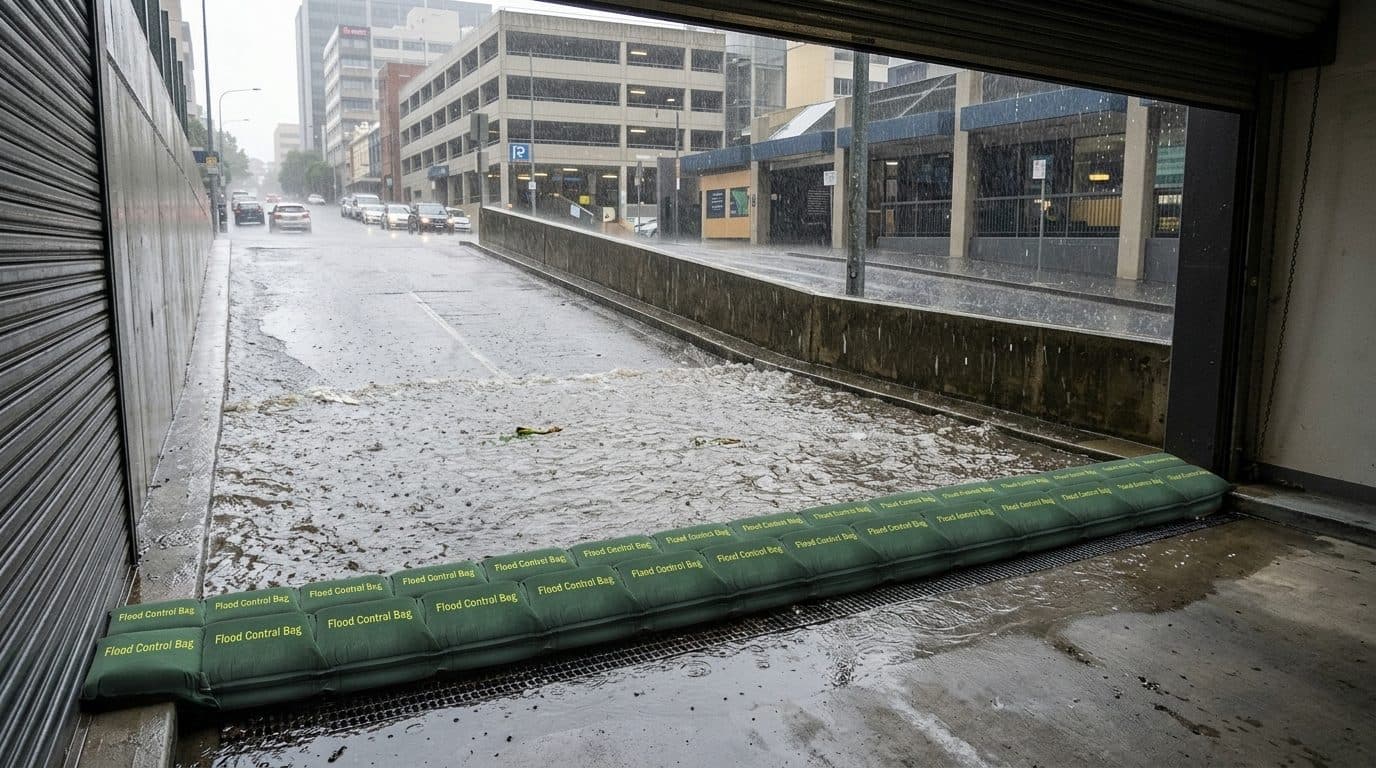
Water-activated sandbags are the lowest-cost entry point and the fastest to deploy. Each bag in the pack of 6 stores flat at 270 g and swells to 18–22 kg within 2–3 minutes of contact with fresh water, forming an instant barrier across low entry points. Height is counted in courses rather than bags. An activated bag measures 600 × 400 × 120 mm, so a single course laid across a threshold stands 120 mm high however long it is, and six bags laid in two courses across a standard doorway reach roughly 240 mm. They suit renters and properties with low threshold risk equally well, and they ship free Australia-wide. The limitation is depth: three courses at roughly 360 mm is the practical ceiling, because above that the stack shifts under sustained lateral pressure and a rated rigid barrier is the more reliable answer.
Oxford barriers are the practical step up for homeowners who want a reusable, purpose-built solution rated to a meaningful flood depth. The telescopic frame adjusts from 150 mm to 1,300 mm wide to fit most standard residential doorways, single-car garage entries, and side access gates without any cutting or professional fitting. The barrier uses water pressure to form its seal against the floor and door frame — no drilling, no anchor installation, and no tools required for deployment. The 900 mm flood depth rating covers the majority of flash flood events affecting urban residential properties in Australia. At 5.3 kg per unit, one person can carry and set up both barriers in the 2-pack within minutes. Oxford barriers fold flat for storage in a cupboard or under a bed between events and are reusable across multiple flood seasons.
Aluminium demountable barriers are the professional standard for properties that flood repeatedly, have wider openings than Oxford barriers can cover, or need water held higher than a fabric barrier manages. Every set is made to measure — the width is built to the opening, whether that is a doorway or the full span of a double-car garage entry, and the height is made up of 200 mm panels. Deployment is under 10 minutes by a single person using a quick-release anchor system, and the marine-grade aluminium construction with a rubber seal closes against the frame. For properties that have experienced two or more flood events and are likely to experience more, the upfront investment in aluminium barriers makes economic sense against the cost of flood damage and repeated sandbag sourcing.
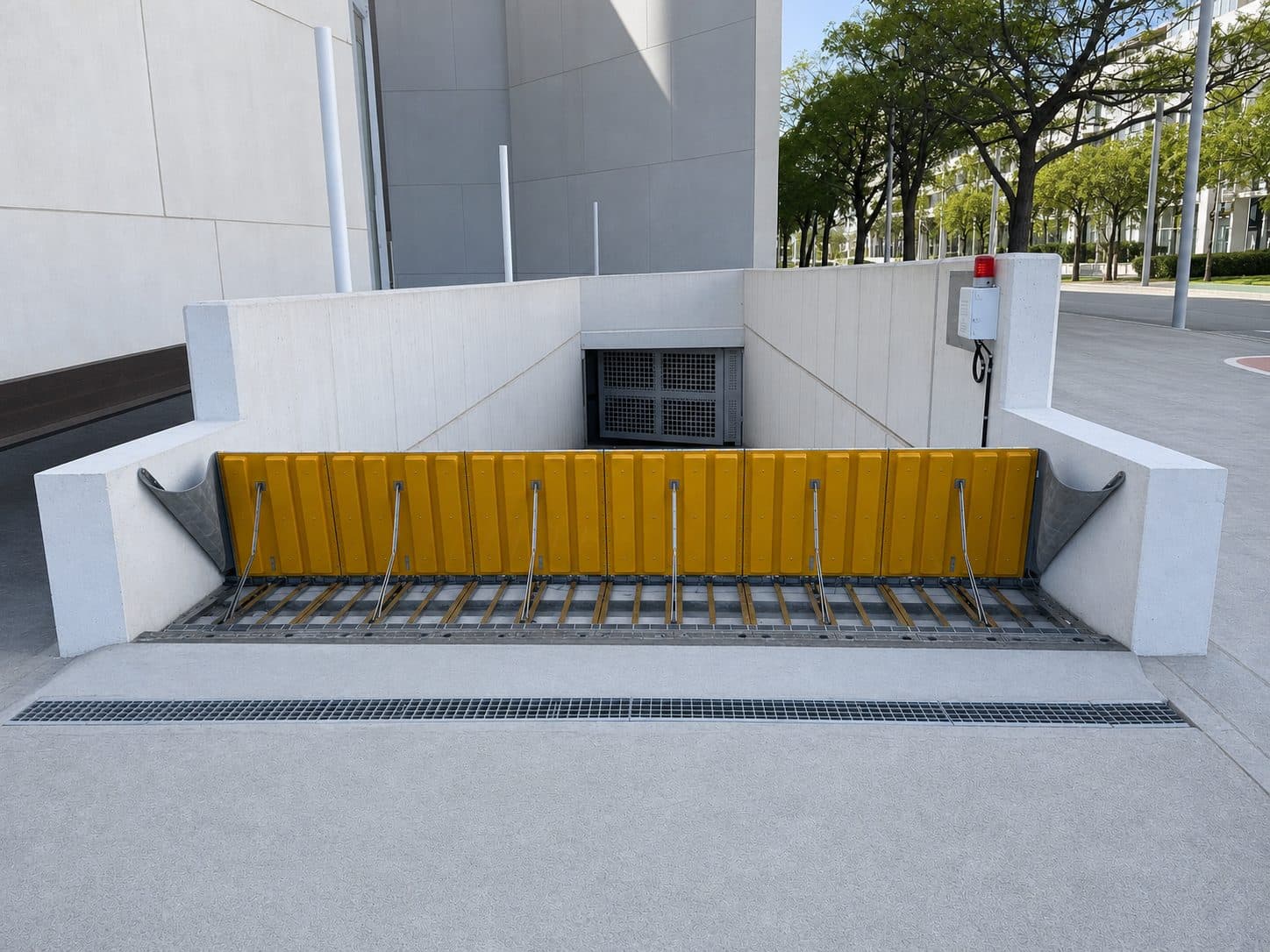
Automatic flood gates are the correct solution for properties where no one will be present when flooding starts: basement carparks, remote sites, and critical infrastructure. The system uses water-level sensing to trigger a hydraulic barrier automatically when water reaches its configured threshold, with no one needed on site to raise it. Afterwards the barrier is lowered and reset from a remote control or central control switch. Automatic gates are custom-engineered to your opening dimensions and site conditions and are quoted individually.
Which entry points on your home need flood protection?
A flood assessment should walk the full perimeter of the property and identify every point where water can enter. Missing one entry point can allow as much water inside as if no barriers were deployed at all.
The six most common residential entry points:
-
Front and rear doorways — the primary flood entry in most threshold events. A standard residential doorway is within the range of both Oxford barriers and aluminium panels. Double doors and French doors require extra attention at the join.
-
Garage roller door — the lowest point on most double-car garages. A 20 mm gap across a 5,000 mm-wide roller door allows significant water ingress before any barrier can be fully positioned. ABS portable barriers or aluminium panels can cover this opening, and some properties use a combination of both for added redundancy.
-
Side access gates — frequently overlooked. Water routing around a protected front entry will take the path of least resistance, and an unsealed side gate can bypass every other measure deployed.
-
Subfloor vents — older weatherboard homes on stumps have ventilation openings at or just above ground level. During overland surface flow, these become flood entry points. Temporary blocking with sandbags or expandable foam plugs is the most common approach.
-
Air conditioning condenser penetrations — pipe and conduit entry points through external walls close to floor level. These gaps are often smaller than 50 mm but contribute to water ingress during extended flood events.
-
External power outlets and meter boxes — frequently mounted at low heights that become submerged during moderate events, creating both flood entry and a live-electricity risk.
Prioritise by opening width and flood exposure. Doorways and garage entries first, because they allow the largest volume of water in the shortest time. Gates and vents second. Penetrations and outlets last.
What should you secure inside the house before floodwater arrives?
Barriers prevent water from entering. Interior preparation limits damage if any water does get through.
- Raise furniture, appliances, and valuables at least 300 mm off the floor. Use benches, beds, raised shelving, or roof storage space.
- Move important documents, hard drives, photo albums, and irreplaceable items to an upper floor or as high as possible.
- Turn off electricity at the switchboard if instructed by SES or emergency services. Do not turn off the power while standing in water or in the dark.
- Move vehicles to higher ground before beginning barrier deployment — not after. A car parked in a garage blocks access when deploying the garage barrier.
- Photograph the interior of the property and its contents before water arrives. This record is critical for insurance claims.
For a full checklist covering the steps before, during, and after a flood event, see the guide on what to do if your property is flooding.
How much does flood proofing a house cost in Australia?
Cost depends on how many entry points need protection, their widths, and the flood depth expected at the site. The table below provides indicative ranges for common residential scenarios.
| Property scenario | Products | Estimated cost |
|---|---|---|
| Single doorway, shallow flood risk | Water-activated sandbags, 2 packs | From $78 |
| Single doorway, moderate flood depth | Oxford barriers, 1 x 2-pack | From $449 |
| Double garage + front door | Two Oxford 2-packs + sandbags | From $937 |
| Wide entry or higher flood depth | Aluminium demountable barriers | Quoted per opening |
| Basement carpark or unattended site | Automatic flood gate | Quote required |
Most residential properties with one or two entry points at risk can achieve a meaningful level of protection for $450–$900. Full-perimeter protection across multiple wide openings — a double garage, a front door, a rear sliding door, and a side gate — usually combines Oxford barriers with aluminium barriers quoted per opening. For a more detailed breakdown by property type and opening count, the flood barrier cost guide for Australian homes covers the full range of residential scenarios.
What should you do when a flood warning is issued for your area?
According to the Bureau of Meteorology's flood warnings service, Australia operates a two-stage alert system. A flood watch means conditions are developing and flooding is possible — this is the time to prepare barriers and move valuables. A flood warning means flooding is occurring or imminent in a named catchment — this is when barriers must be deployed.
When a flood watch is issued:
- Check your council's flood zone map and confirm your property's hazard classification.
- Inspect and stage all barriers so they are accessible and not stored behind other items.
- Move vehicles to higher ground and relocate valuables and documents off the floor.
- Monitor BOM and your local SES channel for updates.
When a flood warning is issued:
- Begin barrier deployment at every entry point immediately — before water reaches the threshold.
- Call SES on 132 500 if you need assistance or if evacuation instructions are issued.
- Do not drive through floodwater under any circumstances. Even 150 mm of moving water can shift a vehicle.
The most important principle is preparation well before an event, not at the point of warning. Barriers set up before water arrives are fully effective. Barriers being deployed while water is rising against the door are already compromised. Having the right products on the shelf and knowing where each one goes is the difference between a clean interior and a flood damage claim.
For the full entry-point audit, product sizing by opening, and cost by property scenario, see residential flood barriers.
Recommended next step
Match the guide to a flood barrier option.
These are the product pages and guides most relevant to this topic. Use them to compare flood barriers Australia-wide, then request a site-specific recommendation.