Article · 21 July 2026
Flood Watch vs Flood Warning in Australia
Understand the difference between a Flood Watch and Flood Warning in Australia, and know the right time to deploy flood barriers at home or work.

When the Bureau of Meteorology issues a flood-related alert, many Australians know something is coming but aren't sure what to do — or when. The difference between a Flood Watch and a Flood Warning is not just terminology: it determines how much time you have to act, and whether deploying flood barriers is still safe and practical. In southern Australia, cold fronts can arrive quickly during winter months, and a Flood Watch can escalate to a Minor Flood Warning within 12 hours. Understanding the alert system and knowing which flood protection can be deployed within each window makes the difference between a secured property and one that floods.
What is the difference between a Flood Watch and a Flood Warning in Australia?
A Flood Watch is the Bureau of Meteorology's early advisory. It is issued when forecast rainfall or river catchment conditions suggest that flooding is possible in the coming 24 to 48 hours. A Flood Watch does not confirm that flooding will occur — it signals that conditions are favourable for it to develop and that you should begin preparation immediately.
A Flood Warning is issued when flooding is occurring or imminent. It refers to a specific river, catchment, or locality, and is graded by the expected severity of inundation. In practical terms, a Flood Warning means the situation has moved from "may happen" to "is happening."
The key distinction for property protection is timing. Under a Flood Watch, you still have a window to deploy barriers, clear drains, move valuables, and run through your emergency plan. Under a formal Flood Warning — particularly a Moderate or Major one — the priority shifts to evacuation and personal safety.
What do the three Flood Warning levels mean for your property?
The Bureau of Meteorology grades Flood Warnings as Minor, Moderate, or Major. Each level has different implications for property owners and businesses.
Minor Flooding means low-lying and flood-prone land is affected. Some property flooding is possible, and local roads may become impassable. This is the stage at which barrier deployment becomes urgent — if you have not already acted under the Flood Watch, act now.
Moderate Flooding means large areas of low-lying land are inundated. Major roads may be cut, some evacuations may be required, and flood levels can rise to a metre or more in affected areas. By this stage, deploying barriers safely becomes difficult, and evacuation preparation should take priority.
Major Flooding means extensive inundation of towns or communities with serious risk to life. This is a life-safety emergency. Barrier deployment is not appropriate — follow SES and emergency services instructions immediately.
According to the Bureau of Meteorology's flood warning services, flood forecasting for most major rivers in Australia includes predicted water levels and timing so residents can plan. Knowing your river's forecast peak time tells you how much of the deployment window you actually have.
How long does a Flood Watch give you to prepare?
The lead time depends on the type of flooding your property faces.
For slow-rising riverine flooding — the kind that follows sustained rainfall in an upstream catchment — a Flood Watch can provide 24 to 48 hours or more before water levels affect your property. This is enough time to deploy even the most involved barrier systems, clear gutters and drains, and run through a full pre-flood checklist.
For fast-rising urban catchments — typically smaller creek systems in hilly suburban areas — the window may compress to 6 to 12 hours between a Watch and water reaching your doorstep. Barrier deployment needs to start within hours of a Watch being issued.
For flash flooding triggered by extreme localised rainfall, there may be almost no advance warning. Storms that dump 50 to 80 mm in under an hour can produce dangerous surface runoff in minutes. In this scenario, no barrier deployment is safe or practical — the right action is to move to high ground.
The type of flood risk your property faces is the most important thing to know before any Flood Watch is issued. Council flood maps and the BoM's river level monitoring pages can help you identify whether your property is in a riverine, creek, or flash flood zone.
Which flood barriers can be deployed before a warning arrives?
The best time to deploy flood barriers is under a Flood Watch, not a Flood Warning. Here is how the main options compare for a property owner with limited deployment time.
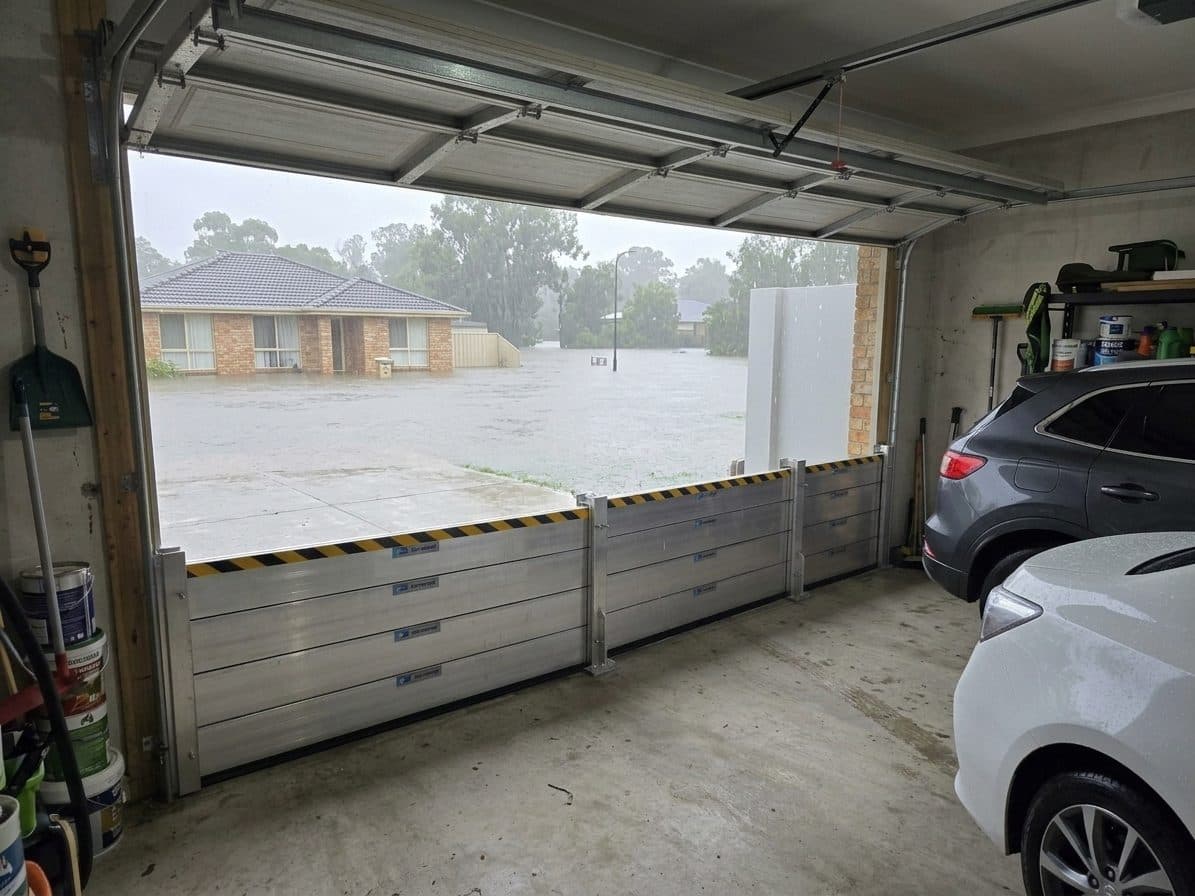
Aluminium demountable barriers are the strongest choice for properties where flood risk is predictable and recurring. Aluminium flood barriers are made to measure for doorways, garage doors, and shopfront entries, with one person able to complete deployment in under 10 minutes. The rubber seal closes against the frame, and the marine-grade aluminium construction takes repeated seasonal use. The anchor system is installed once; every later deployment needs only a spanner to tighten the top clamps.
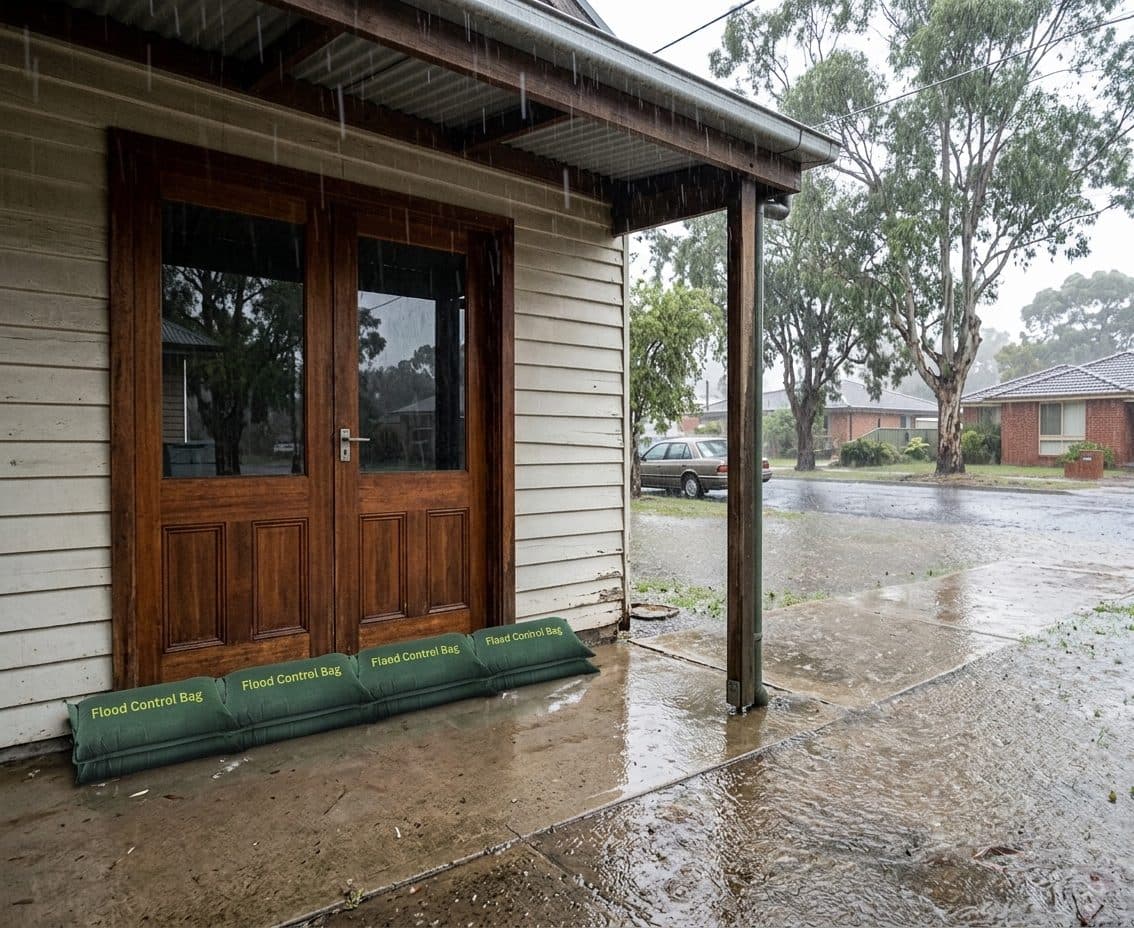
Water-activated sandbags are the fastest option for last-minute gaps and supplementary coverage. Water-activated sandbags swell from 270 g to 18–22 kg within 2 to 3 minutes of contact with fresh water — no sand, no shovels, no filling. A pack of 6 at $59 can seal a standard doorway or close the gap at the base of a roller door. They can be dried out and used again, and they work best as a backup layer alongside rigid barriers rather than a standalone solution.
Oxford barriers adjust from 150 to 1,300 mm wide and deploy in minutes without tools, protecting openings to 900 mm high. Water pressure holds the base down to form a seal — the heavier the water, the better the barrier presses against the floor. A 2-pack covers a standard entry door.
ABS portable barriers in an 8-panel pack suit wider openings such as loading docks and double garages. They take around 15 minutes to configure and connect, which is a comfortable margin under a Flood Watch but may be tight if a Warning arrives quickly.
Automatic and passive flood barriers require no deployment at all. An automatic hydraulic flood gate raises when water-level sensing triggers the lift system, making it ideal for unattended carpark ramps and commercial entries. A hydrodynamic passive barrier raises using the pressure of the water flow itself, with no power or manual action required.
What should you do when a Flood Warning escalates?
Flood Warnings do not always escalate gradually. A Minor Flood Warning can be upgraded to Moderate within a few hours if upstream catchments receive more rainfall than forecast. When a warning escalates, the actions that were practical under the previous level may no longer be safe.
If you are sheltering in a property protected by deployed flood barriers during a Minor Flood Warning, continue monitoring the BoM river level gauge for your area. If the warning escalates to Moderate, avoid going outside to adjust or reinforce barriers — at that point, personal safety takes priority.
If an SES or police evacuation order is issued, leave immediately. Flood barriers are property protection tools, not a substitute for evacuation when authorities direct one. The cost of a lost barrier is far lower than the risk of being trapped during a Major Flood Warning.
After the flooding recedes, inspect barriers for damage before storing them. Aluminium barriers should be rinsed and dried. Oxford barriers should be checked for fabric tears and seal integrity. Water-activated sandbags can be dried out and used again. Do not bury any you are discarding in garden soil — they contain sodium polyacrylate, which can suppress plant growth.
How should you prepare before any flood alert is issued?
The most effective flood preparation happens between events, not during them. Arriving at a Flood Watch with barriers already stored, accessible, and labelled removes time pressure when conditions are worsening.
Practical steps before any alert:
- Know your flood risk. Check your local council's flood map to understand whether your property is in a riverine, overland flow, or flash flood zone. Each requires a different approach.
- Register for BoM alerts. The Bureau of Meteorology's alert service delivers Flood Watches and Flood Warnings by email and SMS. Register for your river and suburb so you do not rely on news coverage alone.
- Register with SES. State emergency services send alerts and provide pre-flood assistance in some regions. NSW SES, Queensland SES, and VicSES all maintain community alert systems.
- Run a deployment practice. Once a year, before winter or the summer storm season, take your flood barriers out and run through the deployment sequence. Identify any missing parts, check seals, and confirm anchor fittings are secure.
- Store barriers accessibly. Flood barriers stored behind furniture or at the back of a garage are useless in a 30-minute window. Keep them near the entry point they protect, in a clearly labelled container.
- Map your openings. Walk around your property and identify every ground-floor opening that water could enter — doors, roller doors, vents, air-conditioning ducts at ground level, and garages. Match each opening to a barrier type and confirm you have the right product for each.
What does it cost to be flood-ready before a warning arrives?
The cost of flood preparedness scales with how frequently your property floods and the number of openings that need protection.
| Solution | Upfront cost | Typical lifespan | Annual cost |
|---|---|---|---|
| Water-activated sandbags | $59 per pack of 6 | Reusable; depends on how they are used | Depends on how many times they are reused |
| Oxford barriers (1 doorway) | $449 per 2-pack | 3+ seasons | ~$100–$150/yr |
| Aluminium flood barriers (1 opening) | Quoted per opening | Reused every season | Lowest cost per deployment over its life |
| ABS portable barriers (wide opening) | $1,659 per 8-pack | Multiple seasons | under $300/yr |
These figures do not account for flood damage costs, which the Insurance Council of Australia has estimated at an average of $20,000 to $100,000 per residential event for properties in high-risk zones.
The most economical long-term solution for properties that flood annually is almost always the highest-quality reusable option — the upfront cost divides across every season the set is redeployed, and deployment is far faster and less stressful than buying sandbags from a service station the morning of a warning.
If you are not sure which barriers are right for your property, the contact page is the starting point for a site assessment. Knowing your opening dimensions, flood risk type, and whether the site is attended during flood events narrows the product selection quickly.
Recommended next step
Match the guide to a flood barrier option.
These are the product pages and guides most relevant to this topic. Use them to compare flood barriers Australia-wide, then request a site-specific recommendation.