Article · 21 May 2026
Flood Barriers for Home Garages
Flood barriers for home garages stop roller doors, side entries, and driveways flooding in NSW, QLD, and VIC during heavy rain and storm events.

Oxford barriers and water-activated sandbags stop floodwater entering home garages before it reaches vehicles, stored belongings, and internal walls. For Australian homeowners in coastal NSW, Queensland, and Victoria, garage flooding is one of the first damage scenarios to develop during a heavy rain event — the roller door seal gives way, the driveway backs up, and water enters well before the rain eases. Choosing the right barrier for your door type takes minutes; having it in place before the warning arrives takes a little planning.
Why are home garages so vulnerable to flooding?
Three features let water in: a roller door bottom seal built for dust and light rain rather than standing water, a driveway that slopes toward the door and pushes runoff against it, and side doors that sit only 15–20 mm above the slab.
The bottom seal gap on a roller door is the most common culprit. Standard residential roller doors use a flexible rubber or brush seal along the base, but that seal is designed for dust and light rain, not sustained surface water. It is not built to hold a head of water and it does not improve with age — the gap widens as the seal hardens, and it is rarely replaced before it fails. Treat the base of the door as an open gap the full width of the opening and size the barrier for the opening, not for the gap you can see.
Driveways slope toward the garage for drainage reasons — which works well under normal conditions but becomes a problem during intense rain. When storm runoff exceeds what the driveway channel can shed, water backs up against the roller door. Any gap, worn seal, or soft spot in the door frame becomes a flood entry point under that load.
Side-entry personnel doors are a second vulnerability. Many single-skin garage side doors have no weatherstrip along the bottom rail and sit with only a 15–20 mm clearance above the concrete. That is more than enough for 150 mm of external water to reach the interior floor.
Low-lying properties across the Northern Rivers and Mid North Coast of NSW saw this combination play out in mid-May 2026, when the Bureau of Meteorology issued flood watches for the Richmond, Wilson's, Orara, Bellinger, and Nambucca catchments following prolonged autumn rainfall. The NSW State Emergency Service recommends that homeowners plan flood protection for garages and low entries well before a watch or warning is issued.
Which flood barriers suit a residential roller door?
Oxford barriers suit most households, water-activated sandbags fill gaps and go down fast, and aluminium flood barriers give the highest protection for garages that flood regularly, where an anchor can be fixed to the door frame. Which fits depends on door width, flood depth and how often the garage needs protection.
Oxford barriers are the most practical option for most households. Each unit adjusts from 150 mm to 1,300 mm in width and protects against water depths up to 900 mm. The telescopic steel frame and PVC-coated Oxford cloth deploy without tools in a few minutes, and the incoming water pressure increases the seal at the base rather than undermining it. A 2-pack of Oxford barriers weighs 5.3 kg and stores flat in the corner of the garage. A pack is two barriers, so linked end-to-end it spans up to 2,600 mm — enough for a standard single roller door around 2.4 metres wide. Multiple barriers connect using overlapping fabric sections that seat against each other under load.
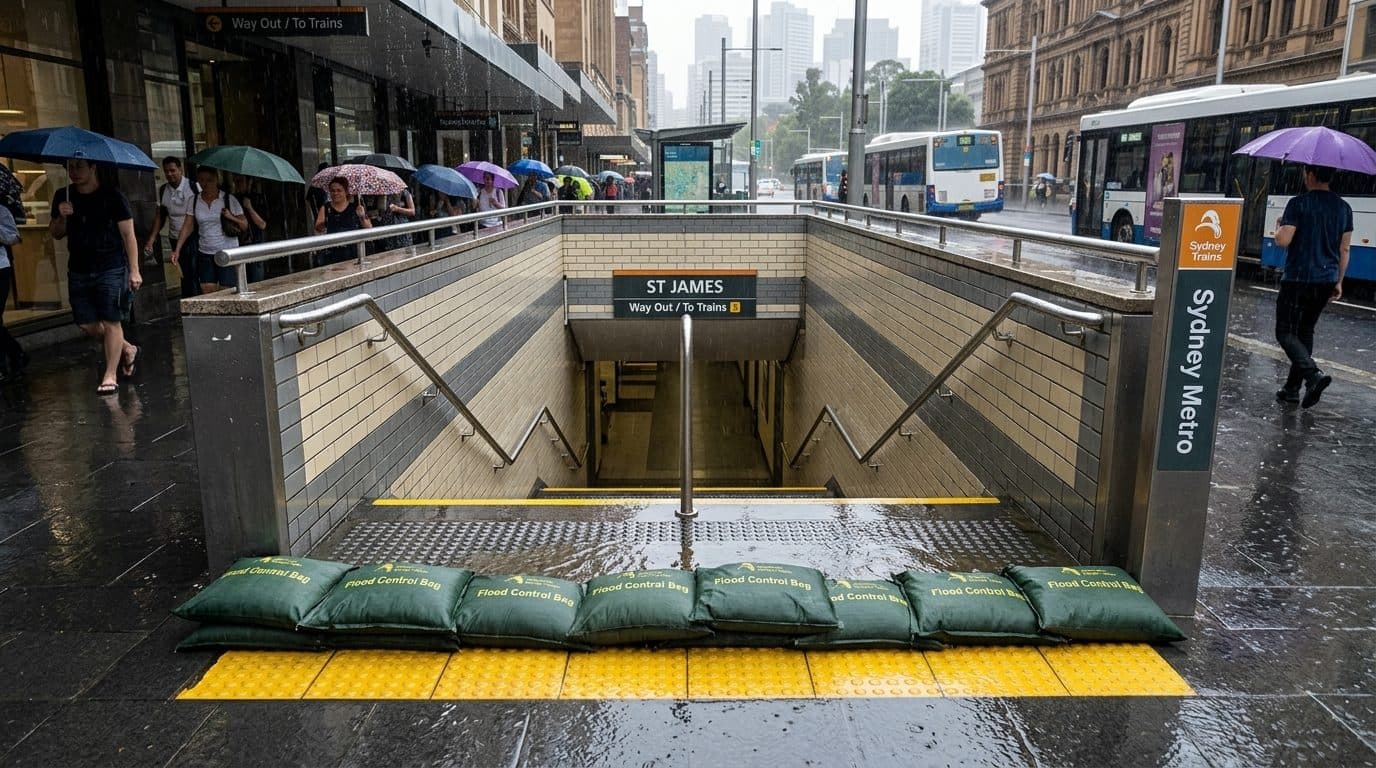
Water-activated sandbags serve as a fast-deploy first line of defence and as a complement to rigid barriers. Each bag in a pack of 6 water-activated sandbags expands from 270 g to 18–22 kg within 2–3 minutes of contact with fresh water. They are particularly effective at sealing the gap under a roller door bottom seal where a rigid barrier base cannot make full contact with an uneven floor, and for plugging the drainage channel running along either side of a driveway ramp.
Aluminium flood barriers suit roller doors and side entries where a permanent anchor system can be installed in the door frame. Aluminium flood barriers are made to measure for the opening, with the height built up in 200 mm panel steps, and deploy in under 10 minutes. They are the highest-protection option for garages that flood regularly or that store high-value equipment.
How much protection does a home garage need against flash flooding?
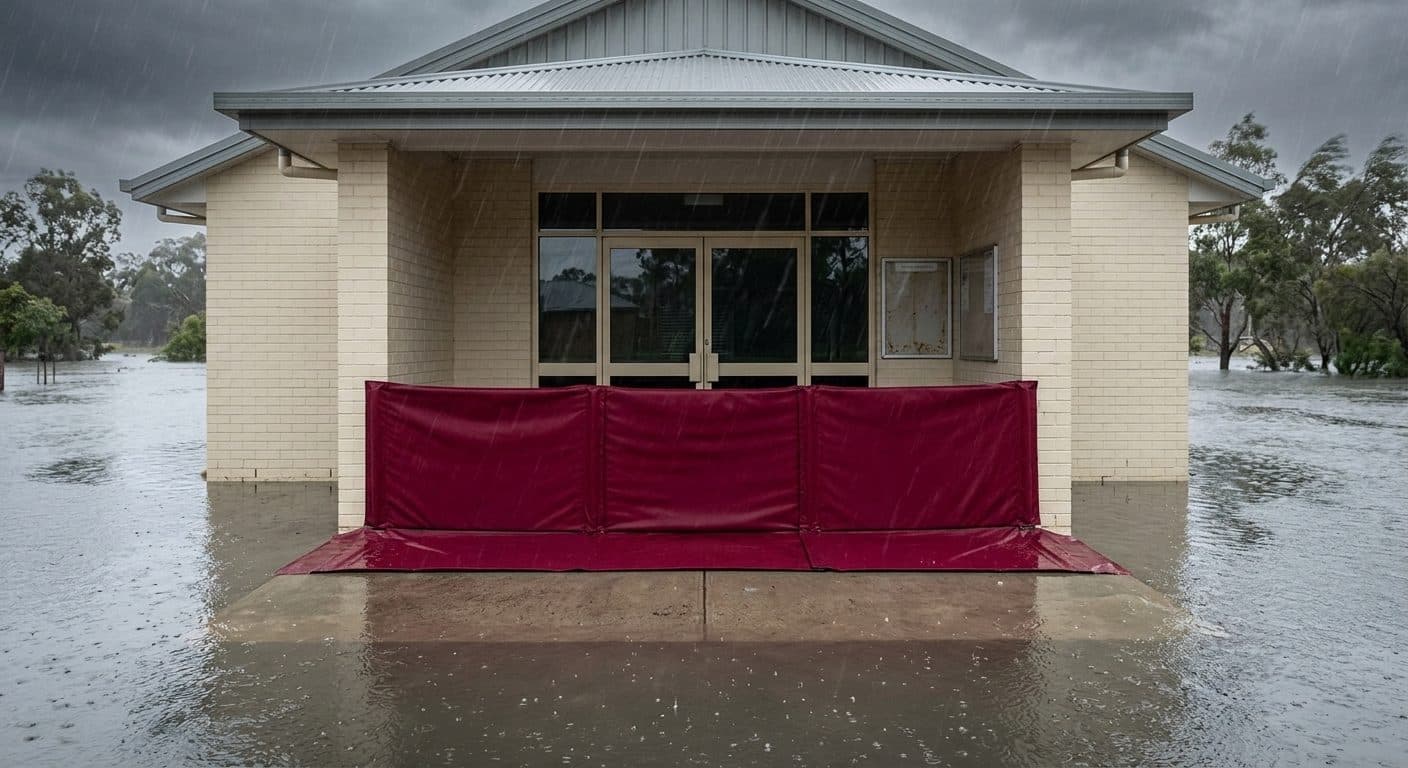
Flash flooding in residential areas typically produces water depths of 100–300 mm at garage floor level. Extended river or catchment flooding can push depths beyond that, but most urban residential garage flooding events fall within the range that Oxford barriers handle.
A single Oxford barrier unit, at 900 mm protection height, exceeds what is necessary for all but the most extreme residential flood scenarios. The more important variables are width coverage — ensuring the full roller door span is protected — and the bottom seal, where sandbags fill any gap between the barrier base and an uneven floor.
For side-entry personnel doors, a single 2-pack of Oxford barriers adjusted to door width covers most standard 820–900 mm residential door openings. Pair with a sandbag along the threshold gap for a tighter seal.
How do you deploy Oxford barriers at a garage roller door?
Oxford barriers are designed for solo deployment without tools. The sequence for a garage roller door takes about five minutes once the barriers are out of storage.
Close the roller door fully before placing barriers. Extend each Oxford barrier to the required width by pulling the telescopic steel frame to the desired length. Position the first unit flat on the driveway against the door face, centred on the bay. If using two or more units to span the full width, butt them end-to-end with the fabric edge sections overlapping. As water contacts the upstream face, the load presses the base seal against the concrete and draws the fabric tight against the door.
For the side-entry door, adjust the barrier to the door width and place it at the door base from the outside, with the upstream face toward the water source. Check that the fabric edges seal against the door frame on both sides.
After the event, lift the barriers away, rinse with fresh water if exposed to sediment, and fold flat for dry storage. A single Oxford barrier unit weighs 5.3 kg and folds to about the size of a rolled sleeping bag.
What to do when the Bureau of Meteorology issues a flood watch for your area
A flood watch is earlier than a flood warning — it indicates that flooding is possible if rainfall develops as forecast. It is the right time to act, not to wait.
When a watch is issued for your area:
- Deploy garage flood barriers before rain starts. Oxford barriers and sandbags cannot be placed safely once water is rising.
- Move vehicles to higher ground if your property has a sloped driveway.
- Clear gutters and downpipe outlets so roof drainage does not overflow toward the garage.
- Check the seal at the base of the roller door. If it is worn or missing sections, place a row of water-activated sandbags directly against the door base as a primary seal before positioning rigid barriers in front.
- Check the side-entry door. If the base clearance is more than 15 mm, position a barrier across the opening.
- Monitor the BoM app for updates. A watch can escalate to a warning or a major flood warning within hours once heavy rain sets in.
- Know your SES number: 132 500. If water enters the property and threatens safety, call the SES for assistance.
The NSW SES recommends making a household flood plan that identifies all the ground-level entry points to your home, including garages, laundry doors, and below-ground access points, so that no opening is overlooked when you start deploying barriers in a hurry.
How do you choose between sandbags and reusable flood barriers?
Choose sandbags if the garage floods rarely, Oxford barriers if it floods seasonally or several times a year, and aluminium barriers if it floods regularly and holds high-value contents.
Water-activated sandbags are best for households that flood infrequently and want low-cost protection they can act on in minutes. A pack of 6 at $59 covers a standard doorway. They activate on contact with fresh water — no sand, shovels, or filling required. After the event they can be dried out and used again; how many times depends on how they are used.
Oxford barriers are better for households that flood seasonally or several times across a wet year, or anywhere that wants protection stored and ready to deploy with minimum setup time. At $449 for a 2-pack, the upfront cost is higher, but the barrier can be deployed and packed away repeatedly across many seasons. The 5.3 kg weight and flat-fold storage make them practical for a corner of the garage.
Aluminium flood barriers suit properties where the garage floods regularly and high-value contents justify a permanent solution. The anchor system fixes to the door frame and the barriers deploy in under 10 minutes once installed. Across seasons of regular use, the cost per deployment keeps falling.
The most effective approach for most households is to keep both on hand: Oxford barriers for the main opening, and a pack of 6 sandbags for threshold gaps and secondary doors.
What flood barrier suits a double garage?
A standard double garage roller door spans 4.5–5 m. Two 2-packs — four barriers linked end-to-end — span up to 5,200 mm and cover that range. The connection between units uses overlapping fabric edges, and water pressure seals the join from the upstream side under load.
For a triple garage or a commercial garage door wider than 4 m, ABS portable flood barriers offer a modular solution. An 8-panel ABS pack is designed for garages, loading bays, and wide commercial access points. The panels interlock and can be configured to any opening without permanent installation.
Aluminium barriers are built to the measured opening, so a wide residential entry is covered as a single unit or by paired sets. Contact the team with the opening dimensions for a quote.
What to do next
A garage flood barrier is most useful when it is already in storage before the warning lands. For most Australian households, a 2-pack or 4-pack of Oxford barriers and a pack of 6 water-activated sandbags covers the main garage entry and the secondary door without requiring permanent installation or specialist tools.
Browse the full range of flood barriers at Flood Control, or get in touch if your property has a wide roller door, a sloped driveway, or other features that complicate a standard off-the-shelf approach. Barrier sizing for unusual openings takes five minutes and gets the right product to your door before the next warning.
For the full entry-point audit, product sizing by opening, and cost by property scenario, see residential flood barriers.
Recommended next step
Match the guide to a flood barrier option.
These are the product pages and guides most relevant to this topic. Use them to compare flood barriers Australia-wide, then request a site-specific recommendation.