
Article · 4 June 2026
Flood Barriers for Strata Buildings
What flood barriers work for Australian strata buildings — protecting basement car parks, entries, and common areas from storm runoff and rising water.

Basement car parks and ground-floor entries are the biggest flood liability in a strata building. An unguarded car park ramp during a storm event can fill a basement level with half a metre of water in under an hour. The right combination of automatic flood gates and aluminium barriers can seal a strata building's vulnerable points before flooding arrives — but the choice of product depends on whether the site is attended or not when water begins to rise.
Why do strata buildings flood differently from standalone homes?
Large residential and mixed-use buildings concentrate roof and pavement runoff into fewer drainage points. A multi-storey apartment block with a 1,000 m² footprint generates significantly more surface runoff than the surrounding detached houses because impermeable roofs, concrete podiums, and paved courtyards divert almost all rainfall directly to drains rather than absorbing it. When those drains exceed capacity during a heavy downpour, floodwater backs up at ground level — and follows gravity straight down the car park ramp.
Several factors compound this risk in strata buildings:
Ramp gradient: a basement ramp is graded to let vehicles descend, which means water crossing the lip descends quickly too. Gradients in a parking facility are set under AS 2890.1 and the figure for your building is on its design drawings — worth taking from there rather than estimating, because it decides whether a barrier at the lip is enough or whether the ramp needs treating along its length.
Multiple entry points: Most strata buildings have at least one car park entry plus lobby doors, fire exits, storage entries, and loading docks. Each becomes a potential flood path at ground level.
Overnight and unattended risk: Flooding events in NSW and QLD frequently begin late at night or during business hours when a building is lightly staffed. A flood barrier that requires manual deployment only helps if someone is there to deploy it.
Large basement volumes: A basement level 3 m below street level with 50 vehicles can be irreparably damaged within hours. The restoration cost — structural drying, remediation, insurance claims, and vehicle losses — regularly exceeds $500,000 in severe events.
Standalone homes face their own flood risks, but they typically have fewer entry points, no basement, and a single occupant capable of acting quickly. A strata building requires a deliberate, property-wide strategy that covers both attended and unattended scenarios.
What flood barriers suit a strata basement car park ramp?
For a basement car park ramp, automatic hydraulic flood barriers can be a suitable engineered solution. Water-level sensing triggers an electrically powered hydraulic system to raise the barrier at its configured activation level.
Each automatic flood barrier system is custom-engineered to the opening, flood conditions, electrical supply and control requirements. The barrier requires electrical power for its hydraulic pump and control system, plus routine inspection and maintenance in line with the supplied operating instructions.
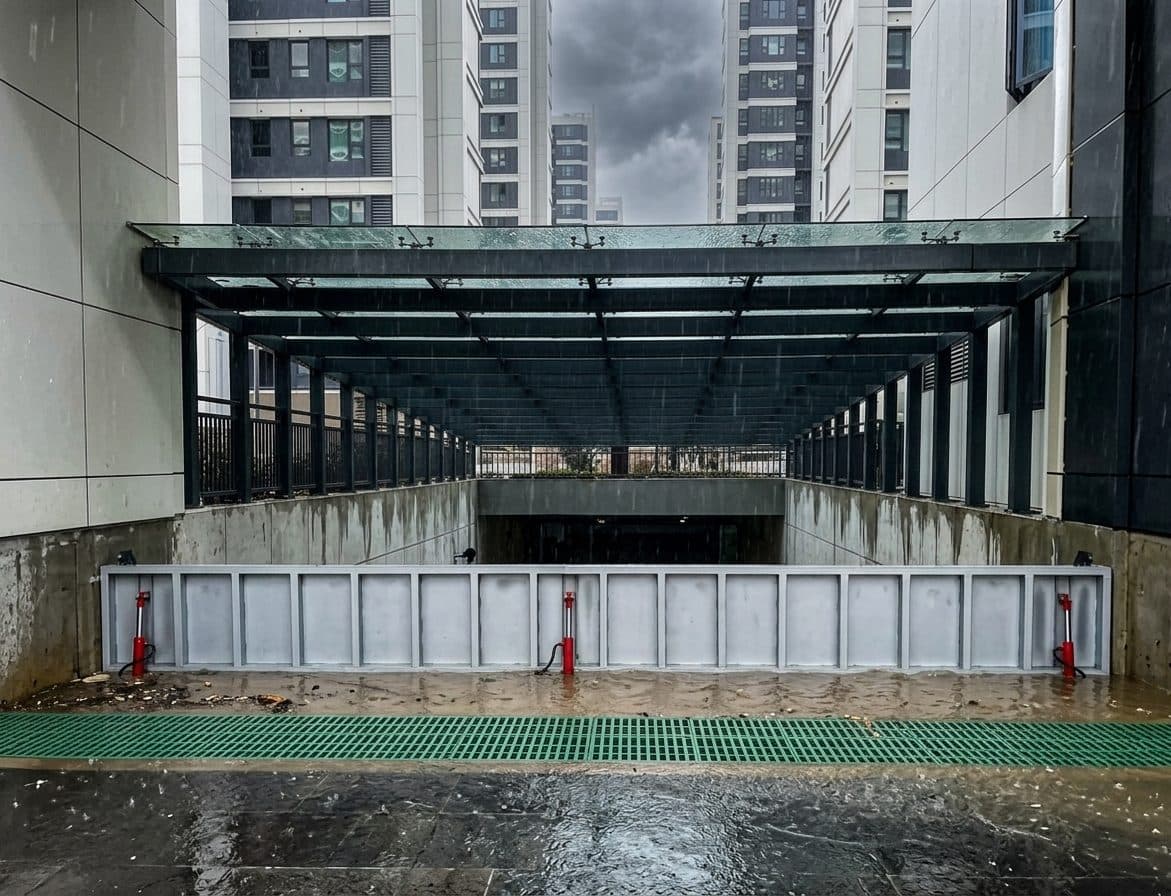
Automatic flood gates are engineered to each individual site and quoted after a site assessment. The assessment confirms ramp geometry, electrical supply, water-level sensing, hydraulic controls and any installation work required.
The defining advantage for strata applications is that automatic gates can remove the need to manually assemble a temporary barrier at the point of a flood event. Their sensing, electrical and hydraulic systems need to be correctly specified, maintained and tested as part of the building's flood plan.
How do aluminium barriers protect strata lobby entries?
Lobby entries, loading docks, and accessible fire exits are typically attended openings — meaning a building manager or on-call maintenance person can deploy barriers in advance when the Bureau of Meteorology issues a Flood Watch.
Aluminium flood barriers are the preferred choice for these openings. Precision-engineered from marine-grade aluminium, each set is made to measure for its doorway or opening. One person can deploy the full set in under 10 minutes using the quick-release anchor system, and the rubber perimeter seal seals against standard door frames and thresholds.
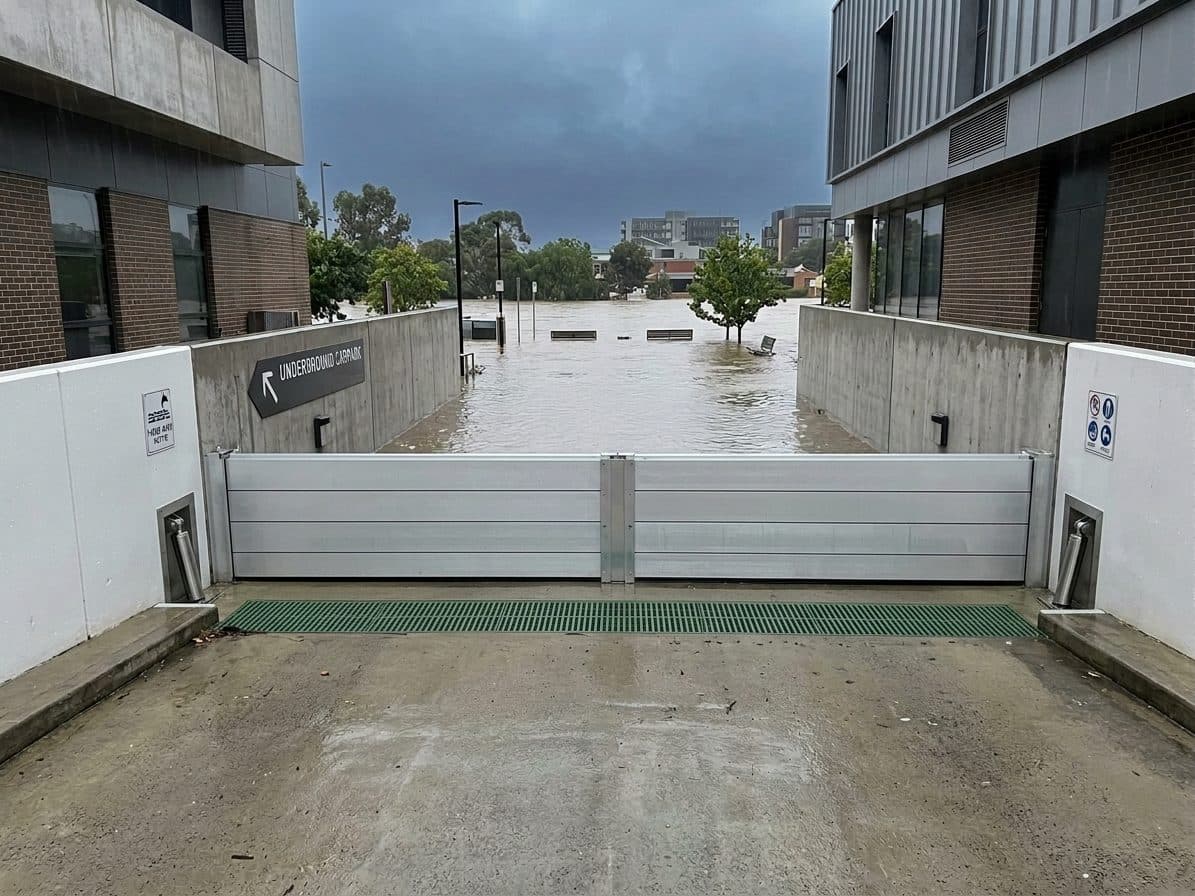
Aluminium barriers are redeployed season after season, which makes them cost-effective over multiple flood seasons. Marine-grade aluminium resists corrosion from salt air — relevant for strata buildings on the Sydney, Brisbane, and Gold Coast waterfront — and the powder-coated finish provides additional UV protection.
For a multi-entry strata building, a set of aluminium barriers can be stored in the basement plant room or a secure common area cupboard, ready to deploy across multiple openings at the first sign of a Flood Warning. Custom widths and heights are available for non-standard lobby framing, step-down thresholds, or service entrances.
Who is responsible for flood barriers in a strata building?
In all Australian strata schemes, the body corporate (or owners corporation in NSW and VIC) holds responsibility for common property. This includes basement car parks, lobbies, stairwells, loading docks, and the building exterior. Flood protection for these areas sits with the body corporate — not individual lot owners.
Individual owners are responsible for their own unit entries and private garage doors within their lot boundaries. A ground-floor unit owner whose garage door opens directly onto a flood-prone driveway should consider an Oxford barrier or water-activated sandbags for that specific opening. Oxford barriers adjust from 150 mm to 1,300 mm wide and protect to 900 mm depth, making them suited to standard residential garage and unit entries.
Body corporates should address flood protection through several formal channels:
- Record all barrier locations, product models, and deployment instructions in the strata's maintenance plan
- Assign a building manager or designated resident to deploy barriers when a Flood Watch is issued for the local area
- Include flood barrier replacement and inspection costs in the 10-year sinking fund forecast
- Include flood response protocols in the building's emergency management plan, particularly for overnight and weekend events
- Review and physically test all barriers at the start of each wet season before the risk window opens
Strata legislation across NSW, QLD, VIC, and WA requires body corporates to hold building insurance. However, the definition of "flood" in most policies distinguishes between storm water runoff, riverine flooding, and storm surge — and basement flooding caused by a blocked car park drain may be treated differently from flooding caused by a riverine event. Committees should review their product disclosure statement carefully and seek clarification from their insurer on basement coverage.
What does recent storm activity reveal about strata flood risk?
In late May 2026, severe weather warnings were issued across south-east Queensland, coastal NSW, and Tasmania as a complex low-pressure system delivered heavy rainfall and unseasonal thunderstorm activity to the east coast. Basement car parks and ground-floor entries in the Darling Downs, Wide Bay, and coastal NSW regions faced rapid inundation as drainage systems were overwhelmed.
According to the Bureau of Meteorology's national flood warning service, Australia's east coast regularly experiences winter east coast lows — slow-moving low-pressure systems that can deliver 100–200 mm of rain in 24 hours across coastal catchments between June and September. Unlike summer convective storms, which typically last two to three hours, east coast lows persist for one to three days. Drainage systems and waterways receive sustained input without time to recover between rain bands.
For strata buildings in Sydney, Brisbane, Newcastle, Wollongong, and Geelong, this seasonal pattern represents a predictable, recurring liability. A basement that floods during one event and is not subsequently protected will flood again. The cumulative cost of repeated flood events — drying, remediation, vehicle losses, insurance premium increases — quickly exceeds the cost of installation for a permanent automatic gate system.
Can sandbags or Oxford barriers supplement strata flood protection?
Within limits, yes. Oxford barriers suit individual unit entries on the ground floor: their telescopic width adjusts from 150 mm to 1,300 mm, they protect to 900 mm depth, and each 2-pack weighs 5.3 kg, making them practical for a building manager to carry and deploy across multiple openings. They are a reasonable first layer of protection for attended entries that do not have aluminium barrier systems in place.
Water-activated sandbags are useful as a secondary measure in strata common areas — sealing a gap at the base of a roller door, blocking a surface drain, or supplementing an aluminium barrier where the threshold is uneven. Each bag swells from 270 g to 18–22 kg within two to three minutes of contact with fresh water. A building manager deploying them at the Flood Watch stage can protect five or six openings from a single pack of 6 without tools or heavy lifting.
Neither product replaces a sealed car park ramp. For ramp openings wider than 1,300 mm, or for unattended deployment, an automatic gate or demountable aluminium panel system is the correct solution.
What should a strata committee do before the next flood season?
The most effective time to install flood barriers is before wet season begins — not during an event forecast. For strata buildings in NSW and QLD, the practical installation window is April through June, ahead of the peak east coast low season. For tropical Queensland buildings, the window is May through August before the summer monsoon season.
A pre-season action checklist for strata committees and building managers:
-
Audit every vulnerable opening — identify all car park ramps, lobby entries, fire exits, and loading docks that sit at or below the 1-in-100-year flood level for your postcode. Local council flood maps are available through council websites or state planning portals.
-
Separate attended from unattended exposures — basement ramps that are unoccupied overnight or on weekends require automatic gates. Attended lobby entries can use aluminium barriers with a named deployment officer and documented instructions.
-
Obtain a site assessment for automatic gates — the system is custom-engineered to each opening. A site visit from an installer determines exact gate dimensions, anchor points, and installation requirements before ordering.
-
Plan for lead times — catalogue products ship from stock, but an automatic gate or a customised aluminium set is fabricated to the measured opening and the lead time is confirmed at quote. Add the body corporate's own meeting cycle on top. Ordering after a weather forecast is too late.
-
Train the building manager — aluminium barriers, Oxford barriers, and water-activated sandbags can all be deployed in minutes, but only by someone who has practised. A 30-minute walkthrough at the start of each season is sufficient.
For site assessments, product specifications, and supply enquiries, contact Flood Control.
For basement ramp protection, automatic versus passive selection, and the body corporate approval process, see strata flood barriers.
Recommended next step
Match the guide to a flood barrier option.
These are the product pages and guides most relevant to this topic. Use them to compare flood barriers Australia-wide, then request a site-specific recommendation.