Article · 23 July 2026
Aluminium Flood Barriers: Specs & Cost Guide
Marine-grade aluminium flood barriers made to measure for each opening. Sizing in 200 mm panel steps, rubber seals, specs and install.
Aluminium flood barriers outperform sandbags for doorways, shopfronts, and garages in almost every scenario: faster to deploy, sealed against the frame, and reusable season after season. There is no standard size — a set of aluminium flood barriers from Flood Control is made to measure for its opening and quoted after a measurement, without the annual restocking cost of consumables or the labour of sand-filling. This guide covers how aluminium barriers work, how they compare to other options, what installation involves, and what the full cost of ownership looks like.
What makes aluminium barriers different from other flood protection options?
When floodwater threatens a property, the barrier type you choose determines how quickly you can respond, how reliably the opening is sealed, and whether you are restocking before every event or deploying the same equipment for the next two decades. The table below compares the main flood protection options available to Australian property owners and managers.
| Type | Max depth | Reusable | Deploy time | Price from | Best for |
|---|---|---|---|---|---|
| Aluminium demountable | Made to measure, 200 mm panel steps | Yes | < 10 min | Quoted per opening | Annual flooding, doorways, shopfronts |
| ABS portable | 750 mm (1,000 and 1,200 mm on enquiry) | Yes | 15 min | $1,659/8 panels | Wide openings, loading bays |
| Oxford barriers | 900 mm | Yes | 5 min | $449/2-pack | Standard doors, garages |
| Water-activated sandbags | ~240 mm stacked two deep | Yes | 3 min | $59/pack of 6 | Gaps, irregular surfaces, first response |
| Automatic flood gates | 2,000 mm | Permanent | Automatic | Site assessment | Unattended sites, carparks |
Aluminium barriers occupy a distinct position in this range. They are more durable and structurally rigid than Oxford cloth or fabric options, and less capital-intensive than a fully engineered automatic gate system. Their defining advantage over sandbags is the seal: a rubber gasket runs the full length of the base and both sides of the panel and is clamped against a smooth door frame or concrete threshold. Their advantage over portable barriers is the quick-release anchor system — once the anchor is fitted to the frame on first use, every subsequent deployment is repeatable and takes under 10 minutes, regardless of when the flood warning arrives.
The comparison also makes clear where aluminium barriers have limits. For very wide openings — loading bays, roller doors, wide commercial entries — ABS portable flood barriers provide a modular solution without fixed anchor requirements. For sites where no one may be present when water rises, an automatic system is the more appropriate specification.
How are aluminium flood barriers installed?
Installation happens in two stages: a one-time anchor-fitting on first deployment, and then a quick, repeatable deployment for every subsequent flood event.
First deployment — anchor installation (one time only)
The anchor brackets fix permanently to the door frame or surrounding wall surround. The process takes approximately 30 minutes with a drill and the supplied fixings:
- Clean and dry the door frame surface where the anchor brackets will attach.
- Position the brackets at the marked locations using the template supplied with the barrier set.
- Drill and fix the brackets to the frame using the supplied fixings — standard masonry or timber fixings depending on the substrate.
- Slide the first panel into the anchor channels on both sides and check the fit and seal against the floor threshold.
Once the brackets are in place, they remain permanently installed and require no adjustment or removal between events.
Every subsequent deployment (one person, under 10 minutes)
- Retrieve the barrier panels from storage.
- Slide the lower panel into the anchor channels on both sides of the opening.
- Add further panels in vertical sequence if the opening requires stacked coverage.
- Tighten the clamp at the top of each channel with a spanner to press the stack down and seal it against the floor threshold.
The barrier is now deployed and ready to resist water pressure. Retrieval after the flood event reverses these steps — panels are lifted clear, wiped down if necessary, and returned to storage.
Storage and maintenance
Panels store flat in a dry indoor space close to the point of use. Wall-mounted brackets or a slim storage cabinet are the most common configurations. The only component that experiences wear over time is the rubber water-stop seal. The seal will eventually compress and lose elasticity after many deployment cycles; replacement seals are available separately and can be fitted without disturbing the fixed anchor system. Checking the seal condition before the flood season is the main recommended maintenance step.
Where are aluminium flood barriers used in Australia?
Aluminium demountable barriers suit any property where a reliable, reusable seal is needed on a standard doorway, garage, or shopfront entry during a flood event. Property types include:
- Residential garage doors — single and double garage openings in flood-prone postcodes across the Hunter Valley, Northern Rivers, Hawkesbury-Nepean corridor, and Brisbane River catchment, where annual or biennial flood risk is well established.
- Shopfronts and retail entries — glass-fronted shopfronts on ground-level commercial strips, where the anchor fits to the door frame and the barrier seals the full width of the entry against rising water.
- Strata and apartment lobby entries — ground-floor lobby doors in strata-title apartment buildings, a specification increasingly requested by strata managers and body corporate committees following residential building flood events in Sydney and Brisbane.
- Office buildings and commercial premises — entry doors on commercial office premises and multi-tenancy buildings, where a building manager can deploy the barrier across multiple ground-floor entries before an event.
- Light industrial and warehouse entries — personnel door entries on warehouse and industrial facilities, complementing wider opening protection from portable ABS systems on roller-door entries.
- Schools and community buildings — accessible doorway entries on public buildings where the barrier can be deployed by facilities staff without specialist assistance.
Australian flood risk is concentrated along river corridors and coastal catchments that cover densely populated areas. The Bureau of Meteorology's flood warning service provides real-time flood alerts across NSW, QLD, Victoria, South Australia and Western Australia — including the Northern Rivers, Hunter, Maribyrnong, and Brisbane River corridors where aluminium barrier installations are most common.
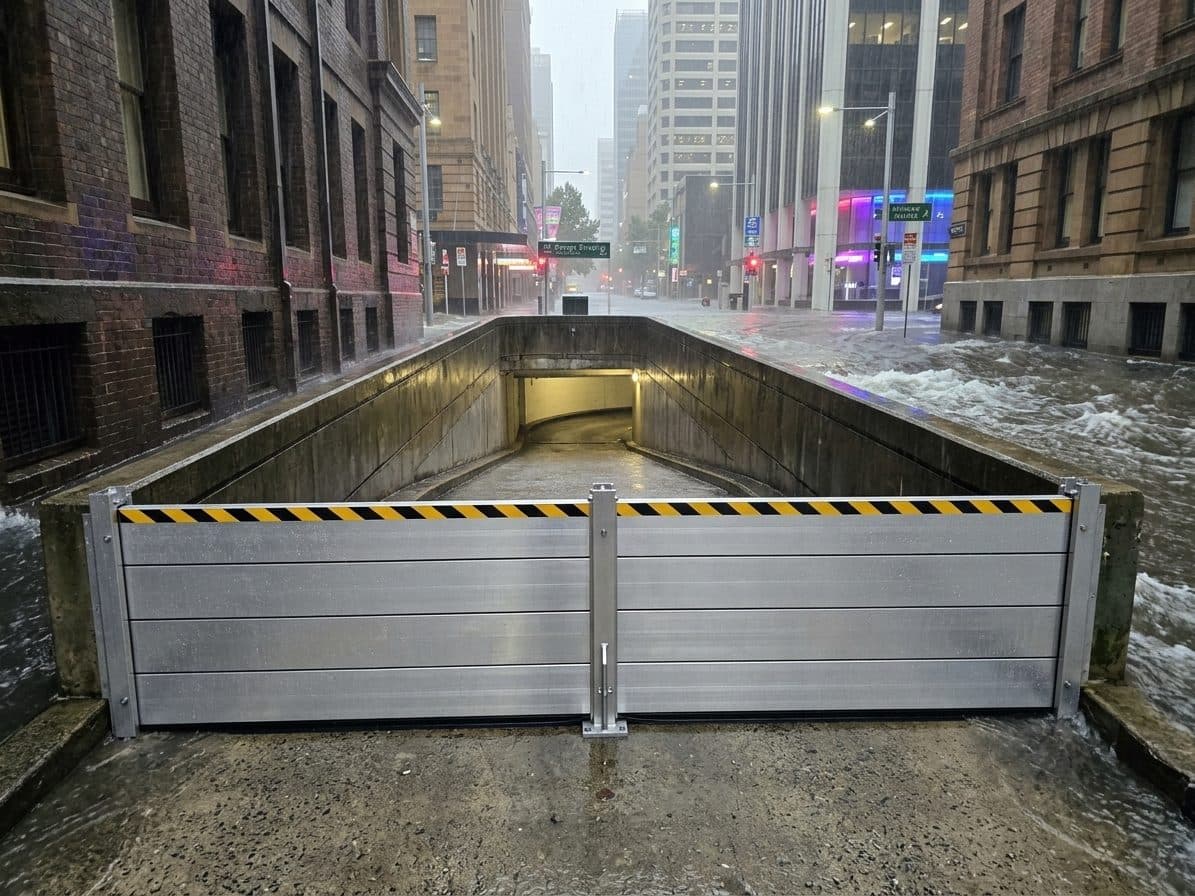
Aluminium barriers deliver best results for slow to moderate-rising riverine flooding where there is enough lead time after a flood watch or warning to retrieve and deploy the system. For sites that require protection without manual deployment — unattended commercial premises, basement carparks, or properties with a history of rapid-onset flooding — automatic or passive flood gate systems offer an alternative specification path that does not depend on staff or occupants being present.
How do aluminium flood barriers hold up between floods?
The panels and frame use marine-grade aluminium — the same material specification found in coastal construction and marine hardware, chosen specifically for its resistance to moisture, salt air, corrosion, and ultraviolet exposure.
This material choice matters in Australia's coastal and subtropical flood zones, where a barrier stored in a garage or plant room is exposed to high ambient humidity between flood events.
The rubber water-stop seal is the only wear item in the system. When it needs replacing, only the seal is changed; the panels, frame, and anchor system stay in service.
For an overview of all flood protection options and their full price ranges, the flood barrier cost comparison guide covers every product type available in Australia.
How much do aluminium flood barriers cost in Australia?
Aluminium flood barriers from Flood Control are made to measure, with each set quoted for its opening. There is no standard size, so send the opening dimensions — width, and the height you need covered — for a quote.
One set is reused at every event, so its quoted cost is spread across every season it is deployed. For a property that experiences one flood event per year — common across the Hunter Valley, Northern Rivers, and parts of Western Sydney — the same set keeps protecting the opening at no further cost. For properties with two or more events per year, the economics are considerably more compelling.
What should you do next?
Measure the opening you need to protect — the clear width, and how high you need the water held back. Every set is made to measure from those two figures, with the height made up of 200 mm panels.
For several openings, or an opening with an awkward threshold or frame, contact for a site-specific quote. For properties where no one will be present when water rises, explore the automatic flood gate range as an alternative specification.
A made-to-measure set of aluminium flood barriers provides repeatable flood protection from a single capital purchase — no annual restocking, no sourcing under pressure before a storm event, and no disposal after.
Recommended next step
Match the guide to a flood barrier option.
These are the product pages and guides most relevant to this topic. Use them to compare flood barriers Australia-wide, then request a site-specific recommendation.