Article · 10 May 2026 · Updated 6 October 2026
Warehouse & Factory Flood Barriers Australia
Flood barriers for Australian warehouses and factories: loading docks, roller doors, drain backflow and automatic gates compared for industrial sites.
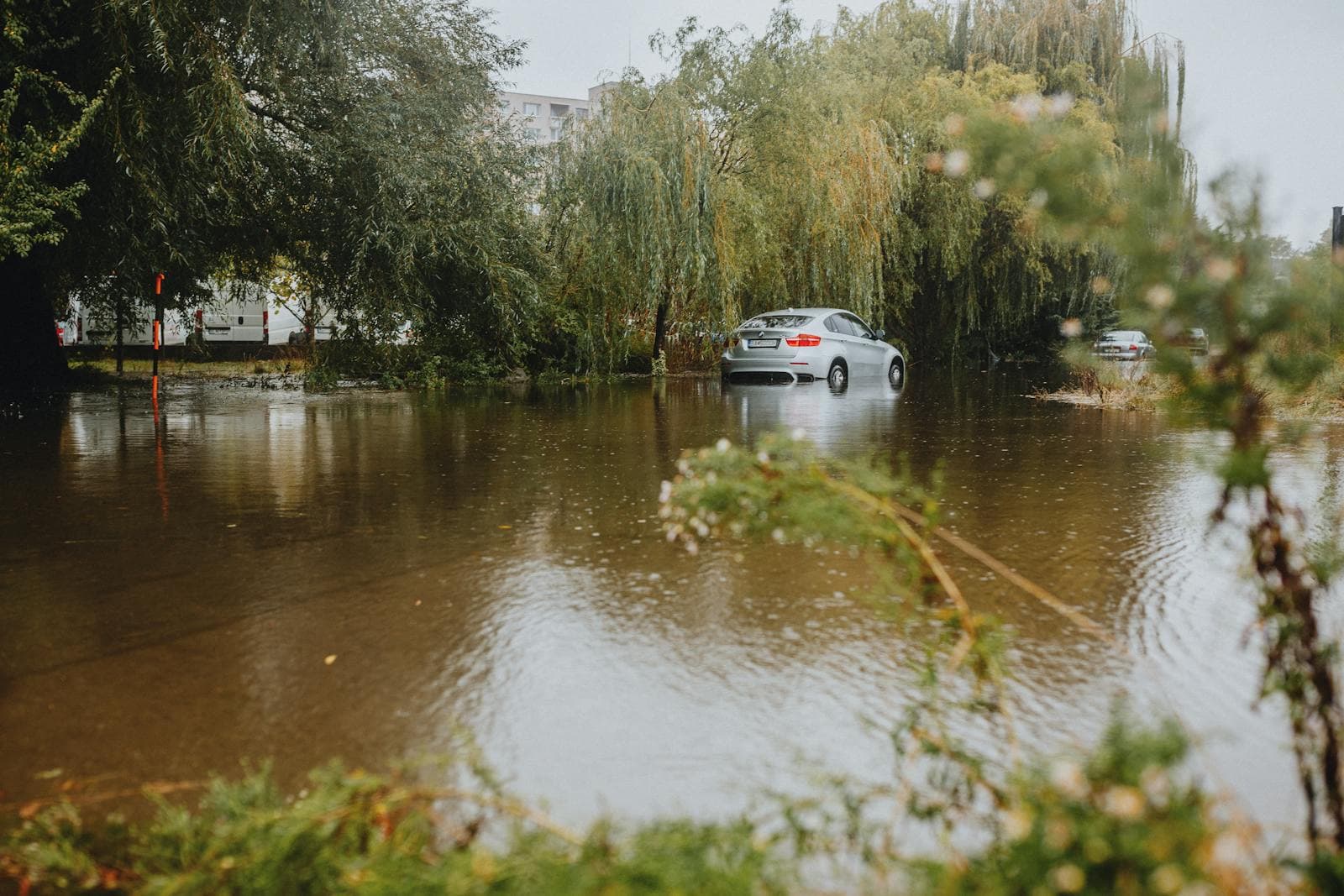
Industrial flood protection fails more often from the wrong product choice than from any engineering flaw. A barrier rated for a 900 mm domestic doorway does nothing for a 4 m loading dock. Australian warehouses and factories face openings that are wider, floors that are more irregular, and traffic patterns that make permanent fixtures impractical. Getting the match right between opening type and barrier type is the whole job.
Why do industrial sites present a different flood protection problem?
Residential and small-business flood barriers are engineered for standard openings — typically 900 mm to 1,200 mm wide, with flat, level thresholds. Industrial sites routinely have:
- Loading dock doors at 3–6 m wide — often the largest single unprotected opening on a site
- Roller doors with dock levellers — threshold irregularities that prevent a standard rubber seal from working
- Multiple simultaneous openings — a warehouse may need four to eight doors protected in parallel
- Shift work and after-hours operations — the site may be unattended when a flood event begins
- Heavy or immovable stock — the cost of a flood rises sharply when contents cannot be relocated quickly
These differences mean you need to size and select barriers for each opening individually, not apply a single product across the whole facility. A flood plan written around the widest and lowest opening, then scaled to the rest, is the correct starting point.
It is also worth consulting the Bureau of Meteorology flood watch and warning pages before each wet season. BOM provides catchment-specific flood histories and current forecasts that help calibrate both barrier height selection and deployment trigger criteria for your site.
What are the main flood entry points in a factory or warehouse?
A site walk with a tape measure is the starting point. Photograph every potential entry point with dimensions visible so you have working data for barrier selection. Critical vulnerability areas in industrial facilities include:
- Roller doors and personnel doors — primary water entry points, often overlooked because the door itself appears substantial
- Loading docks and dispatch bays — wide, low openings with threshold irregularities from dock levellers
- Low vents and service penetrations — easy to overlook on a site walk but consistent water entry paths
- Floor drains and backflow paths — water can rise from below through stormwater-connected drains during peak events
- Electrical switchboards, pumps, IT racks, and stock storage — not entry points, but the assets most damaged when water enters
Backflow through floor drains is the most commonly overlooked flood pathway in industrial facilities. Backflow prevention valves and drain plugs are inexpensive and available at plumbing suppliers — they address a gap that no barrier product covers.
How do you compare flood barrier types for an industrial site?
| Barrier type | Typical opening width | Deploy time | Reuse | Best for |
|---|---|---|---|---|
| Water-activated sandbags | Gaps up to ~1 m | 3–5 min | Up to 5× | Emergency gap-fill, secondary sealing |
| ABS portable barriers | Up to ~3 m (modular) | 10–20 min | Multiple seasons | Mid-size doors, budget-conscious sites |
| Aluminium demountable barriers | Made to measure | Under 10 min | Reused every season | Doorways, personnel entries, dock openings |
| Automatic flood gates | Site-specific | Water-level sensing | Site-specific | Unattended sites, high-value assets |
The right answer for most industrial sites is a combination: automatic gates at the highest-risk entry, demountable aluminium at the remaining openings, and water-activated bags for cable entries, drain sealing, and secondary gaps.
How do aluminium flood barriers seal a warehouse loading dock?
The loading dock is almost always the most exposed point on an industrial site. It is low, wide, and designed for vehicles — not for flood resistance. Before selecting a product:
- Measure the clear opening width including any dock bumpers or guide rails
- Confirm whether a dock leveller plate creates an uneven threshold — it usually does
- Determine if the dock has a drain, and whether that drain is prone to backflow under pressure
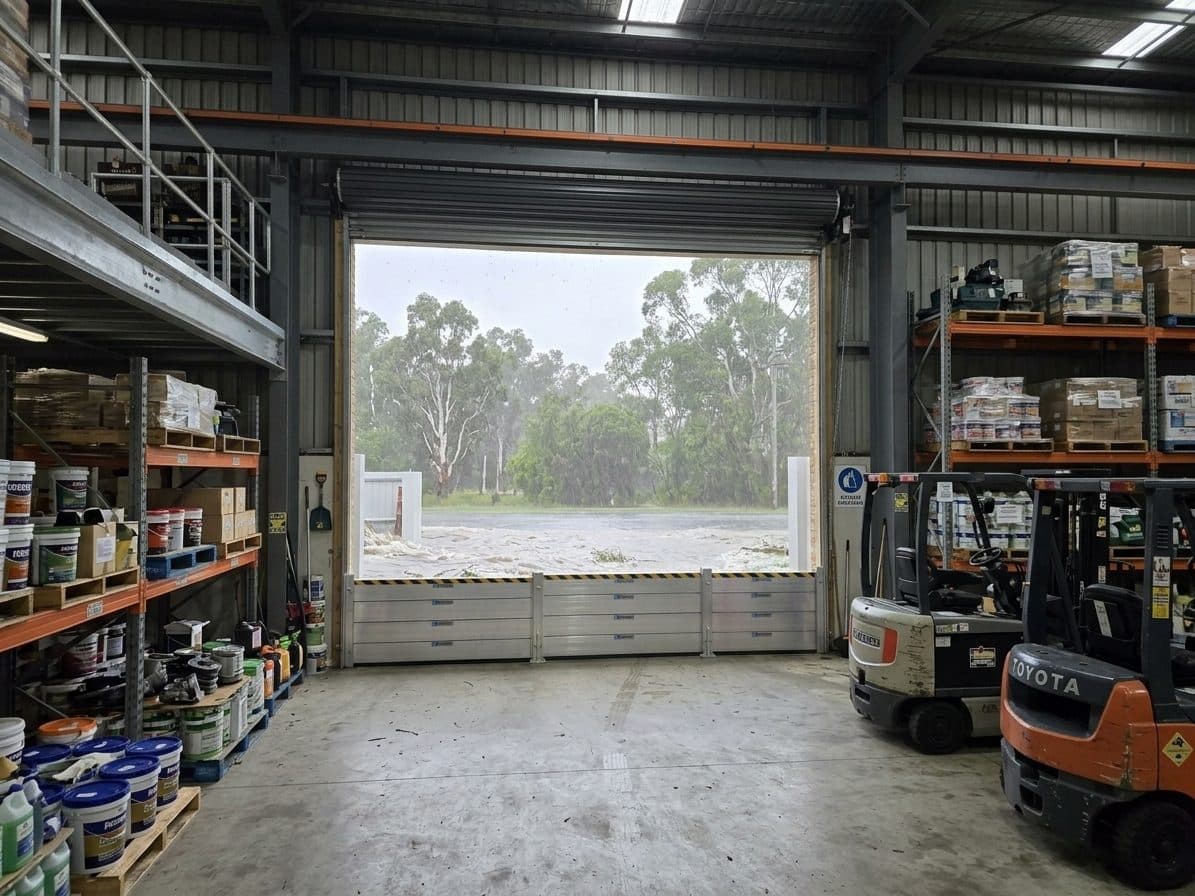
An aluminium demountable barrier set is built to the width you measure and deploys in under 10 minutes by sliding the panels between side posts fixed permanently either side of the opening. Wider docks are covered with adjacent sets and one deployment crew. The aluminium construction is marine grade, meaning it will not corrode after repeated wet events, and the same set comes out again every season.
Beyond 3 m, custom-width solutions or automatic flood gates become the practical choice. Dock leveller thresholds often need a row of water-activated sandbags to fill the gap before the rigid panels go in. Those sandbags — a 270 g flat pack that swells to 18–22 kg on contact with water — conform to irregular surfaces that rigid panels cannot seal.
How do you protect roller doors and personnel entries from flooding?
Roller doors present a specific challenge. The door itself provides some resistance, but the bottom seal is typically not waterproof, and the side channels are often the first water entry point. Personnel doors adjacent to the main roller door are frequently overlooked and should carry the same barrier priority as the wider opening.
Practical approach for roller doors:
- Deploy a demountable aluminium barrier across the opening, sliding the panels into the side posts fixed either side of it
- Run a row of water-activated sandbags behind the barrier along the base of the roller door to address seal gaps and threshold irregularities
- Seal adjacent personnel doors with a single-panel demountable set — these are made to the measured door opening and store flat against a wall
For multi-bay facilities, mark each barrier set by bay number and assign named deployment personnel for each bay. The single most common failure in industrial flood response is the time lost locating equipment and establishing who is responsible for each opening.
What waterproofing approaches miss in industrial facilities
Several common oversights undermine otherwise sound flood plans:
Drain backflow: Perimeter barriers protect against external water. They do nothing for water rising through floor drains when the stormwater network is overwhelmed. Backflow prevention valves on stormwater-connected drains are a mandatory supplement to any barrier plan.
Cable and pipe penetrations: Conduits through walls and floors are consistent entry paths. Hydraulic foam sealants or mechanical pipe plugs are the correct fix — not the job of a flood barrier.
Internal splash damage: Even when major flooding is prevented, water driven through seal gaps at high pressure can damage stock, electrical systems, and machinery. A secondary row of water-activated sandbags behind the main barrier reduces this exposure.
Decision delay: The slowest part of most flood responses is not deployment — it is the time spent deciding who deploys what and when. Fix this with a written trigger, named roles, and a pre-season rehearsal. SafeWork NSW emergency planning guidance recommends written emergency response procedures for all commercial premises.
When do automatic flood gates make more sense than manual barriers?
If your warehouse is in a known flood zone and operates with skeleton crews or after-hours automation, manual deployment becomes the weakest link in your protection plan. One person called in late is enough to miss the deployment window entirely.
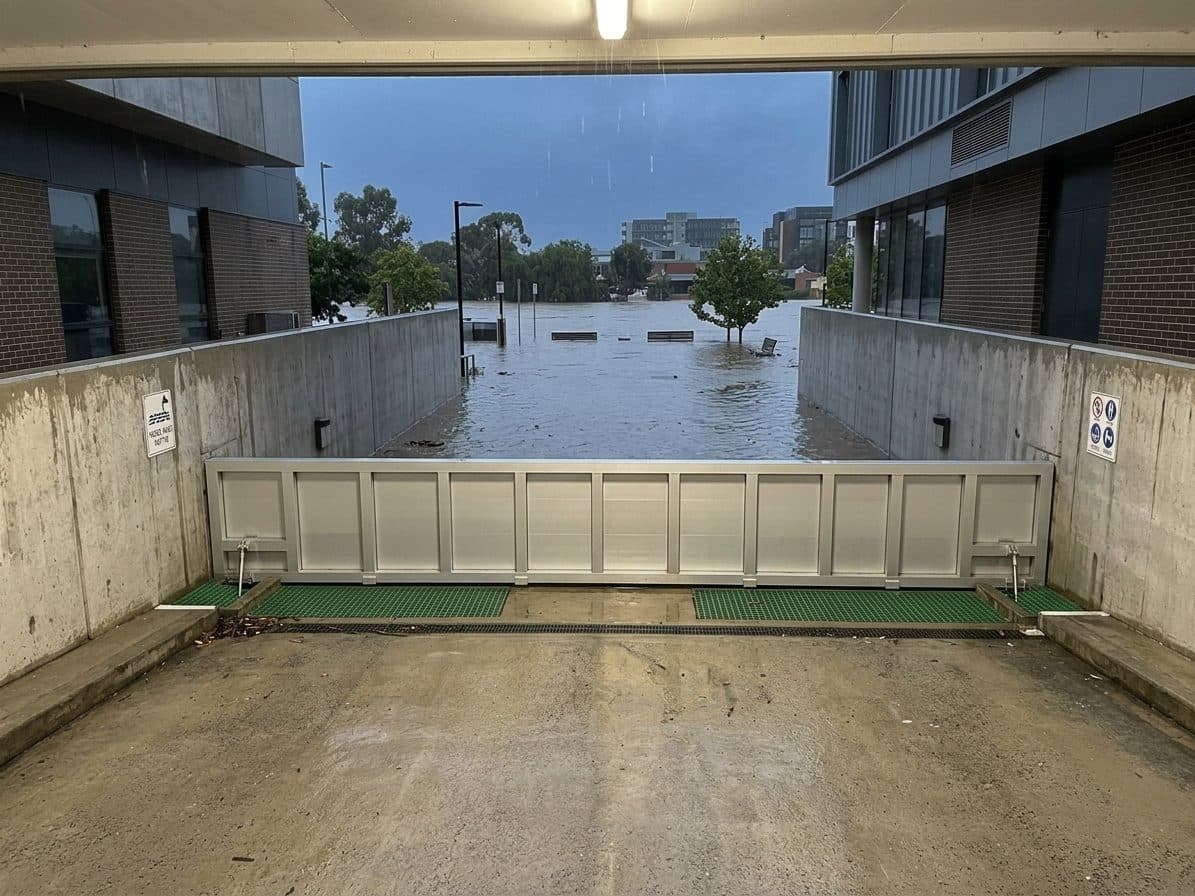
Automatic flood gates use water-level sensing and an electrically powered hydraulic system. When the configured water level is reached, the system raises the barrier; remote or central controls lower and reset it. They are quoted after a site assessment rather than sold at a fixed catalogue price. For a loading dock or vehicle entry without dependable power, a mechanical passive flood barrier is raised by the floodwater itself and is trafficable to 20 tonnes GVM when fully lowered.
For warehouses storing high-value stock, refrigerated goods, or hazardous materials, the economics shift decisively toward automatic systems at the critical entry points. The manual alternatives are excellent where staff can be reliably present; automatic gates are the correct specification when that assumption does not hold.
How do you size barriers to your flood risk level?
Every barrier has a rated depth — the maximum water height it will hold. Match this against your site's realistic flood scenario. The BOM flood history tool and state emergency services provide historical flood depth data for most AU postcodes:
- Low risk (overland flow, light rain events): 200–400 mm barrier depth is usually sufficient
- Moderate risk (creek or stormwater overflow): 500–800 mm is a more appropriate design depth
- High risk (catchment or riverine flooding): Engineered solutions and levee assessment may be required alongside off-the-shelf barriers
Over-specifying by one level is worthwhile insurance. A barrier rated at 600 mm provides far more confidence than one rated at 300 mm if the actual event reaches 350 mm. For sites in Queensland or northern New South Wales — where catchment rainfall can be sudden and severe — the Queensland Disaster Management portal provides site-specific flood mapping tools that complement BOM forecasts.
What storage and deployment logistics does an industrial site need?
A barrier stored behind a pallet two warehouses away from its deployment point is effectively useless. Plan storage as carefully as you plan selection:
- Assign a named storage location for each barrier set, close to the door it protects
- Label each set clearly by door — "Dock 2 barrier", not a generic description
- Assign primary and backup deployment personnel for each opening
- Store spare seals and any deployment tools with the barriers, not in a separate toolroom
- Run a full dry deployment before the wet season — most problems appear here, not during a real event
Aluminium demountable barriers store flat against a wall or in a purpose-built rack. The full set for a 3 m opening typically weighs under 25 kg total, meaning one person can carry, position, and lock the panels in a single trip.
What equipment protection measures should a warehouse or factory include?
Flood barriers stop water at the perimeter. Inside the facility, a second layer of equipment protection reduces loss when the perimeter is breached or when a slow-drain event causes shallow standing water:
- Elevate critical machinery on plinths if floor-level flooding is a realistic scenario at your site
- Store chemicals, lubricants, and flammables above the projected flood height — this is also a requirement under state dangerous goods regulations
- Document equipment serial numbers and purchase records for insurance — this speeds claims considerably
- Confirm that electrical switchboards and distribution panels are above projected flood height; if not, raise or relocate them
Which flood protection approach suits a multi-building industrial campus?
Large facilities with multiple buildings often have a mix of opening types, flood exposure levels, and staffing patterns across the site. A tiered approach works best:
Tier 1 — automatic at the boundary: Install automatic flood gates at any entry that is wide, low, and likely to be unattended during a flood event. Carpark ramps, loading dock aprons below site grade, and any opening in a known inundation zone are candidates.
Tier 2 — demountable aluminium at the building perimeter: Fix the side posts at every significant personnel and roller door opening. Store the aluminium panels adjacent to each door so a single staff member can complete the building seal in one sweep.
Tier 3 — water-activated bags as secondary fill: Keep a supply of water-activated sandbags at each building for threshold gaps, drain sealing, cable entries, and any irregular-profile opening that a rigid panel cannot cover. Each 270 g bag swells to 18–22 kg in 2–3 minutes — the fastest deployable flood fill available.
Commercial flood protection checklist for warehouses
A workable industrial flood plan covers:
- Every vulnerable opening mapped and measured with clear dimensions on record
- Barrier type and depth rating confirmed for each opening against realistic flood scenario data
- Barriers stored at or near each deployment point, labelled by location
- Named primary and backup staff for each barrier set
- Written trigger criteria (weather warning level, rainfall threshold, or visible water at the entry)
- Floor drain backflow prevention valves or plugs installed and tested
- Equipment elevation plan in place for critical machinery
- Annual pre-season deployment drill with timing recorded
- Post-event inspection checklist for seal condition and panel integrity
For sites with after-hours operations or high-value contents, review the plan with your insurer. Many commercial policies include flood risk assessment credits for documented preparation and engineered barriers.
FAQ
What is the difference between waterproofing and flood protection for a factory?
Waterproofing reduces baseline water ingress through building fabric. Flood protection plans for an active flood event — selecting barriers rated to the expected depth, assigning deployment roles, and defining a trigger for action. Both are required for a complete industrial risk plan.
Which flood barrier is best for a warehouse loading dock?
For a fixed dock opening, aluminium demountable barriers made to measure are the practical default — one person can deploy a set in under 10 minutes. For unattended sites, automatic flood gates can be assessed where water-level sensing, electrical supply and hydraulic controls suit the opening.
Can one person deploy industrial flood barriers?
Aluminium demountable barriers are designed for single-person deployment in under 10 minutes per set. ABS systems are similarly manageable alone. Heavier custom-engineered systems may require two people — confirm with the product specification.
Do automatic flood gates need maintenance?
Yes. The barrier, seals, sensors, electrical controls and hydraulic system require routine inspection and maintenance in line with the supplied operating instructions.
What flood depth do most off-the-shelf warehouse barriers cover?
Most off-the-shelf products protect to 300–600 mm. Industrial-grade and custom-engineered solutions can reach 1,000 mm or more. Always confirm rated depth before purchasing.
Can warehouse flood protection be claimed as a business expense?
Generally yes — consult your accountant. Equipment used to protect commercial premises from loss is typically deductible as a capital asset or operational expenditure depending on cost and use.
Useful external references
- Bureau of Meteorology severe weather warnings
- SafeWork NSW emergency planning
- Queensland Disaster Management flood maps
For a site-specific product recommendation and opening dimensions assessment, contact us. We supply to warehouses and industrial facilities across Australia.
For barrier selection across every opening on a commercial site — design depth bands, deployment roles, and lease and insurance responsibility — see commercial flood barriers.
Recommended next step
Match the guide to a flood barrier option.
These are the product pages and guides most relevant to this topic. Use them to compare flood barriers Australia-wide, then request a site-specific recommendation.