Article · 28 May 2026 · Updated 12 September 2026
Flood Preparation Checklist Australia
A step-by-step flood preparation checklist for Australian homeowners and businesses — what to do at Watch, Warning, and Emergency Warning stages.

Act at the Watch stage — not the Warning. Most preventable flood damage occurs when property owners wait for the Bureau of Meteorology to upgrade an alert before taking action, by which time barriers are unavailable, couriers are not delivering, and water is only hours away. This checklist organises preparation by BoM alert stage so you know exactly what to do and when, covering every opening type from standard doorways to garage roller doors to unattended strata car parks.
For a full overview of barrier options for Australian properties, see the guide to flood barriers for Australian homes and businesses.
What does each BoM flood alert stage mean?
The Bureau of Meteorology issues three alert levels for flooding in Australia. Understanding the lead times associated with each stage is as important as knowing the recommended actions.
Flood Watch — Flooding is possible if rain develops as forecast, typically 12 to 48 hours out. At this stage, flooding is not certain, but the preparation window is open. Deploy barriers, move assets, and confirm your flood kit is ready. The Watch stage is when you should act.
Flood Warning — Flooding is expected in specific river catchments or locations named in the warning. Time is now measured in hours, not days. If barriers have not been deployed and vehicles have not been moved, start those tasks immediately. The NSW State Emergency Service (SES) can be reached on 132 500 for sandbag collection points and evacuation support.
Emergency Warning — Flooding is imminent or occurring. Evacuate if directed by SES or Queensland Disaster Management. Do not attempt to drive through floodwater — 150 mm of moving water can knock an adult off their feet; 300 mm is sufficient to float a standard vehicle.
The practical implication of the BoM stage framework is straightforward: by the time a Flood Warning is issued, the action window is already closing. Hardware store sandbag stocks deplete within hours of a Watch being issued. The only reliable approach is to have barriers stored and ready before the flood season begins, then deploy them at the Watch stage when time is on your side.
What should you do at the Flood Watch stage?
The Watch stage is your working window. A 12 to 48 hour lead time is enough to deploy barriers, photograph contents for insurance purposes, move vehicles to higher ground, and ensure your household is prepared. Work through this checklist as soon as a Watch is issued for your area.
-
Check the BoM app and register for alerts. Open the Bureau of Meteorology national flood warning service and locate active warnings for your catchment. Enable push notifications so you receive automatic updates as alert levels change.
-
Locate your flood barriers and check their condition. Retrieve stored barriers from your shed, garage, or cupboard. Check for cracking in Oxford barrier seals, corrosion on aluminium panels, and confirm that all water-activated sandbags remain sealed in their original packaging.
-
Deploy barriers at all ground-level entry points. Place barriers across every door, roller door, side entry, and low-threshold window at ground level. Do not wait for water to be visible in your street before acting.
-
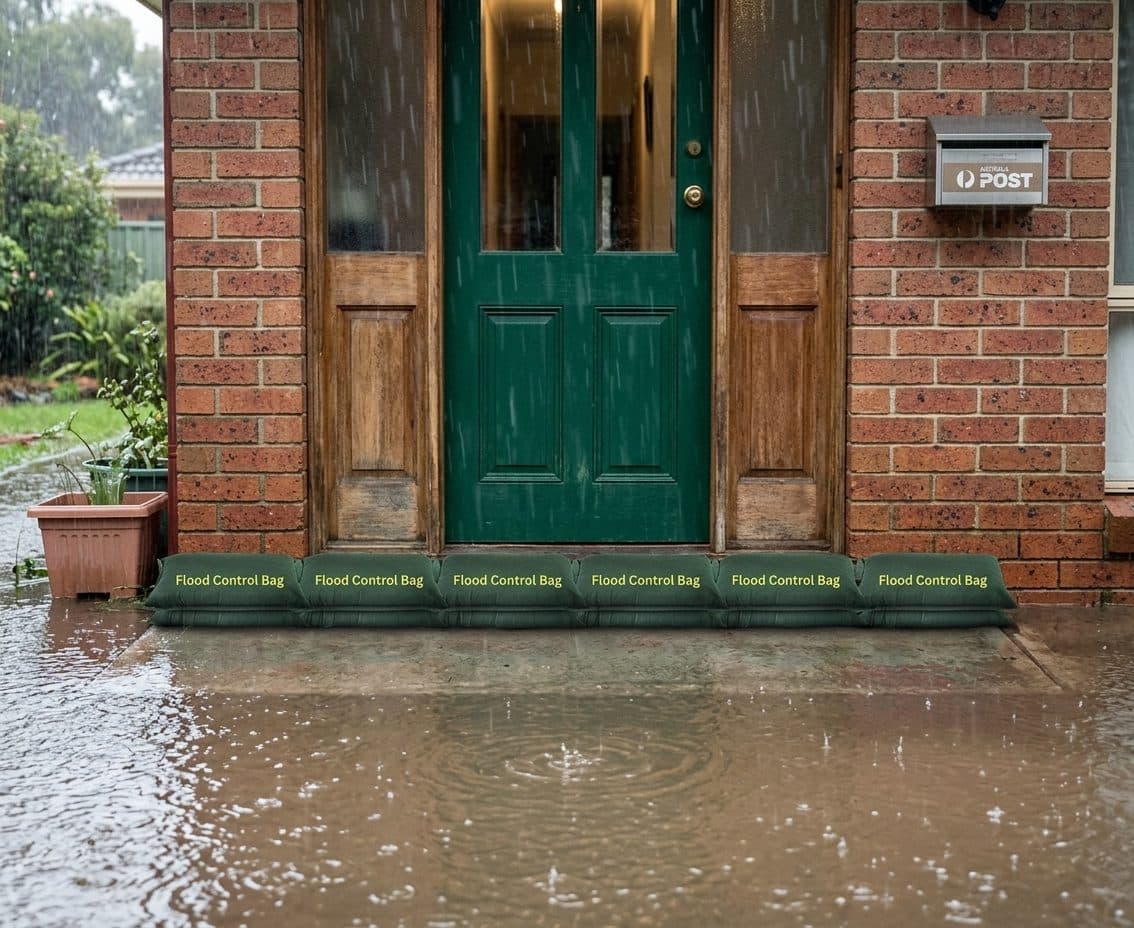
Address the garage roller door base seal. Place water-activated sandbags along the base of the roller door to fill the gap between the door seal and the concrete. Each bag activates to 600 × 400 × 120 mm within 2–3 minutes of contact with fresh water and weighs 18–22 kg when fully expanded. Two bags in a row across a single-bay door close the base gap effectively.
-
Extend Oxford barriers across wider openings. Oxford barriers adjust from 150 mm to 1,300 mm wide and protect against water depths up to 900 mm. For a double garage bay (approximately 2.4 m wide), link two 2-packs end-to-end. Water pressure on the upstream face presses the fabric base down onto the surface to form a seal, so no anchoring is required.
-
Move vehicles to higher ground. If your driveway slopes toward the property, or your building has a basement car park, move vehicles to elevated street parking before rain arrives. Flooded vehicles are one of the most common and costly domestic flood damage outcomes.
-
Clear gutters, downpipes, and drainage channels. Surface water that cannot drain quickly backs up against doorways and low entries. A clear drainage path reduces the head pressure your barriers need to hold and slows the rate of water accumulation around your building.
-
Photograph your contents. Take time-stamped photographs or video of all rooms, stored items, and vehicle condition. This documentation is what your insurer will request if you make a claim, and it is far easier to gather before a flood than after.
-
Move high-value items off the floor. Electronics, documents, business stock, and machinery should be raised at least 300 mm above floor level. Stack items on shelves, trestle tables, or pallets. If flooding is expected to be deep, move irreplaceable items to an upper storey.
-
Charge all devices and prepare a battery radio. Power outages frequently accompany significant rain events. Ensure all phones, tablets, and power banks are fully charged. A battery-powered or hand-crank radio keeps you connected to ABC Local Radio and emergency broadcasts if mobile networks are congested or unavailable.
-
Know your evacuation route. If directed to evacuate, use the highest-elevation routes out of your area. Avoid low-lying roads, underpasses, and creek crossings. Identify the route before the event — not during.
-
Confirm your flood barrier sizes match your openings. If a gap exists — an entry point not covered by a stored barrier — check stock availability immediately. Aluminium flood barriers are made to measure — the width is built to the opening and the height is set by panel count in 200 mm steps.
What should you do at the Flood Warning stage?
A Flood Warning means flooding is expected in your specific area. If the Watch-stage checklist is complete, the Warning stage should leave you with a short confirmation list. The heavy lifting should already be done.
-
Confirm all barriers are in place. Walk every ground-level entry and verify that each barrier is sealed against the door frame or roller door base. Look for any gaps where water could find its way under or around the barrier.
-
Fill water containers. Flood events often coincide with temporary disruptions to mains water supply. Fill baths, large storage containers, and any portable water vessels. Allow a minimum of 3 litres per person per day for three days.
-
Charge remaining devices and top up power banks. Power outages often begin during or shortly after the peak of the rain event, sometimes lasting 12 to 48 hours in severely affected areas.
-
Move pets and animals to safety. Ensure pets are in a secure, elevated location within the property or have been moved to safe boarding if flooding may be prolonged. Do not leave animals in garages or ground-floor rooms that may fill with water.
-
Contact the SES if you need assistance. NSW SES: 132 500. Queensland QFES: 13 74 68 (13 QGOV). SES can advise on local sandbagging collection points, evacuation timing, and safe routes out of affected areas.
-
Do not drive through floodwater. More Australians die in flood events from attempting to drive through water than from any other cause. A standard two-wheel-drive vehicle can be swept off a road at 300 mm depth. If the road ahead is flooded, turn around.
-
Monitor updates continuously. Track the BoM weather app, ABC Local Radio, and official SES and emergency management social channels throughout the event. Conditions can deteriorate rapidly in east-coast low events and tidal catchments.
If barriers have not yet been deployed by Warning stage, prioritise the opening most likely to admit water first — typically the door closest to where surface water accumulates on your block — rather than attempting to cover every entry at once.
What flood barriers and sandbags do you need?
The right product depends on the opening type, expected water depth, and whether the property is attended during a flood event. The following breakdown covers the most common scenarios.
For homes
Front and rear doors: Oxford barriers are the most practical general-purpose residential solution. Each 2-pack adjusts from 150 mm to 1,300 mm wide and protects against depths up to 900 mm. At 5.3 kg, the set stores flat in a cupboard and can be deployed without tools by one person in a few minutes.
Garage roller doors: Link two or three Oxford barrier 2-packs end-to-end for full-width coverage of a single or double garage bay. Add water-activated sandbags along the base to seal the gap between the roller door seal and the concrete floor — the irregular contact point that rigid barriers alone cannot fully bridge.
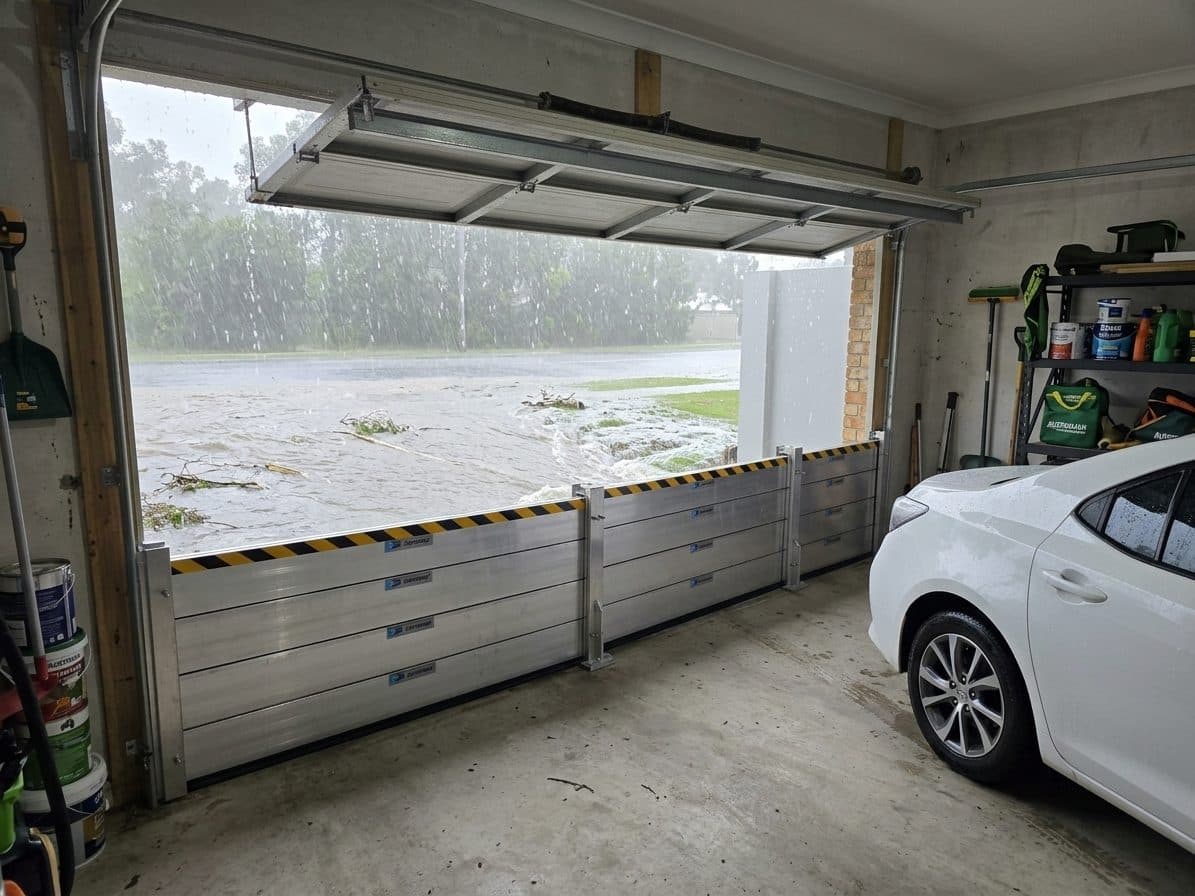
Sliding glass doors and low-threshold entries: Oxford barriers or water-activated sandbags both provide effective protection for moderate depths. For entries that flood regularly each season, or where depths above 600 mm are expected, aluminium flood barriers are made to measure, with a rubber seal and one-person deployment in under 10 minutes.
For businesses
Shopfronts and retail entrances: Aluminium demountable barriers are made to measure for the doorway, with a rubber seal and the height built up in 200 mm panel steps. A set deploys in under 10 minutes and is reused season after season. Sets are quoted per opening.
Warehouses and loading bays: ABS portable flood barriers suit wide roller doors and loading bay entries. The 8-panel modular format configures to any opening size and deploys manually without tools. Multiple packs can be linked for openings wider than a single bay.
Unattended sites — car parks, storerooms, and common areas: Automatic flood barrier systems use water-level sensing and an electrically powered hydraulic lift. They can be assessed for basement car parks, shared-access storerooms and other sites where manual deployment is not practical. See the full guide to automatic flood gates for car parks and unattended sites for installation details.
A useful rule of thumb: if someone must be present to deploy the barrier, it is a manual system. If the site may flood when unattended, the correct solution is automatic.
How do you build a flood emergency kit?
Flood barriers protect your property from water entry. A flood emergency kit addresses everything else — power outages, evacuation, and disruption to mains services. Every household in a flood-prone area should maintain both.
Per person, store:
- Three-day supply of non-perishable food and 3 litres of drinking water per day
- Required medications plus copies of prescriptions and dosage notes
- Waterproof bag containing insurance policy and insurer contact number, identification documents, Medicare card, and property title or lease agreement
For the household:
- Battery-powered or hand-crank AM radio — ABC Local Radio provides continuous emergency updates when mobile networks are congested or offline
- Torch with spare batteries, or a solar/hand-crank torch
- Phone chargers and at least one portable power bank, fully charged before the event
- First aid kit
- Cash in small denominations — ATMs fail in power outages and many businesses in flood-affected areas cannot process card payments during the event
- Pet supplies and carriers, if applicable
- Change of clothes and footwear per person in a waterproof bag
The emergency kit works alongside flood barriers, not instead of them. For guidance on what to do once flooding is already underway, see what to do if flooding.
Do the same flood preparation rules apply to renters and strata properties?
Yes, with some practical differences in how barriers are sourced and deployed.
Renters can use water-activated sandbags and Oxford barriers at any entry point without modification to the property — neither product requires any installation, drilling, or permanent attachment. Both deploy manually in minutes. If you are in a rental property and flooding is likely, notify your property manager, document the property condition before the event with photographs, and retain copies of your communications. You are entitled to protect your rented home from flood damage.
Strata properties present a different challenge at common-area access points, particularly basement car parks and shared ground-floor entries. Body corporates hold responsibility for common area flood management, but most standard strata emergency plans do not include barrier deployment procedures or stored equipment. Water-activated sandbags provide a practical stopgap for ground-level pedestrian entrances, and Oxford barriers can be used at individual apartment entry doors in ground-floor units.
For unattended basement ramps and shared vehicle access points, an automatic hydraulic flood barrier is a site-specific engineered option. The installation requires water-level sensing, electrical power and a hydraulic control system. Full guidance is available in the guide to automatic flood gates for car parks and unattended sites.
For a direct comparison of barrier types across different property and tenure arrangements, see flood barriers vs sandbags.
What flood preparation mistakes do most Australian households make?
Waiting for a Flood Warning before acting. The Watch-to-Warning window is typically 12 to 24 hours. In that window, hardware store sandbag stocks are depleted, courier deliveries cannot be guaranteed, and adjacent streets may already have surface water. Acting at the Watch stage avoids this entirely.
Relying on sandbags without any surrounding support. Water-activated sandbags expand to 18–22 kg each and form a solid initial barrier, but under sustained water pressure, individual unsupported bags shift sideways. Place them against a door frame, wall face, or rigid barrier to hold them in position. For expected depths above 300 mm, supplement with a rigid barrier rated to the appropriate height.
Forgetting side-entry doors and the garage roller door base seal. Most flood damage enters through the point of least resistance, not the most obvious entry. Front and rear doors are checked; laundry side entries, low-threshold garage pedestrian doors, and the gap at the base of the roller door seal are overlooked. Walk the full ground-level perimeter and seal every opening.
Not moving vehicles until water is already rising. A flooded vehicle is one of the most expensive and avoidable outcomes of a residential flood event. Move vehicles to elevated parking at the Watch stage.
Using a single layer of sandbags for depths above 200 mm. Water-activated sandbags activated to 120 mm height provide adequate protection for shallow surface water. For expected depths of 300 mm or more, stack a second layer, or use a rigid barrier rated to the required height. The flood barriers vs sandbags comparison covers depth ratings across all product types.
What should you do next?
The most effective flood preparation is the preparation completed before the season begins — not the preparation assembled at 6 am on the morning of a Flood Watch. Review the full range of flood barriers for Australian homes and businesses, confirm what you have in storage, and order any gaps now.
For data on what a single unmitigated event costs — repair breakdowns, the insurance gap, and the return-on-investment case for barriers — the flood damage cost guide for Australian properties sets out the numbers in full.
If you are unsure which barrier suits your openings, contact us with your door or opening dimensions. We will recommend the right product and quantity before the next warning arrives.
Recommended next step
Match the guide to a flood barrier option.
These are the product pages and guides most relevant to this topic. Use them to compare flood barriers Australia-wide, then request a site-specific recommendation.