
Article · 10 October 2024
Flood Protection for Small Business AU
Australian small businesses lose trading days, not just property, when flooding hits. Here is how to build a flood plan your team can actually execute.

For most small businesses, the largest flood cost is not physical damage — it is lost trading days, disrupted supply chains, and customers who find alternatives while the doors are closed. Flood protection is fundamentally an operations problem: a response plan your team can execute on a busy day with reduced staffing and compressed lead times.
What should a small business protect first?
Two zones produce the highest return on flood protection effort:
Customer-facing entries — the doors, shopfronts, garages, or loading bays the business depends on to operate. Water entering through these points stops trading immediately. Protection here reduces downtime directly.
Core business systems — payment terminals, point-of-sale equipment, essential inventory, communications infrastructure. Loss of any of these extends downtime beyond the physical flood event into IT and equipment recovery.
The common mistake is trying to protect every edge at once. A plan that attempts full coverage on the first deployment is slower to execute and harder to maintain than a staged approach. Prioritise the primary entry points first; address secondary gaps with the preparation time remaining.
This staged logic applies to product choice as well. A simple system that the team deploys consistently is worth more than a sophisticated one that gets skipped under time pressure.
What flood products suit different business types?
Matching barrier type to opening type is the most important decision in flood preparation. Using the wrong product for an opening adds deployment time and reduces reliability.
Shopfronts and glass entrances
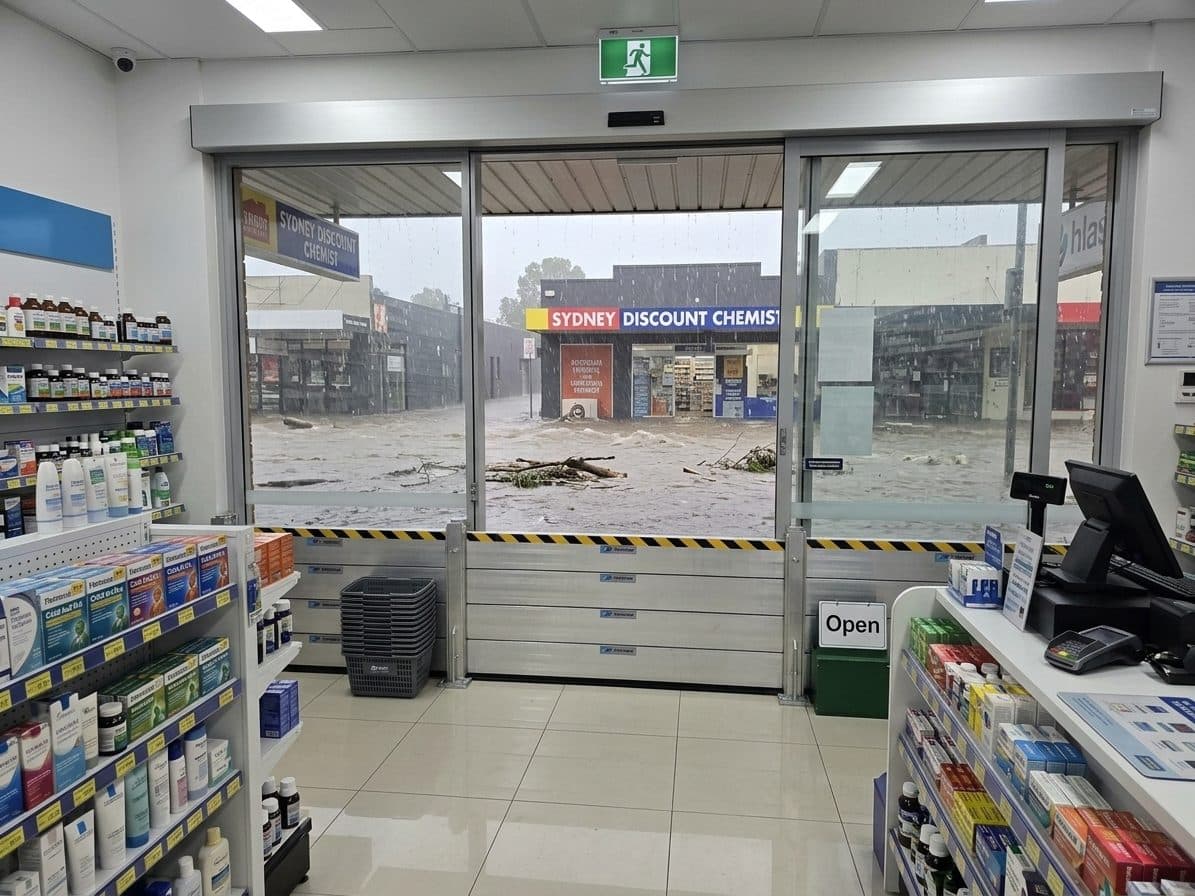
Aluminium demountable flood barriers are the standard solution for retail and hospitality shopfronts. A single set is built to the measured opening, deploys in under 10 minutes by one person, and provides a professional-looking seal that does not damage the facade. Marine-grade aluminium construction takes repeated seasonal use with minimal maintenance. Each set is made to measure and quoted for its opening.
Roller door entries
Roller door bottom seals compress over time and provide little resistance to water under pressure. A two-tier approach works reliably: water-activated sandbags at the base (which activate on contact with rising water in 2–3 minutes) combined with a demountable panel above covers most scenarios up to 600 mm depth. The $59 pack of 6 suits initial coverage of a single roller door entry.
Wide entries and loading docks
Commercial loading docks typically exceed 3 metres in width. ABS portable flood barriers are modular and reusable, suiting wider spans and irregular dock configurations. The 8-panel pack allows flexible configuration to match opening geometry.
Properties without permanent on-site staff
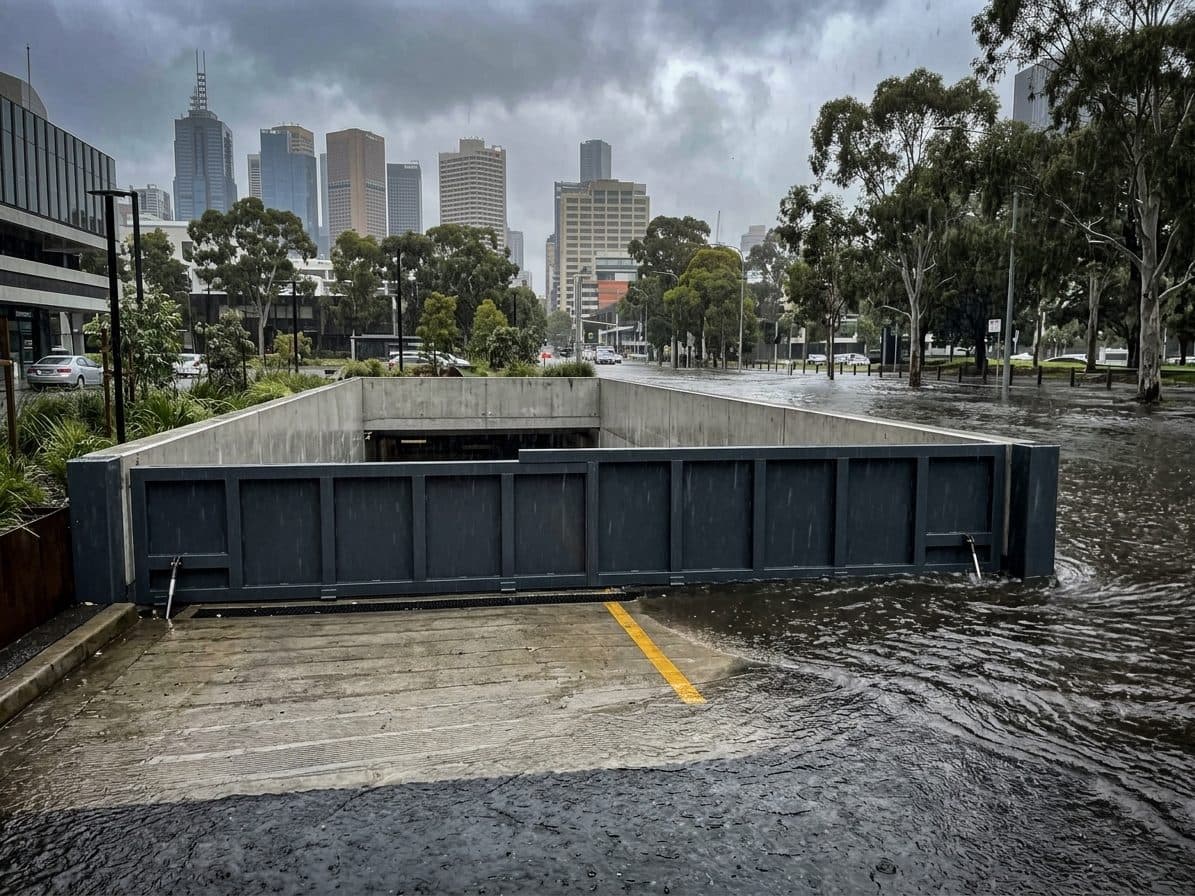
Automatic flood barrier systems use water-level sensing to trigger an electrically powered hydraulic lift at the configured level. They can be assessed for businesses where no one is guaranteed to be present when an event develops; basement entries, car park ramps and overnight service entries are typical applications.
How do you build a flood response plan that actually works?
The barrier is only useful if it gets deployed. The gap between owning flood protection equipment and using it reliably is almost always a people and process problem, not a product problem.
Three named roles cover most small business scenarios:
- Site lead — overall coordination; decides when the warning threshold has been met and activates the plan
- Deployment owner — physically installs barriers in the correct sequence at assigned entry points
- Communications owner — notifies customers, suppliers, and staff; updates Google Business Profile and social channels; contacts insurers if needed
Role clarity prevents the most common failure mode in small business flood response: the situation where everyone assumes someone else has activated the plan. In a business with two or three staff members, these roles may overlap — the site lead and deployment owner can be the same person in a solo operation. The point is explicit assignment, not division of labour.
Add a single line to the staff handbook: who monitors BOM warning updates, and what threshold triggers deployment. Removing the subjective judgement call from the trigger eliminates hesitation during a time-pressured event.
A complete business-ready pre-season checklist — including risk assessment, entry-point audit, staff role assignment, and drill schedule — is available in the flood preparation checklist for Australian homes and businesses.
When should a business activate its flood plan?
Do not rely on subjective assessments of whether the weather looks serious. Use official channels with a predetermined threshold:
- Bureau of Meteorology warnings — Severe Weather Warning with heavy rainfall and possible flooding in your area
- NSW SES alerts — Flood Watch or Flood Warning for your local government area
- Queensland Disaster Management — Flood Alert or Flood Warning for your region
A common threshold for retail and hospitality businesses is: activate at Flood Watch, not at Flood Warning. Flood Watch is issued 12–24 hours before expected impact; Flood Warning may arrive with 2–4 hours. The difference between those lead times is the difference between a calm, rehearsed deployment and a rushed improvised response.
What are the most common flood vulnerabilities for small businesses?
Commercial premises in Australian cities share a set of recurring flood entry points that go unaddressed until the first event:
Degraded roller door seals. Bottom seals on roller doors compress and crack over years of use. A visually intact roller door can admit several centimetres of water per hour through its base seal during a flood. Check seal condition annually — replacement is inexpensive compared to flood damage.
Sunken driveways and ramps. Premises with a driveway that descends from the street or a loading bay ramp below street level funnel surface water directly toward the building. These entries need permanent or rapidly deployable protection — they will fill with water regardless of whether adjacent properties flood.
Cable and pipe penetrations. Electrical conduit, plumbing, and data cable entries through external walls at ground level create water entry paths that are invisible until a flood. Waterproof seal penetration foam or a sandbag laid across a penetration cluster addresses most of these.
Backflow through floor drains. During significant flood events, municipal stormwater systems can surcharge and push water back up through floor drains. Businesses with multiple floor-level drains in workrooms, kitchens, or wet areas are particularly exposed. Backflow prevention caps or plugs installed before an event are one of the lowest-cost flood protections available.
Adjacent property runoff. A higher neighbouring property, a commercial car park, or a large paved area that concentrates runoff toward your entry point can produce flooding independent of any street-level flood event. Identify these in a dry-weather walk-around.
How do you compare flood protection options for a small business?
| Scenario | Recommended product | Approximate cost | Deploy time |
|---|---|---|---|
| Retail shopfront, single door | Oxford Barriers | From $449 / 2-pack | Under 5 min, 1 person |
| Shopfront entry | Aluminium demountable barriers | Quoted per opening | Under 10 min, 1 person |
| Roller door with degraded seal | Water-activated sandbags + demountable panel | From $59 + a quoted panel set | Under 10 min |
| Loading dock over 3 m | ABS portable flood barriers | Contact for quote | 15–20 min, 2 people |
| Unattended basement or ramp | Automatic flood gate | Site assessment required | Water-level sensing and hydraulic control |
| Secondary gaps and cable entries | Water-activated sandbags | $59 / pack of 6 | 2–3 min per location |
What recovery steps reduce a business's downtime after flooding?
Recovery speed determines how long customers go without service. Businesses that prepare for recovery before an event consistently reopen faster than those that improvise.
Maintain a photographic asset record. A current record of all equipment, stock, and fittings — updated annually — removes the most time-consuming element of insurance claims. Store it off-site or in cloud storage.
Know your insurer's claim process. Most commercial flood policies require notification before clean-up begins. Find the claim process number and notification requirements before any event, not during one.
Post-event debrief. Run a 20-minute review after any rain event that tested the plan — what was slow, what worked, what was missing. Businesses that do this consistently improve their response time without significant additional expenditure.
Staged reopening. Partial reopening — phone and online orders, click and collect, reduced trading hours — during clean-up maintains customer relationships and cash flow while full operations are restored. Communicate clearly through social media and Google Business Profile.
For a recommendation tailored to your business, its entry points, and your budget, contact the team for a no-obligation assessment.
For barrier selection across every opening on a commercial site — design depth bands, deployment roles, and lease and insurance responsibility — see commercial flood barriers.
Recommended next step
Match the guide to a flood barrier option.
These are the product pages and guides most relevant to this topic. Use them to compare flood barriers Australia-wide, then request a site-specific recommendation.