
Article · 14 May 2026
East Coast Low Flood Preparation Guide
East coast lows strike NSW and SE Queensland with very little warning. Learn how to protect your property before the autumn–winter season peaks.
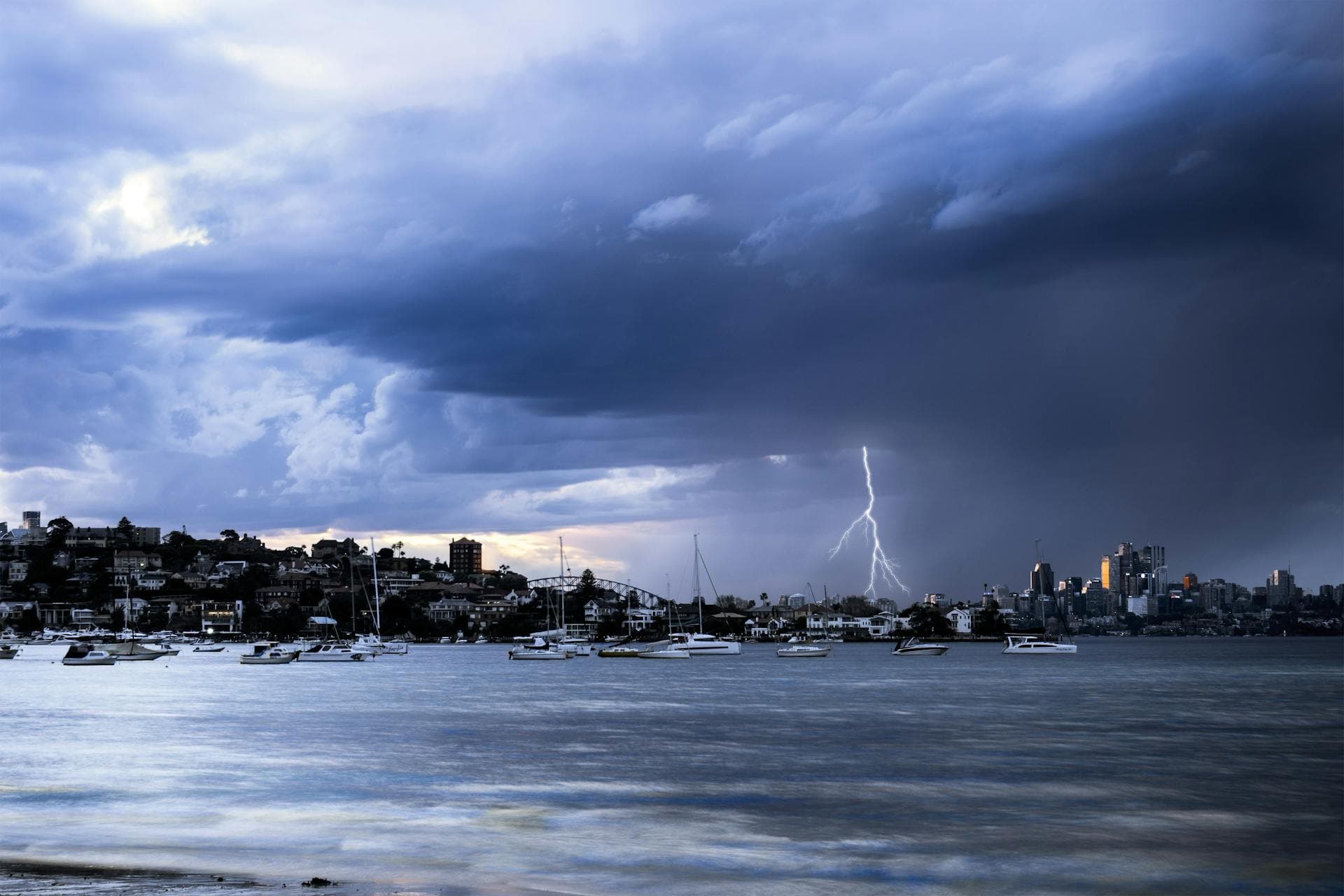
East coast lows are the most common source of flash flooding for residential and commercial properties across coastal NSW and southeast Queensland. When a system deepens rapidly overnight, a severe weather warning may arrive only 12–24 hours before impact — leaving a narrow window to act. The time to prepare is before the season peaks, not after the warning appears.
What is an east coast low and how does it form?
An east coast low is a rapidly deepening low-pressure system that develops just offshore from the NSW and southern Queensland coastline, typically over the Tasman Sea. Unlike tropical cyclones, which draw energy from warm tropical seas, east coast lows form in temperate latitudes through baroclinic instability — a process driven by the temperature contrast between cold polar air and warm subtropical air masses. This mechanism makes them difficult to forecast more than 24–48 hours ahead.
The Bureau of Meteorology records approximately ten east coast lows per year on average, with peak frequency between April and August. Autumn is the most dangerous window because sea surface temperatures remain warm from summer while cold southerly air masses begin pushing northward — the exact combination that accelerates low-pressure development.
Once formed, a system can intensify at a rate of 24 hPa or more within 24 hours, a threshold meteorologists call "explosive cyclogenesis." For property owners, this translates directly into compressed warning lead times. A system that appears manageable on Tuesday morning can be producing dangerous surf, coastal erosion, and inland flash flooding by Tuesday evening.
Where does east coast low risk fall hardest?
The geographies most exposed to east coast lows align precisely with where Australians live in the highest densities. The coastal corridor from Newcastle through Sydney to Wollongong receives the full effect of systems that track southward along the continental shelf. Brisbane's southeastern suburbs and the Gold Coast hinterland are also regularly affected during autumn, particularly when systems track up the coast from the south.
Narrow coastal catchments behind these cities amplify rainfall totals significantly. A regional average of 150 mm in 24 hours may translate into 250–350 mm over the escarpment above Wollongong or in the Blue Mountains foothills west of Sydney. That concentrated runoff drains into creek systems that run through residential suburbs, producing flash flooding that can peak within two hours of the heaviest rain.
Older residential and commercial properties in these areas face compounding vulnerabilities. Ground-floor entries and garages built before current flood-resilience standards often rely entirely on stormwater drains — infrastructure designed for average rainfall that saturates within the first hour of an intense event. Once the drainage network is overwhelmed, water finds the lowest-lying openings: door thresholds, garage roller doors, loading dock entries, and shopfronts at or slightly below kerb level.
How much damage do east coast lows cause?
Australia's 2025–26 weather season drew more than $459 million in Commonwealth recovery assistance across NSW, Queensland, Victoria, Tasmania, and the Northern Territory — the most expensive single season on record. While cyclones and monsoon flooding drove much of that cost, east coast low events contributed significantly to insured losses across the Sydney basin and Hunter Valley.
Insurance data consistently shows that residential flood claims from east coast low events cluster in three categories: garage contents, ground-floor living areas, and home office or workshop spaces located at or below street level. Commercial claims skew heavily toward inventory loss, equipment damage, and trading interruption — losses that compound with each day the business cannot operate.
The financial trajectory is worsening. Higher rebuild costs, denser urban development in flood-prone areas, and ageing stormwater infrastructure mean that even a moderate east coast low can produce claims running into tens of millions of dollars across a single coastal catchment.
What protection options suit east coast low events?
The defining characteristic of east coast low flooding is speed. Unlike riverine flooding, which may develop over days, flash flooding from a coastal low can move from street-level surface water to dangerous depths within 60–90 minutes. Products must either be permanently installed or deployable within the warning window.
Rigid demountable barriers for primary entries
Oxford Barriers are freestanding and telescopic from 15–130 cm, suiting most residential doorways, garage entries, and commercial shopfronts up to standard widths. A single person can install them without tools in a few minutes. They store flat when not in use — significant when storage space is limited in urban homes and small commercial premises.
The from $449 per two-pack price point suits residential properties protecting a front door and a garage entry. For wider commercial openings, multiple barriers can be deployed side-by-side to cover the full width.
Water-activated sandbags for secondary entries and rapid cover
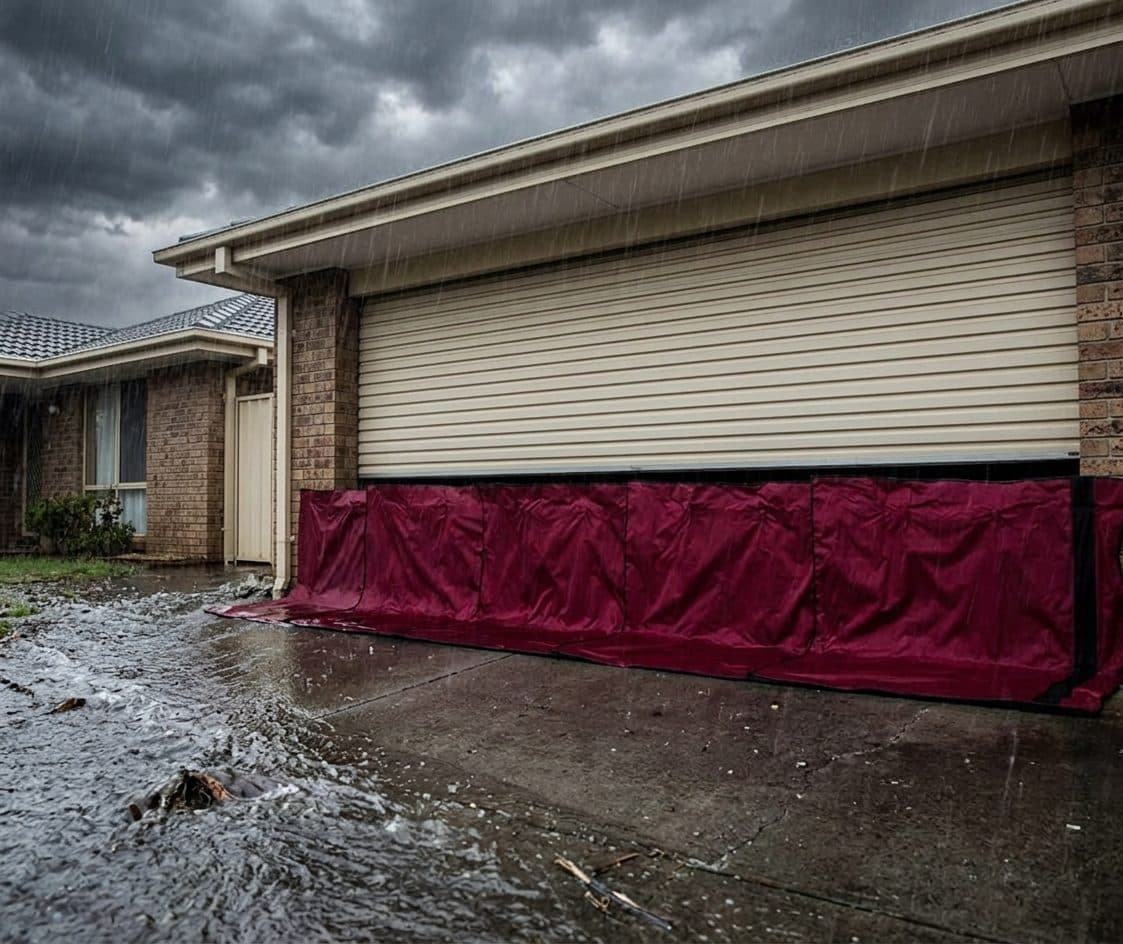
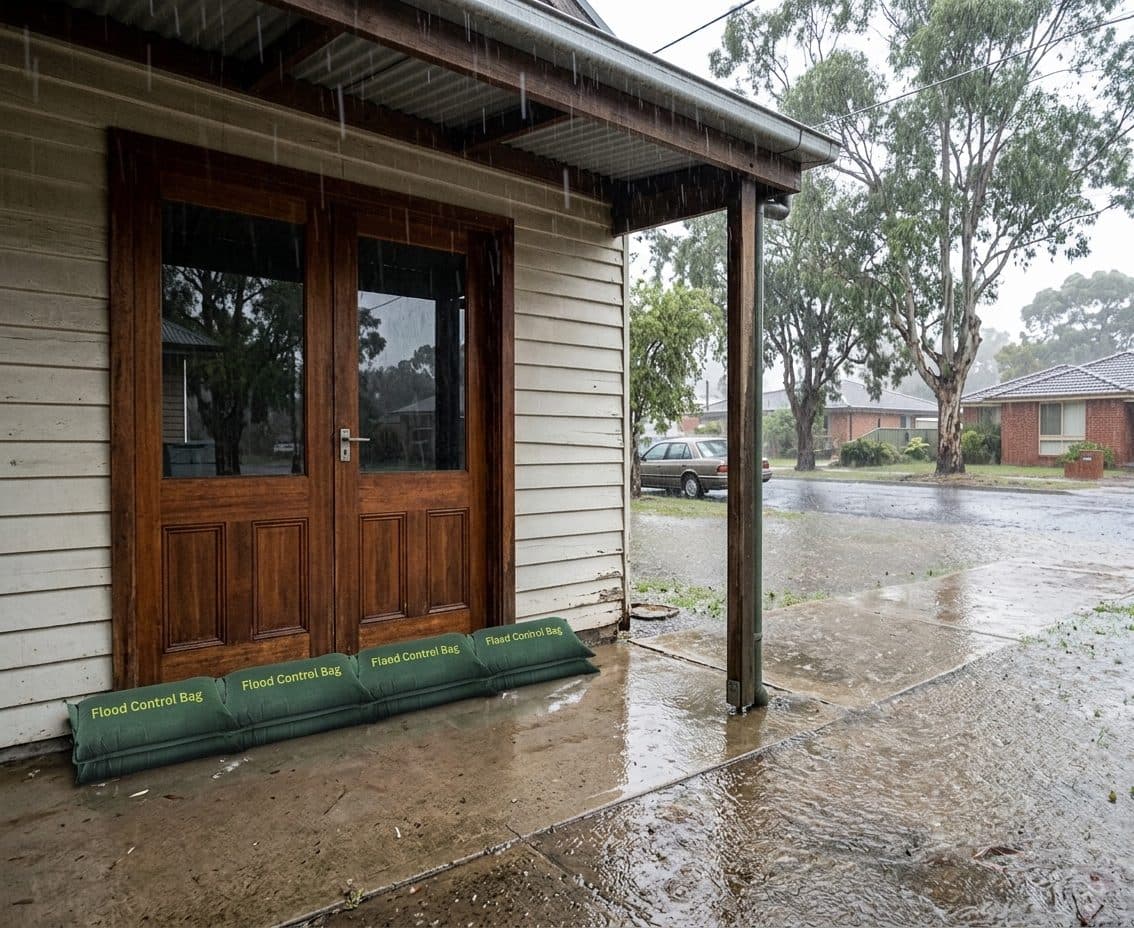
Water-activated sandbags fill a different role. Each bag in the $59 pack of 6 contains a sodium polyacrylate core that absorbs water and expands from 270 g to 18–22 kg within 2–3 minutes of contact — no sand, no filling, no shovels. This makes them the right choice for secondary access points, irregular gaps between rigid barriers, drainage covers, and cable entry points where a rigid panel cannot sit flush.
They also suit situations where the warning window is short and there is no time for a careful rigid-barrier installation. A stack of bags in the garage means protection is available regardless of how much lead time the event provides.
Automatic flood gates for unattended properties
For properties that may be unoccupied when a warning arrives — beach houses, commercial premises without 24-hour staff and basement car park entries — an automatic flood barrier system can reduce the dependency on manual deployment. These systems use water-level sensing and an electrically powered hydraulic lift, so a site assessment is needed to confirm the supply, controls and configuration before quoting.
A step-by-step property assessment for coastal NSW and SE Queensland
A 20-minute walk-around in dry conditions is worth more than a rushed response during a weather event. Work through the following:
Step 1 — Identify the lowest-lying entry points. Stand outside during moderate rain and watch where water naturally flows. Any doorway, roller door, or access gate that collects runoff is a barrier candidate.
Step 2 — Measure opening widths. Oxford Barriers and demountable aluminium barriers are sized to opening width. Write down the clear span of each entry you want to protect.
Step 3 — Check existing seals. Garage roller door bottom seals compress over time and provide little resistance to water under pressure. Cracked or flat seals should be replaced before relying on the door as a water barrier.
Step 4 — Identify secondary gaps. Cable entry points, drainage outlets, and gap-filled corners between rigid structures are common water infiltration paths. Note these for sandbag coverage.
Step 5 — Plan storage. Barriers and sandbags must be accessible within the warning window. Store them near the entry point they protect, not in a hard-to-reach roof space or back shed.
Comparing protection approaches by property type
| Property type | Primary risk | Recommended approach |
|---|---|---|
| Suburban house, front door | Surface water, 50–150 mm depth | Oxford Barriers, 2-pack |
| Suburban garage, roller door | Runoff channelling, 100–200 mm depth | Water-activated sandbags at base + Oxford Barrier above seal line |
| Ground-floor apartment entry | Stormwater overflow, shared drainage | Oxford Barriers at main entry, sandbags at secondary doors |
| Commercial shopfront, under 3 m | Flash flooding, pedestrian entry | Aluminium demountable barriers, single-person deployment |
| Commercial shopfront, over 3 m | Flash flooding, wide span | Multiple aluminium panels or ABS portable barriers |
| Property unattended when flooding | Site-specific | Automatic flood barrier with water-level sensing and hydraulic control |
When to act: the timing argument
The relevant question is not whether an east coast low will affect your property — it is whether you will have usable flood protection in place when one does. The autumn window from May to August is the peak season for these events.
Orders placed before the season peaks arrive in time for a dry-run installation — allowing barriers to be test-fitted, adjusted, and stored correctly before any urgency. Orders placed during or after a warning is issued may not arrive before impact.
The east coast low season is not a theoretical risk. It has produced some of the most costly and disruptive flooding events in Australia's recorded history — including events in Sydney, Newcastle, and Wollongong within living memory for most property owners.
For questions about matching barriers to specific openings or site configurations, contact the team.
Recommended next step
Match the guide to a flood barrier option.
These are the product pages and guides most relevant to this topic. Use them to compare flood barriers Australia-wide, then request a site-specific recommendation.