Article · 28 July 2026 · By Mike
Flood Protection Barriers Australia
Compare flood protection barriers for Australian homes and businesses: types, costs, and how to choose the right system before the next flood season.

Flood protection barriers for Australian homes and businesses come in five types, and the right choice depends on three variables: the flood mechanism your property faces, the size of the openings you need to seal, and how much warning time you will realistically have before water arrives. This guide covers all five types, maps them to the scenarios where they work, and provides the cost context needed to make a confident purchase decision before the next flood season.
What is a flood protection barrier?
A flood protection barrier is any device — temporary, semi-permanent, or automatic — that prevents floodwater from entering a building or site through an opening. In Australia the term covers a wide range of products: single-use sandbags, reusable cloth barriers, modular polymer panels, aluminium demountable panels, and engineered hydraulic gate systems. Each type suits a different combination of flood scenario, opening size, and warning lead time.
The Bureau of Meteorology issues flood watches for NSW, QLD, and VIC catchments seasonally and following major weather systems. Having the right barrier in storage before an event is the only reliable way to deploy it when those watches are issued — retailers and suppliers frequently sell out within hours of a public warning.
Why are Australian properties increasingly at risk from flooding?
Australia experiences more flood damage events per year than any other natural disaster category. According to the Insurance Council of Australia, the average residential flood claim runs to $30,000–$50,000 — a figure that has risen as both climate variability and urban density increase the impact of each event.
Three states carry the highest residential flood claim volume:
- Queensland — tropical cyclone remnants and river flooding, particularly in coastal and inland catchments from Cairns to Brisbane
- New South Wales — east-coast lows and river flooding, from the Hunter to the Hawkesbury-Nepean system and through the Illawarra
- Victoria — flash flooding and stormwater overload, often in suburbs with ageing drainage infrastructure
Most standard home and contents policies include flood cover, but premiums and excesses rise sharply after a claim. Flood protection barriers reduce the likelihood of a claim — and can support renewal negotiations with your insurer where mitigation measures are in place and documented.
What types of flood protection barriers are available in Australia?
Five barrier types are available for Australian properties. The table below compares them on the variables that matter most for a purchase decision.
| Barrier type | Best for | Deploy time | Price from | Max depth |
|---|---|---|---|---|
| Water-activated sandbags | Irregular gaps, stormwater entry points | 2–3 min per bag | $39 (4-pack) | 200–300 mm stacked |
| Oxford cloth barriers | Standard doorways, rapid response | Under 5 min | $449 (2-pack) | 900 mm |
| Aluminium demountable barriers | Doorways, shopfronts, garages to 3 m | Under 10 min | $890 per set | 1,000 mm |
| ABS portable modular panels | Wide entries, loading bays | 15–30 min | $1,659 (8-pack) | Variable by stack |
| Automatic flood gate systems | Unattended sites, carparks, basements | Zero — automatic | Site quote | Custom-engineered |
Water-activated sandbags are the most accessible entry point. Each bag stores flat at 270 g and swells to 18–22 kg within 2–3 minutes of contact with fresh water, forming an instant barrier across doorways, roller door gaps, and drainage entry points. They are single-use and suited to stormwater events and supplemental coverage.
Oxford barriers are a reusable cloth alternative with a telescopic width adjustable from 150 mm to 1,300 mm. The PVC-coated Oxford cloth uses water pressure to form a watertight seal and deploys in under five minutes without tools. A 2-pack covers one standard doorway to 900 mm depth.
Aluminium demountable flood barriers are marine-grade aluminium panels rated to 1,000 mm depth, with a 25-plus year service life. One-person deployment in under 10 minutes and a rubber base seal for a watertight fit make them the most practical reusable option for shopfronts, garages, and residential entries. Custom widths and heights are available for non-standard openings.
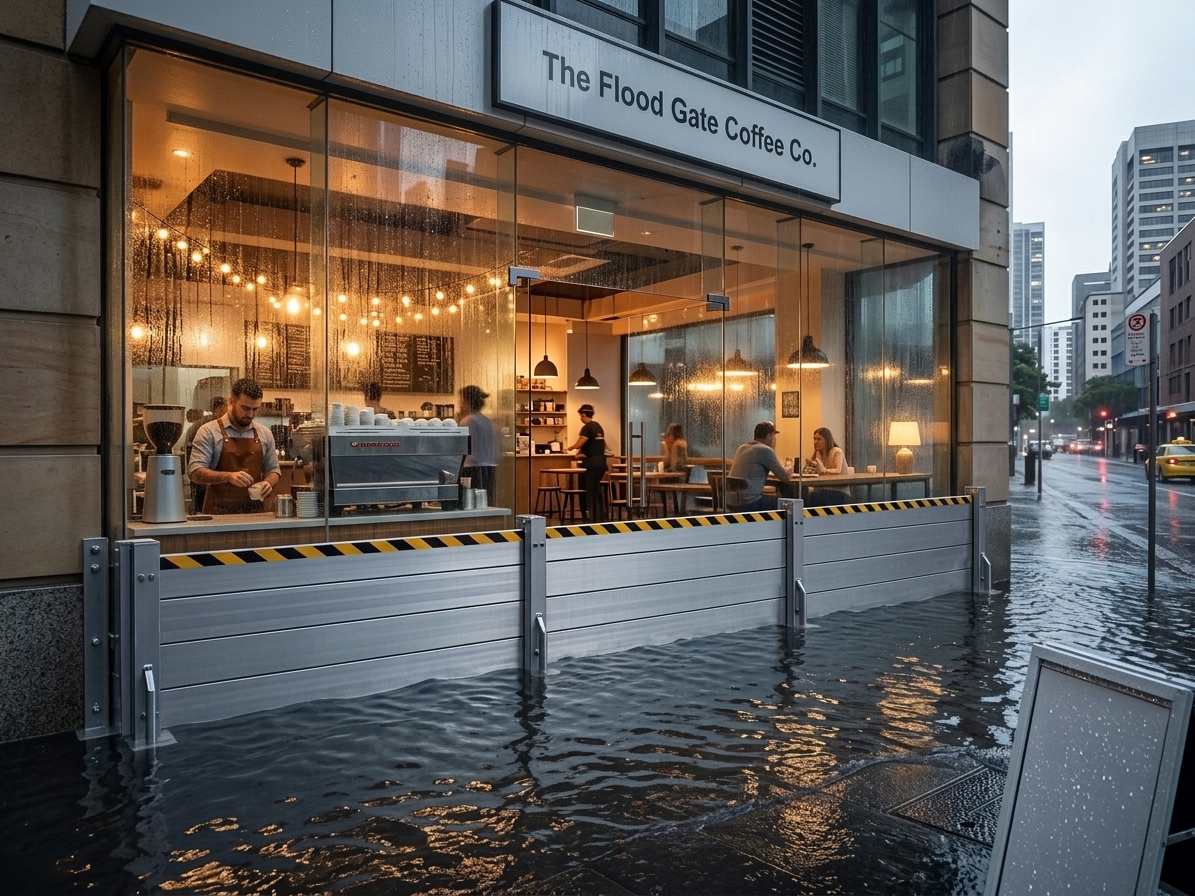
ABS portable barriers are modular polymer panels that link together to cover wider openings — garages, loading bays, and commercial entries that exceed the range of a single demountable set. An 8-panel pack covers a standard double garage door or loading bay entry.
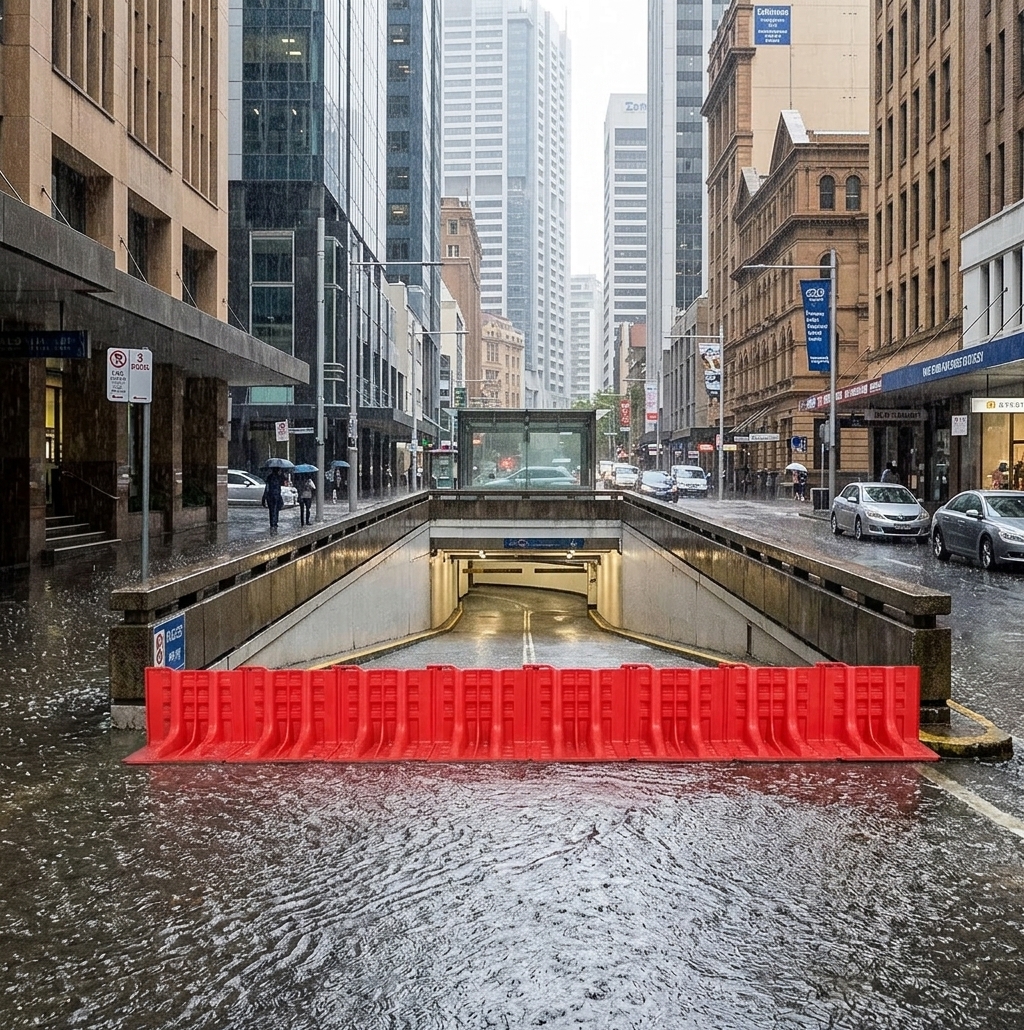
Automatic flood gate systems use water-level sensing and electrically powered hydraulic lifting to raise a barrier without manual deployment. They are the only option for unattended sites where staff cannot be relied on to respond before water arrives.
For a full technical comparison across all five types, see types of flood barriers in Australia.
How do you choose the right flood protection barrier?
The decision comes down to three practical questions. Work through them in order.
Step 1 — What type of flooding threatens your property?
The flooding mechanism determines how fast you need to respond and how high the water will rise.
River flooding (slow-rising, 6–48 hours of BoM warning) suits all barrier types. You have time to complete anchor installation for aluminium demountable systems and to supplement secondary gaps with sandbags.
Flash flooding or stormwater overload (fast onset, 30 minutes or less) requires a pre-positioned barrier or an automatic system. There is no realistic time to deploy and anchor a new barrier set once stormwater starts rising. Properties in inner-city suburbs where ponding in the street is the only visible warning fall into this category — and account for a large share of Australian residential flood claims.
Coastal storm surge involves higher sustained water loads and prolonged exposure. Engineered systems and a professional site assessment are the appropriate response; portable barriers are not designed for sustained hydrostatic pressure above 1,000 mm or for wave action.
Step 2 — What type of opening do you need to protect?
- Standard doorway (up to 1,300 mm wide): Oxford cloth barriers or aluminium demountable flood barriers
- Garage door or shopfront (1,300–3,000 mm): Aluminium demountable barriers (custom widths available) or ABS portable panels
- Loading bay or wide commercial aperture (over 3,000 mm): ABS portable flood barriers — panels link and stack to match any width or height
- Unattended carpark ramp, basement entry, or drainage outlet: Automatic flood gate system — raises without any manual deployment
- Irregular gaps, roller door bases, window wells: Water-activated sandbags as primary filler or supplemental coverage
Step 3 — How much warning time will you realistically have?
The Bureau of Meteorology issues three escalating warning tiers for flood events, each mapping to a different realistic deployment window:
Flood Watch (12+ hours ahead): Any barrier type can be deployed. The long lead time allows first-use anchor installation for aluminium demountable systems and full coverage of secondary openings.
Flood Warning (2–12 hours ahead): Full aluminium demountable panel installation is still feasible for most properties. Oxford barriers and water-activated sandbags deploy in minutes.
Emergency Warning (under 2 hours, sometimes under 30 minutes): Only pre-positioned or automatic systems can realistically be deployed. A demountable set already assembled and stored at the opening can be raised in under 10 minutes; a first-time installation cannot.
If your property sits in a river catchment that receives Flood Watch notices 12 or more hours in advance, any barrier type is viable. If your property drains directly into a stormwater corridor with no structured warning, pre-positioned or automatic systems are the only reliable option.
What flood protection barriers suit residential homes?
For most Australian residential properties, the decision comes down to doorway width and flood type.
Front door and standard entries (up to 1,300 mm wide): An Oxford barrier (from $449 per 2-pack) is the lowest-cost reusable option — the telescopic frame adjusts from 150 mm to 1,300 mm and deploys in under five minutes without tools. For higher-exposure entries where a deeper seal is needed, an aluminium demountable panel set (from $890) provides a 1,000 mm depth rating and a 25-plus year service life.
Garage roller doors: The base gap beneath a roller door is a common flood entry point that standard panel barriers are not designed to fill. Water-activated sandbags (from $39 for a 4-pack) pre-positioned along the roller door base seal this gap effectively for stormwater events up to 200–300 mm depth. For higher flood exposure, aluminium demountable panels configured to the garage opening width are the reusable solution.
Side entries and garden gates: Irregular surfaces and non-standard widths make demountable aluminium barriers difficult to fit without custom fabrication. Oxford barriers — which adjust to irregular shapes — and water-activated sandbags are the practical options for secondary openings.
For a full breakdown of garage-specific configurations, see flood barriers for home garages.
What flood protection barriers work for commercial properties?
Commercial properties face two additional complications: wider openings and multiple openings requiring simultaneous coverage before a single operator can deploy across all of them.
Retail shopfronts: Aluminium demountable barriers accommodate widths up to 3,000 mm and deploy in under 10 minutes with one operator. Custom widths are available for wider entries. Order one set per opening — standard practice for multi-entry shopfronts. For shopfront-specific guidance, see flood barriers for retail shopfronts.
Warehouses and loading docks: Wide loading bay entries typically exceed the 3,000 mm limit of a single demountable set. ABS portable modular barriers link and stack to cover any entry width; an 8-panel pack (from $1,659) covers a standard double loading bay door. For wide-entry configurations and multi-opening strategies, see warehouse flood barriers Australia.
Unattended carparks and basements: Properties where staff are not reliably on-site during flood events — apartment basements, multi-storey carparks, 24-hour facilities — need a system that responds without manual deployment. Automatic flood gate systems use water-level sensing and hydraulic lifting to seal the entry when water reaches its configured threshold, with no operator required on site.
How much do flood protection barriers cost in Australia?
| Barrier type | Price range | Notes |
|---|---|---|
| Water-activated sandbags | From $39 (4-pack) | Single-use; restocked each season |
| Oxford cloth barriers | From $449 (2-pack) | Reusable; one 2-pack per standard doorway |
| Aluminium demountable barriers | From $890 per set | 25+ year lifespan; ~$35.60/year annualised |
| ABS portable modular panels | From $1,659 (8-pack) | Reusable; suits wide entries and loading bays |
| Automatic flood gate systems | Site-specific quote | Custom-engineered; contact for site assessment |
The Insurance Council of Australia estimates the average residential flood claim at $30,000–$50,000. A complete barrier set covering the front door, garage, and side entry of a standard home costs $500–$2,500 depending on barrier type — roughly 1–8% of the average claim cost, and a defensible return on investment for any property in a flood-prone postcode.
For a full breakdown of barrier costs by property type and opening configuration, see flood barrier cost Australia.
If you are ready to protect your property, contact us for a site assessment or browse the full product range to order online.
Recommended next step
Match the guide to a flood barrier option.
These are the product pages and guides most relevant to this topic. Use them to compare flood barriers Australia-wide, then request a site-specific recommendation.