Article · 19 May 2026
School and Public Building Flood Barriers
Protecting schools, universities, and community buildings from flooding in Australia: aluminium and ABS flood barriers for institutional properties.

Flood events on Australian school and university campuses cause damage that is rarely quick or cheap to fix — waterlogged offices, electrical faults, disrupted IT systems, and weeks of remediation. The right flood barrier at the right entry point prevents most of that damage at a fraction of the recovery cost. This guide covers the barrier types that suit school buildings and public facilities, from individual classroom entries to wide loading bays and carpark ramps.
Why do schools and public buildings face higher flood risk?
Schools and universities occupy large, often low-lying sites with multiple buildings, open grounds, and significant electrical and IT infrastructure. They accumulate flood risk in ways that private homes or small businesses do not.
Large campus footprint. More buildings mean more entry points, more variation in ground elevation, and more surface area for runoff accumulation. A localised flood that raises water only 150 mm can reach internal corridors if the campus sits at the base of a slope or adjacent to a drainage catchment.
Unmanned periods. Schools close for holidays. Universities have extended breaks and reduced overnight staffing. A storm arriving at 3 am on a long weekend leaves no one on site to deploy manual barriers or move equipment off the floor.
Equipment concentration. Laboratories, libraries, IT server rooms, and audiovisual equipment are expensive to replace. A single flood event can write off a data centre or specialist science lab that took years to fund.
Legacy buildings. Many older school, TAFE, and community hall buildings were designed without contemporary flood risk in mind. Doorways lack raised thresholds, car parks sit at grade, and stormwater drainage from surrounding streets can run toward the main building footprint.
Autumn and winter storms across south-eastern Australia produce some of the most damaging episodes of urban flooding. In May 2026, storms in Adelaide across a single weekend caused flooding at campus facilities at the University of Adelaide, with IT systems affected by associated power outages — a reminder that institutional buildings face the same risks as retail and commercial properties, but often with higher-value contents and less staff available to respond.
What types of flooding most often affect school campuses?
Campuses experience three distinct flooding patterns, each requiring a different response.
Surface runoff flooding is the most common. Heavy rain overwhelms stormwater infrastructure and water sheets across open grounds, accumulating at low points — typically at the base of stairs, in doorways, under covered walkways, and at car park entries. Even a 100 mm rainfall event can produce 80–150 mm of standing water at a campus low point. This type responds well to portable barriers placed at ground-level entries.
Kerb-overflow flooding occurs when nearby roads and gutters cannot carry peak flow rates. Water rises at the street boundary and moves toward the lowest access point on the site — often a driveway, pedestrian gate, or loading dock. This type can arrive with less warning than creek flooding and reach interior areas quickly.
Stormwater backflow happens when council drains surcharge during intense rainfall and push water back through on-site drainage pits and gully traps. This presents as water appearing to come from inside the building rather than through a doorway, and is more difficult to address with surface barriers alone. A backflow valve in the drainage line is usually needed alongside any entry-point barrier installation.
Identifying which flood type affects your campus determines where barriers should be placed and which products are most effective.
How do aluminium flood barriers protect school entries and doorways?
Aluminium flood barriers are precision-engineered panels made to measure for each doorway or opening, with the height built up in 200 mm steps. Once the anchor channels are fixed, one person can complete deployment in under 10 minutes with a spanner to tighten the top clamps.
For school and university buildings, aluminium barriers work well at:
- Classroom and office entry doors — standard 900–1,200 mm single or double doors are straightforward to cover with a single set.
- Administration building entries — public-facing reception areas are often at grade and among the first points of water entry during surface runoff events.
- Library and hall entries — double-width entries are protected with a single barrier set built to the measured width.
- Stairwell entry doors — sealing the door at the top of a stairwell that leads to a basement or underground level prevents cascading damage downward.
The barrier uses a rubber seal along the base and sides to seal against the existing frame. For doors with an existing metal threshold, the seal compresses to close the gap without modification to door hardware or building structure.
Marine-grade aluminium construction means the same set is redeployed season after season with minimal maintenance — a practical asset for institutions with long planning cycles and limited capital budgets. A set is manageable by most adult staff and stores flat in a cupboard or equipment room between events.
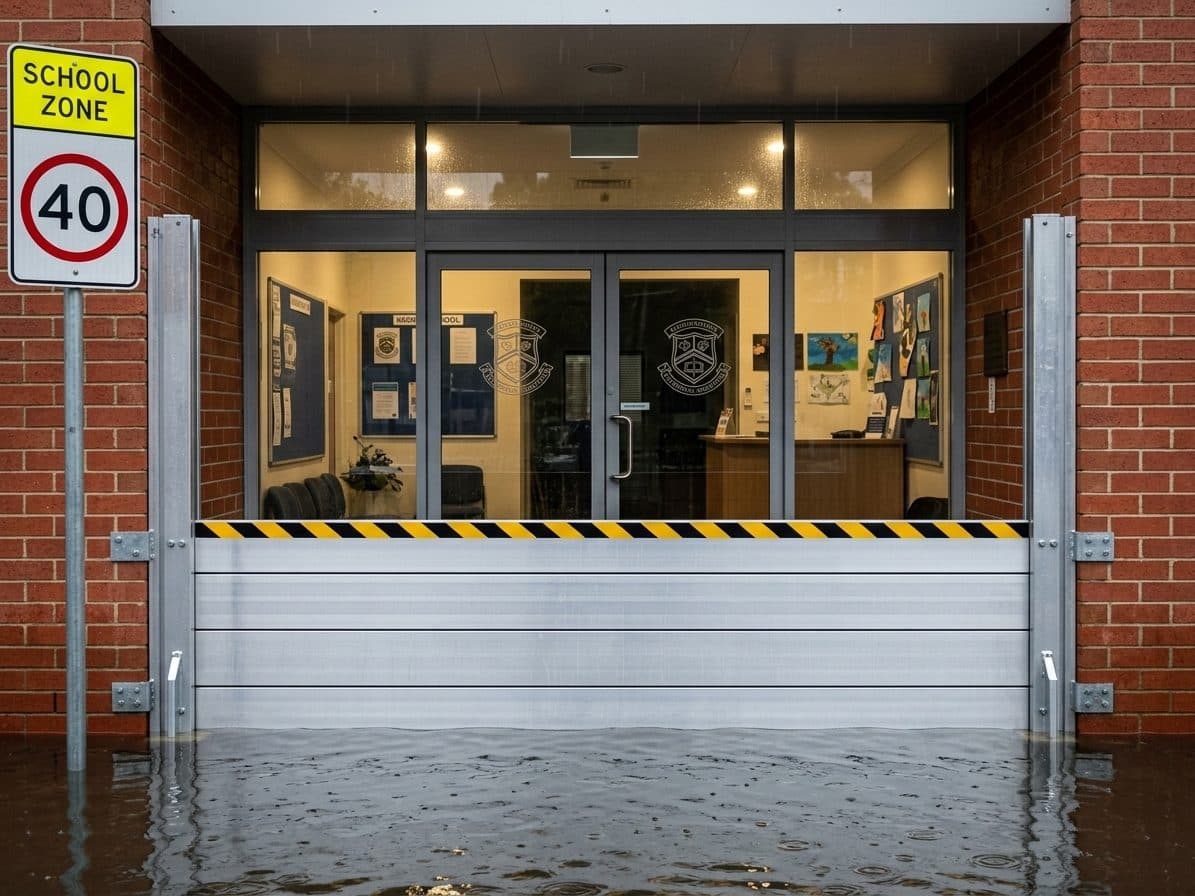
Barriers are made to measure for each opening and quoted after measurement. For a very wide opening, or an unattended site where nobody will be there to deploy anything, an automated solution is likely more practical.
Are ABS portable barriers suited to loading bays and wider access points?
ABS portable flood barriers are a modular polymer-based system that suits wider or more variable access points where a single fixed-dimension aluminium panel would be difficult to anchor. An 8-panel pack covers garage doors, loading bays, roller doors, and wide pedestrian entries without any permanent installation.
For school campuses, the ABS system is effective at:
- Loading docks and service entries — delivery bays rarely have standard door frames, making it difficult to anchor aluminium barriers. The ABS modular format allows flexible configuration across any opening width.
- Gymnasium and hall roller doors — very large openings can be addressed with multiple ABS panels configured across the full width, with no installation at all.
- Covered walkway ends — open-ended covered walkways funnel surface water directly into building entries. ABS panels placed across the walkway opening intercept the flow at the perimeter.
- On-grade car park entries — vehicle access points into open campus car parks can be temporarily sealed during a significant weather event.
The ABS system deploys without tools. Panels interlock and form a barrier without wall anchoring, which means they can be repositioned as the flood situation changes. This flexibility suits large campuses where staff may need to adjust protection progressively as rain accumulates and flow paths shift.
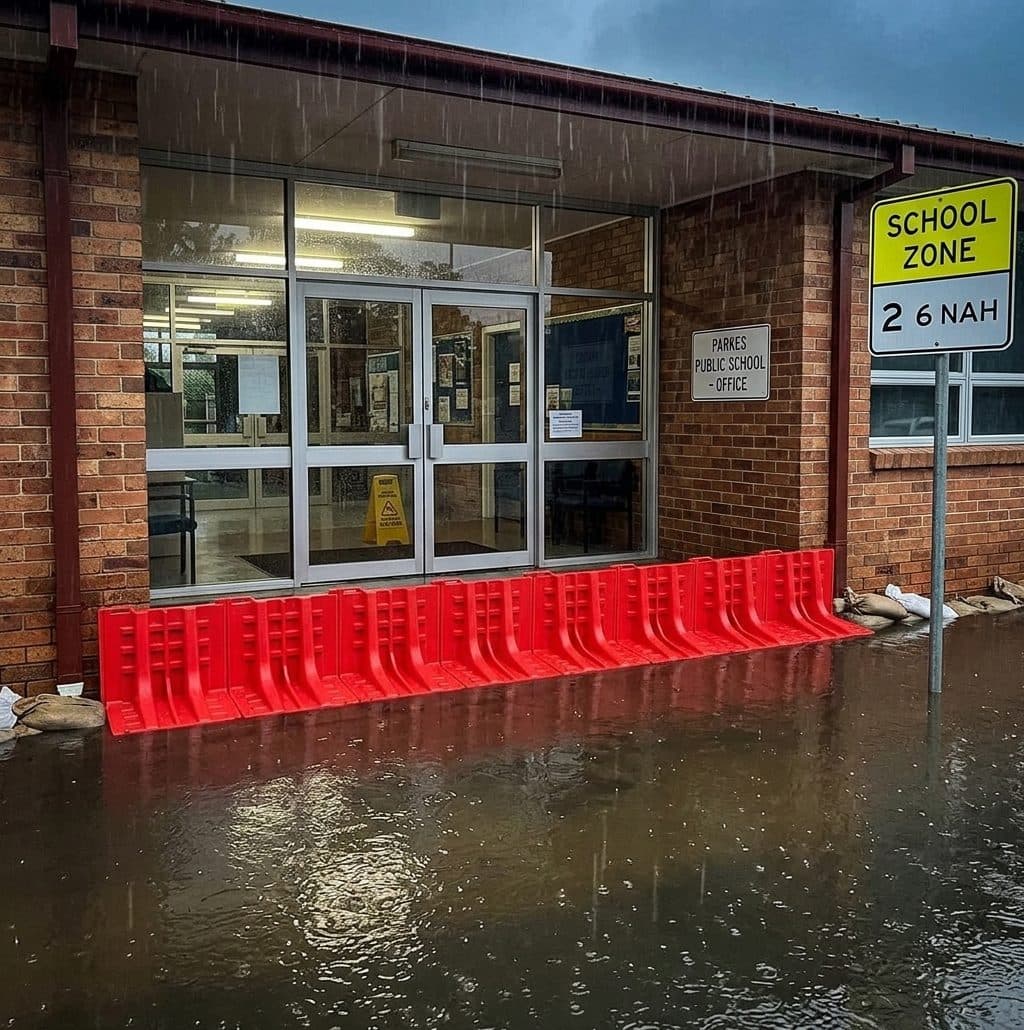
Each 8-panel pack covers one large opening or multiple smaller ones and is priced at $1,659 per pack, offering institutional buyers a lower per-barrier cost than custom aluminium for high-width applications.
What flood preparation plan should a school or campus have in place?
A flood barrier is only as useful as the procedure that ensures it reaches the right doorway at the right time. Schools and universities need a documented flood response procedure covering:
Site risk assessment. Walk the site and identify which buildings, entries, and equipment areas are most vulnerable at 100 mm, 250 mm, and 500 mm rainfall events. Map the low points, drainage paths, and highest-value contents.
Barrier inventory and storage. Store barriers close to the entries they protect. A barrier kept in the administration building cannot protect the library if the path between them is already flooded by the time staff respond.
Named responders. Assign two or three trained staff members who know how to deploy each barrier set. Document the procedure with photographs so a new casual employee could follow it without prior experience.
Warning triggers. Decide in advance what weather signal triggers deployment. The Bureau of Meteorology's flood watch system issues flood watches and warnings with enough lead time for a school to act — provided staff are monitoring forecasts during periods of elevated risk.
After-event checklist. Document the removal, cleaning, and re-storage procedure. Rubber seals and anchor fittings need inspection after each deployment to confirm they are ready for the next event.
Without a written plan, even well-maintained barriers may sit in storage when a storm arrives because no one has clear responsibility for deploying them.
How much does flood protection cost for a school or community building?
Costs vary depending on the number of entry points, the width of openings, and whether the site requires manual or automatic solutions. As a general guide:
| Protection type | Typical application | Starting cost |
|---|---|---|
| Aluminium flood barriers | Doorways and entries, made to measure | Quoted per opening |
| ABS portable flood barriers | Loading bay, wide entry, roller door | From $1,659 per 8-panel pack |
| Automatic flood gates | Carpark ramp, unattended site | Site assessment required |
| Water-activated sandbags | Quick fill-in around doors and low gaps | From $59 per pack of 6 |
A primary school protecting three to five entry points with aluminium barriers quoted per opening and a loading bay with ABS panels is making a one-off capital investment. This compares favourably with the cost of a single significant flood event: a waterlogged IT room or science laboratory commonly runs to $30,000–$80,000 in equipment replacement, specialist remediation, and disruption to the school's operating calendar.
For community halls and sports clubs with minimal staffing, water-activated sandbags provide a lower-cost rapid-response layer for the first hours of a storm, buying time until more permanent barriers can be retrieved and deployed.
State and territory emergency management agencies occasionally offer grants to community facilities for flood resilience measures. It is worth contacting your local council and state SES to ask about current funding programmes before purchasing.
What should building managers do when a flood warning is issued?
When the Bureau of Meteorology issues a flood watch or warning for your area, act on the following before water arrives:
Check the forecast and brief staff. Share the BoM warning with your named flood responders. Confirm who is available and who is leading the response. Send a message to the site manager if the building is unoccupied at the time.
Deploy barriers at the highest-risk entries first. Prioritise entries closest to where surface water will accumulate, which is not always the most-used entrance. A flooded car park is less urgent than a flooded server room or records archive.
Move valuable equipment off the floor. IT equipment, archived documents, and irreplaceable materials should be lifted to shelving or upper floors before water arrives — even if barriers are in place. Barriers provide time; they are not a guarantee against every scenario.
Isolate electrical systems in at-risk areas. Coordinate with your site electrician to identify circuits that should be switched off before water enters a space. This reduces the risk of electrical damage and makes re-energising the building safer once the water recedes.
Monitor water levels and be prepared to act. A barrier protects to the height it was built for, but if water appears likely to exceed that height, staff evacuation and equipment relocation take priority over maintaining barrier positions.
Record damage for insurance claims. Photograph affected areas before and after deployment. If water enters despite barriers, photograph the point of entry and residual damage immediately before remediation begins.
Advance preparation — the right barriers in accessible storage, trained staff, and a clear written procedure — is what separates institutions that manage flood events from those that are managed by them.
For barrier selection across every opening on a commercial site — design depth bands, deployment roles, and lease and insurance responsibility — see commercial flood barriers.
Recommended next step
Match the guide to a flood barrier option.
These are the product pages and guides most relevant to this topic. Use them to compare flood barriers Australia-wide, then request a site-specific recommendation.