Article · 5 August 2024
Flood Barriers for Sydney Public Transport
How automatic and demountable flood barriers protect Sydney train stations, underground passages, and transit access points from flash flooding in NSW.

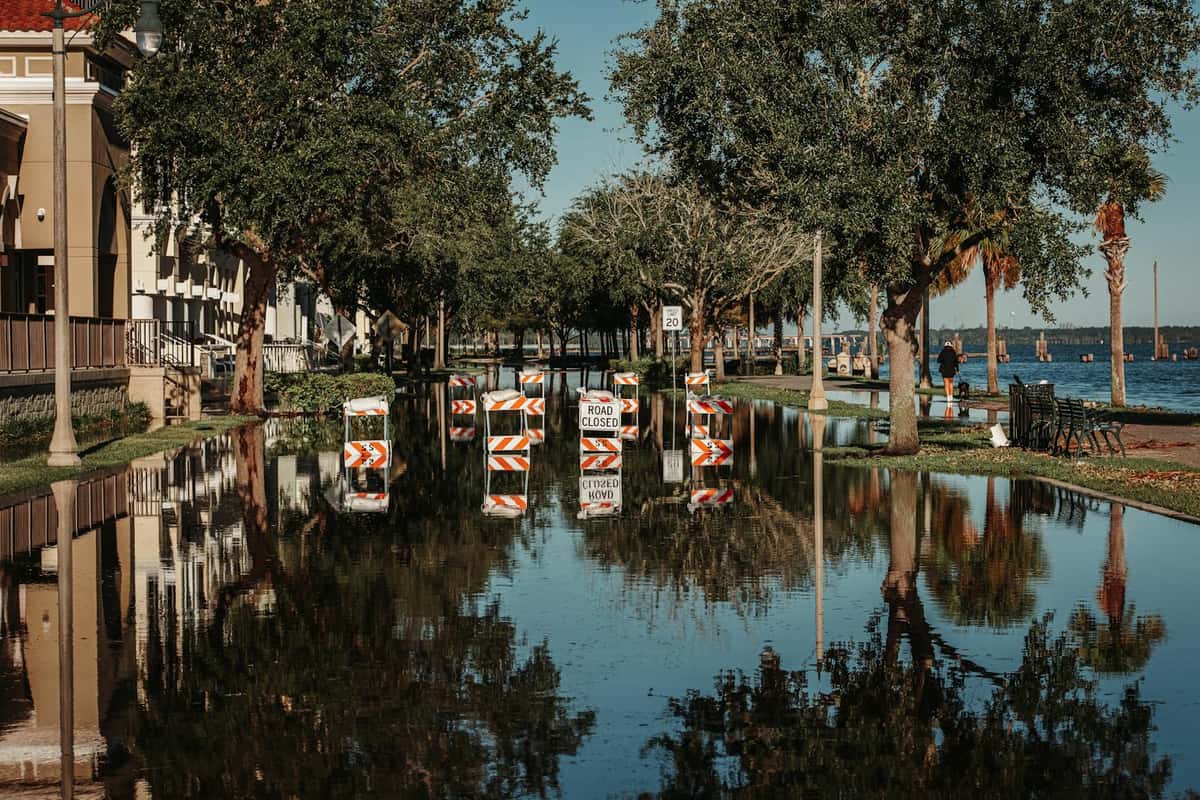
Sydney's rail network includes underground, semi-underground, and at-grade stations with varying degrees of flood exposure. Several stations in the inner city and inner suburbs have experienced significant water inundation during intense rain events, disrupting services, damaging infrastructure, and creating safety hazards for commuters. Flood barriers are one part of a broader resilience response that also involves drainage upgrades, operational procedures, and forecast-based decision-making.
How does flash flooding affect Sydney transit infrastructure?
Sydney receives much of its annual rainfall in short-duration, high-intensity events — particularly in summer and during east coast low weather systems. These events can deliver 30–50 mm of rain in under an hour, overwhelming stormwater infrastructure that was designed to older capacity standards.
Underground and semi-underground stations are structurally exposed to this pattern. Entry points that sit at or below street grade act as collection points for overland flow. Stairwells, escalator entries, and access ramps channel water into the station environment faster than drainage systems can clear it.
The consequences are not just operational. Floodwater in an underground station environment creates immediate safety risks from slippery surfaces, obscured floor conditions, and potential contact with live electrical infrastructure. Signalling equipment, platform lighting, and communications systems are all at risk from water intrusion at relatively shallow depths.
Recent events at Town Hall station and Bardwell Park station illustrated the scale of disruption that results when entry points are not adequately protected. The Bureau of Meteorology's flood intelligence data shows that high-intensity rainfall events in the Sydney basin have become more frequent over the past two decades, and infrastructure planning assumptions based on historical patterns are increasingly unreliable.
What makes transit station flood protection different from commercial applications?
Transit station flood protection is a more complex problem than protecting a retail shopfront or residential driveway. Several factors distinguish it:
- High continuous footfall — entry barriers cannot be deployed until the last practicable moment, because obstructing a high-flow pedestrian entry creates its own safety risks
- 24/7 operations — many stations operate through the night, meaning protection cannot rely solely on on-call staff deployment
- Wide openings — station entries are often 4–8 metres wide, exceeding the capacity of standard single-set barrier products
- Multiple simultaneous entry points — a station with six entry points requires a coordinated response plan, not just a single barrier
- Operational complexity — barrier deployment must be integrated with train service management, emergency procedures, and commuter communication
These factors mean that transit flood protection requires purpose-designed solutions, not off-the-shelf products applied to a larger opening. Automatic systems and custom-engineered manual barriers are both relevant, depending on the specific entry point and operational context.
How do ABS portable barriers protect transit access points?
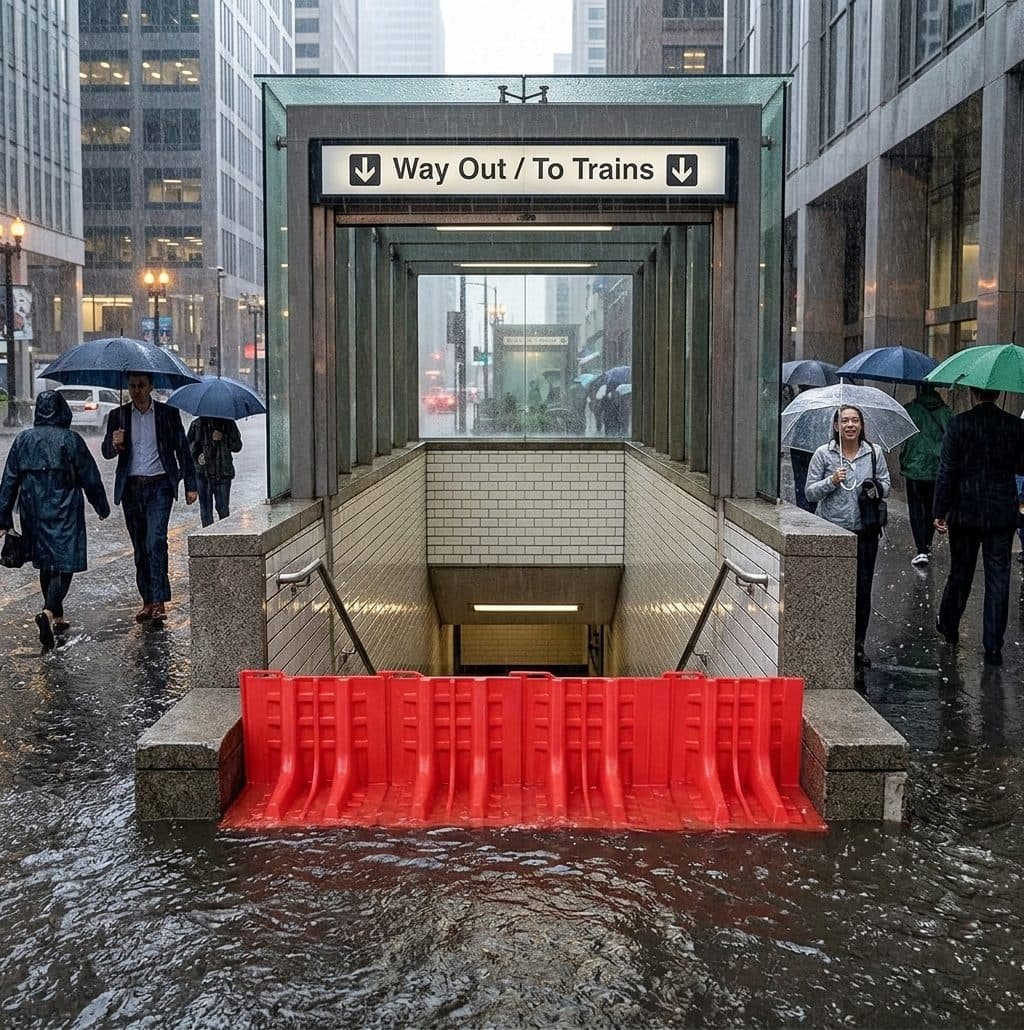
ABS portable flood barriers are a practical, deployable option for transit access points where trained staff can install protection ahead of a forecast flood event. The 8-panel modular system can be configured to cover a range of opening widths, and the L-shaped base design uses water weight as a stabilising force.
The physical mechanism is straightforward: as water presses against the ABS barrier panels during a flood, the accumulated weight increases structural stability rather than undermining it. This makes the barriers effective at diverting most of the water away from an entry without any anchoring to the floor or walls. The system requires no permanent installation hardware and can be deployed and removed without tools.
For transit applications, ABS barriers suit:
- Secondary or lower-frequency access points where forecast-based pre-deployment is operationally feasible
- Maintenance access entries and service corridors that are not on high-footfall pedestrian routes
- Temporary protection at stations undergoing infrastructure upgrade works, where permanent solutions are being designed or procured
How do automatic flood barriers work at unattended transit locations?
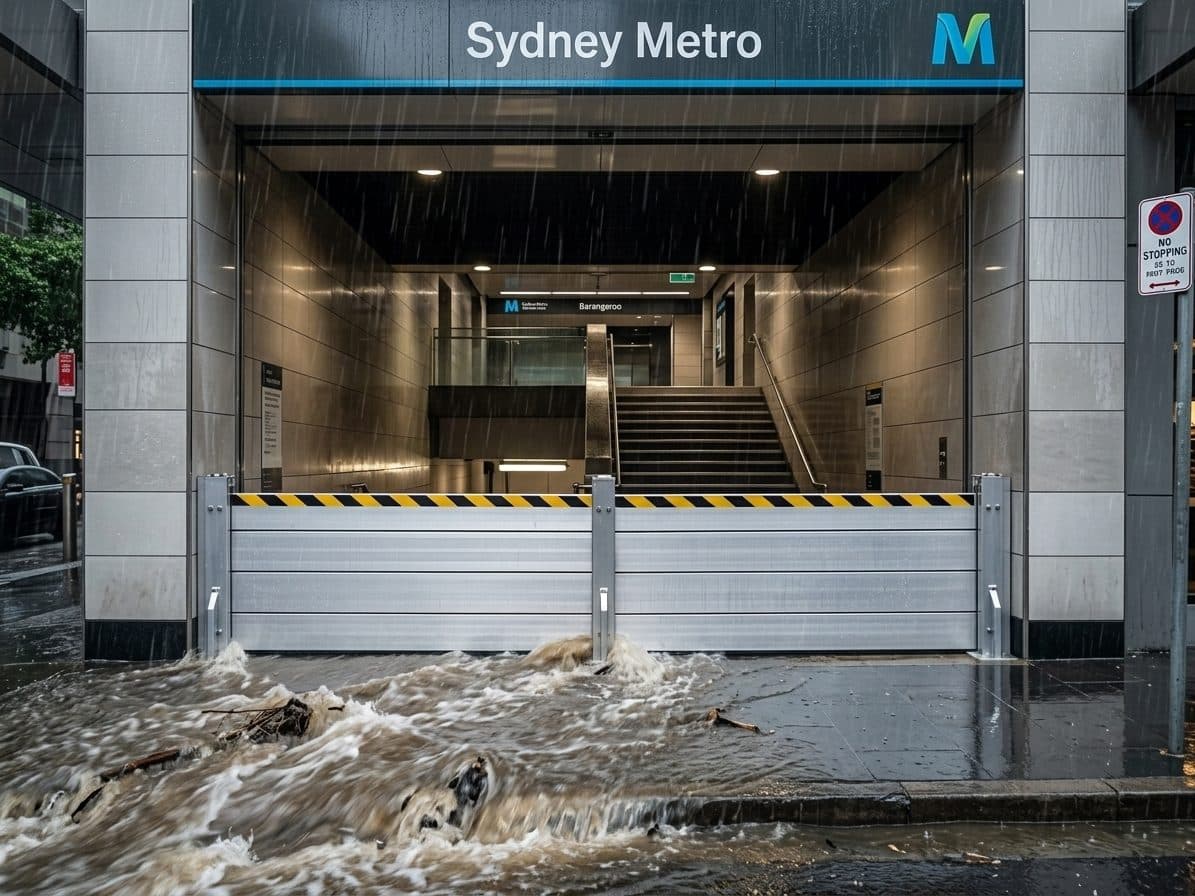
Automatic flood barrier systems can be assessed for transit entry points where manual deployment is not operationally feasible. Water-level sensing triggers an electrically powered hydraulic lift at the configured level, with remote or central controls available for lowering and reset.
The passive mechanism has a critical advantage for transit infrastructure: it is immune to the cascading failures that characterise flood events. When a severe storm hits a CBD transit hub, the likely concurrent failures include power disruption, overwhelmed communications systems, and operational staff engaged with immediate safety priorities. A barrier that requires a working power supply or an available operator to deploy will fail under exactly the conditions where it is most needed.
For night-time flood events, automatic hydraulic barriers can reduce reliance on manual deployment when their sensing, electrical power and controls have been correctly specified for the site.
Key considerations for automatic gate selection at transit sites:
- Opening width must be measured accurately — most standard systems cover up to 3–4 m; wider openings require custom engineering
- Threshold condition affects seal performance; uneven or damaged paving may require preparatory works
- The activation depth must be specified based on the realistic flood scenario for the specific entry, not a generic site-wide assumption
- Maintenance must be scheduled and funded; annual inspection is the minimum for a safety-critical installation
What are the infrastructure and approval requirements for transit flood barriers?
Installations at government-owned transit facilities involve a different procurement and approvals pathway than commercial or residential applications.
In NSW, Transport for NSW is the asset owner for the heavy rail network. Infrastructure modifications at stations — including flood protection installations — are typically managed as capital works projects and may require:
- Development consent under the NSW Environment Planning and Assessment Act, depending on the scope of works
- Heritage impact assessment for stations listed on the State Heritage Register, which includes many inner-city stations
- Compliance with the National Construction Code and relevant Australian Standards for structural works
- Design review by structural and hydraulic engineers to confirm the installation does not create new risks to the station structure
The NSW State Emergency Service and Queensland Disaster Management publish guidance on flood risk assessment and infrastructure resilience that is relevant to transit operators planning upgrades.
For private infrastructure adjacent to transit networks — retail tenancies within station precincts, car access points serving commuter carparks — the approval pathway is simpler, though coordination with the transit authority is still required for any works affecting shared infrastructure.
What does a comprehensive flood resilience plan look like for a transit station?
A barrier installation addresses one component of transit flood resilience. A complete plan for a flood-exposed station typically includes:
- Entry point assessment — hydraulic modelling or simplified analysis of which entries are at risk, at what depth, and during what event frequency
- Barrier specification — selection of automatic or manual protection for each entry point based on operational constraints and risk level
- Drainage review — confirming that platform-level drainage can handle the volume that reaches the station environment in a managed flood scenario
- Operational procedures — defining trigger points, deployment sequences, and communication protocols for staff during a flood event
- Monitoring integration — connecting flood alert systems, such as Bureau of Meteorology warnings, to operational decision-making processes
Without a coordinated plan, even well-specified barriers may not deliver the expected level of protection. A barrier that is not deployed in time, or that is deployed at one entry while an unprotected secondary entry remains open, provides incomplete protection.
How does flood barrier investment compare to the cost of repeated inundation?
The financial case for flood barrier investment at a transit station is straightforward when the history of events is examined. A significant inundation at a busy underground station typically involves:
- Emergency pumping and dewatering — tens of thousands of dollars for large-scale events
- Electrical system assessment and repair — signalling, communications, and platform equipment are expensive to dry out and test
- Structural assessment and any remediation works
- Service disruption costs — substitute bus services, passenger compensation, and schedule recovery
- Insurance premium effects from repeated claims
The supply price of an automatic hydraulic barrier depends on the opening, flood conditions, electrical supply and controls. A site assessment is required before a proposal can be priced against the flood risk being managed, and an installation guide is supplied with the system.
The Australian Institute for Disaster Resilience provides frameworks for cost-benefit analysis of resilience investments that transit operators and asset managers can apply to flood protection decisions.
What product options are available for infrastructure-scale flood protection?
For transit and infrastructure applications, the relevant product range includes:
- Automatic Flood Barrier Systems — custom-engineered water-level-sensing hydraulic barriers for qualifying ramp and entry-level applications; site assessment required before quoting
- ABS Portable Flood Barriers — modular 8-panel packs suited to secondary access points and forecast-based pre-deployment
Both systems are designed and supplied for Australian conditions. Custom engineering is available for openings that exceed standard product dimensions.
For infrastructure projects, we work with project managers, asset owners, and government procurement teams to design, specify, supply, and commission appropriate solutions. Contact our team with site details, identified entry point dimensions, and any available hydraulic or flood risk documentation.
Recommended next step
Match the guide to a flood barrier option.
These are the product pages and guides most relevant to this topic. Use them to compare flood barriers Australia-wide, then request a site-specific recommendation.